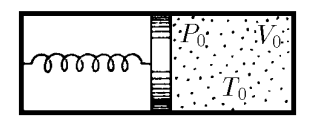
5.6.30*. Find the heat capacity of a system consisting of a vessel closed by a piston and containing a monatomic gas (the initial gas parameters are $P_0, V_0, T_0$). The piston is held by a spring. There is a vacuum to the left of the piston. If the gas is pumped out, the piston will touch the right wall of the vessel, and the spring will be undeformed. Neglect the heat capacities of the vessel, the piston, and the spring.
For problem $5.6.30$
Solution
Assuming the gas is pumped out (or the state changes) slowly, the system is in mechanical equilibrium at any given moment. The pressure force on the piston of area $S$ is balanced by the spring force: $$PS = kx$$
Since the spring is undeformed when the piston is at the right wall, the distance $x$ relates to the gas volume as $V = xS$. Therefore, $x = \frac{V}{S}$, and the pressure is: $$P = \frac{kV}{S^2}$$
Using the ideal gas law $PV = \nu RT$, we substitute $P$: $$\left(\frac{kV}{S^2}\right)V = \nu RT \implies V^2 = \frac{\nu R S^2}{k} T$$
For a small change in state, the new parameters are $V + dV$ and $T + dT$: $$(V + dV)^2 = \frac{\nu R S^2}{k} (T + dT)$$
Expanding the square and neglecting the second-order infinitesimal $(dV)^2$: $$V^2 + 2VdV = \frac{\nu R S^2}{k} T + \frac{\nu R S^2}{k} dT$$
Since $V^2 = \frac{\nu R S^2}{k} T$, this simplifies to: $$2VdV = \frac{\nu R S^2}{k} dT \implies dV = \frac{\nu R S^2}{2kV} dT$$
The work done by the gas $dA$ is: $$dA = P dV = \left(\frac{kV}{S^2}\right) \left(\frac{\nu R S^2}{2kV} dT\right) = \frac{1}{2} \nu R dT$$
The change in internal energy for a monatomic gas is: $$dU = \frac{3}{2} \nu R dT$$
According to the First Law of Thermodynamics, the heat transferred $dQ$ is: $$dQ = dU + dA = \frac{3}{2} \nu R dT + \frac{1}{2} \nu R dT = 2 \nu R dT$$
The heat capacity of the system $C$ is: $$C = \frac{dQ}{dT} = 2 \nu R$$
From the initial state equation $P_0 V_0 = \nu R T_0$, we know that $\nu R = \frac{P_0 V_0}{T_0}$. Substituting this into our result: $$C = \frac{2 P_0 V_0}{T_0}$$