Edits to “Statement”, “Solution”, “Answer”

en/2.1.52.md
+12 −14
| @@ -1,25 +1,23 @@ | |||
| ### Statement | |||
| − | $2.1.52.$ | ||
| + | $2.1.52.$ The accelerations of stars in a binary star system are $a_1$ and $a_2$. What is the mass of the second star if the mass of the first is $m_1$? | ||
| ### Solution | |||
| + | 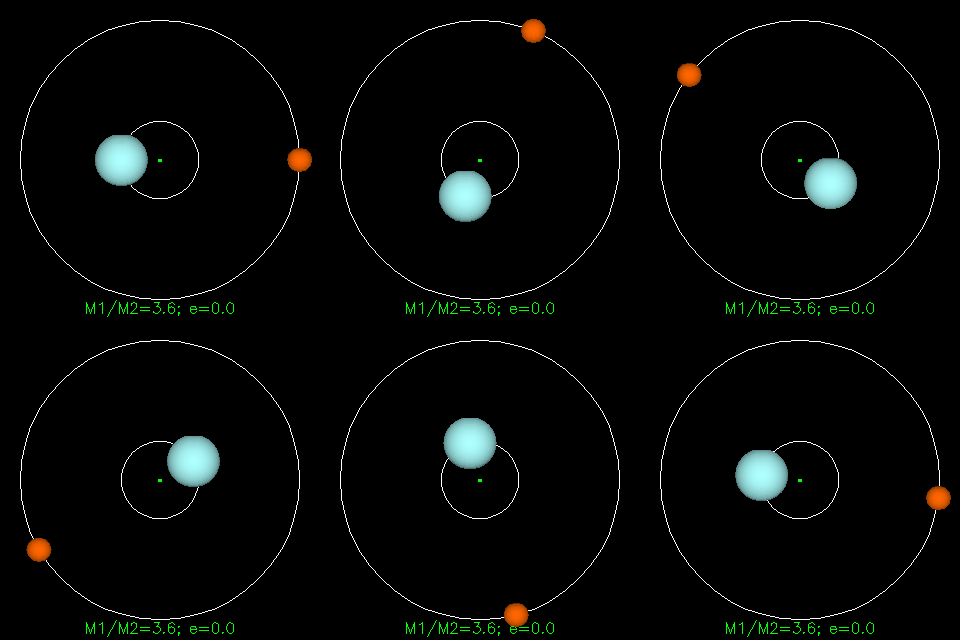 | ||
| + | In a binary star system, the stars orbit their common center of mass due to mutual gravitational attraction. Assuming no other external forces are present, the only force acting on each star is the gravitational pull from the other. | ||
| − | ### Problem | ||
| + | According to Newton's Third Law of Motion, the gravitational forces the stars exert on each other must be equal in magnitude and opposite in direction: | ||
| + | $$ F_1 = F_2 $$ | ||
| − | |||
| + | By Newton's Second Law of Motion, the net force acting on an object is equal to its mass multiplied by its acceleration. Therefore, we can express the magnitudes of the forces acting on each star as: | ||
| + | $$ F_1 = m_1 a_1 $$ | ||
| + | $$ F_2 = m_2 a_2 $$ | ||
| − | ### Solution | ||
| − | |||
| − | |||
| − | $$ m_1 a_1 = F_1 $$ | ||
| − | $$ m_2 a_2 = F_2 $$ | ||
| − | |||
| − | Since the interaction forces are equal in magnitude ($F_1 = F_2$), it follows that: | ||
| + | Substituting these expressions into the equality derived from Newton's Third Law, we get the following relationship: | ||
| $$ m_1 a_1 = m_2 a_2 $$ | |||
| − | |||
| − | $$ m_2 = \frac{ | ||
| + | Finally, dividing both sides by $a_2$ allows us to solve for the unknown mass of the second star: | ||
| + | $$ m_2 = m_1 \frac{a_1}{a_2} $$ | ||
| #### Answer | |||
| − | |||
| − | [Insert a concise answer or boxed result] | ||
| + | $$ m_2 = m_1 \frac{a_1}{a_2} $$ | ||
| @@ -1,25 +1,23 @@ | |||
| ### Statement | ### Statement | ||
| $2.1.52.$ |
$2.1.52.$ The accelerations of stars in a binary star system are $a_1$ and $a_2$. What is the mass of the second star if the mass of the first is $m_1$? | ||
| ### Solution | ### Solution | ||
|  | |||
| In a binary star system, the stars orbit their common center of mass due to mutual gravitational attraction. Assuming no other external forces are present, the only force acting on each star is the gravitational pull from the other. | |||
| ### Problem | According to Newton's Third Law of Motion, the gravitational forces the stars exert on each other must be equal in magnitude and opposite in direction: | ||
| $$ F_1 = F_2 $$ | |||
| By Newton's Second Law of Motion, the net force acting on an object is equal to its mass multiplied by its acceleration. Therefore, we can express the magnitudes of the forces acting on each star as: | |||
| $$ F_1 = m_1 a_1 $$ | |||
| $$ F_2 = m_2 a_2 $$ | |||
| ### Solution | Substituting these expressions into the equality derived from Newton's Third Law, we get the following relationship: | ||
| $$ m_1 a_1 = F_1 $$ | |||
| $$ m_2 a_2 = F_2 $$ | |||
| Since the interaction forces are equal in magnitude ($F_1 = F_2$), it follows that: | |||
| $$ m_1 a_1 = m_2 a_2 $$ | $$ m_1 a_1 = m_2 a_2 $$ | ||
| Finally, dividing both sides by $a_2$ allows us to solve for the unknown mass of the second star: | |||
| $$ m_2 = \frac{ |
$$ m_2 = m_1 \frac{a_1}{a_2} $$ | ||
| #### Answer | #### Answer | ||
| $$ m_2 = m_1 \frac{a_1}{a_2} $$ | |||
| [Insert a concise answer or boxed result] | |||