Edits to “Statement”, “Solution”, “Answer”

en/13.4.5.md
+4 −4
| @@ -1,15 +1,15 @@ | |||
| ### Statement | |||
| − | $13.4.5.$ [Insert the problem statement] | ||
| + | $13.4.5.$ The screen is illuminated by a parallel beam of light. How will the illumination of the screen change if a prism with an angle $\alpha$ and bottom side parallel to the screen is placed in the path of the rays? Draw a graph of light changes along the screen. | ||
| ### Solution | |||
| − | 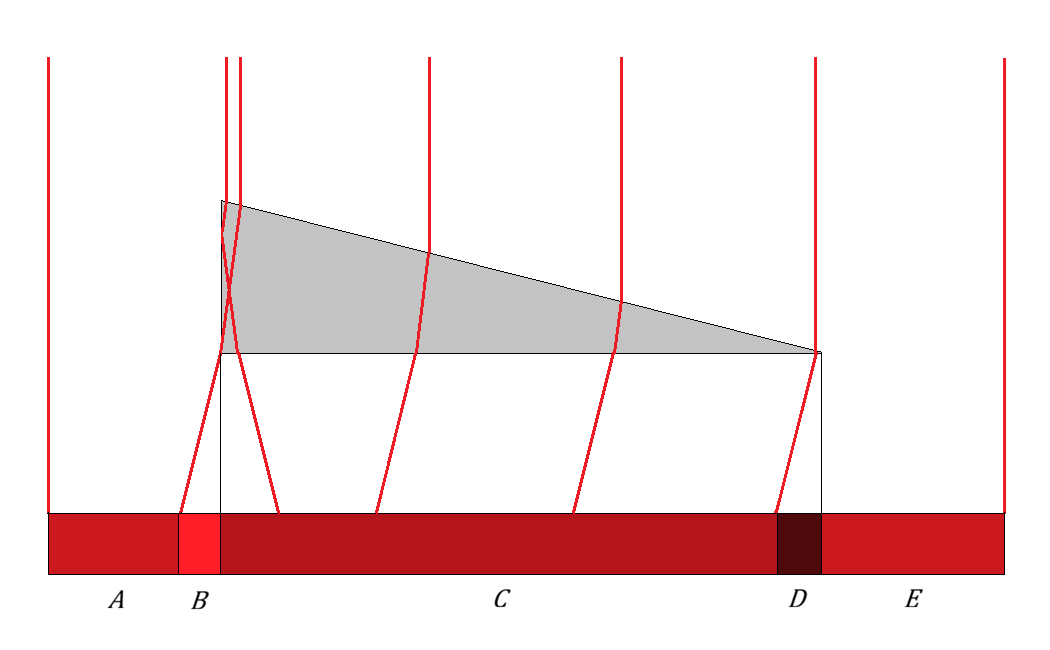 | ||
| Roughly speaking, almost all light that falls on the prism will bend by the same angle toward the left. This makes the intensity of light in Band $C$ slightly lower than that in Bands $A$ and $E$, which are unaffected by the prism. The intensity of light in Band $B$ is almost double that in unaffected bands, while Band $D$ is practically dark. | |||
| − | More specifically, the incident angle of light rays entering the top surface of the prism is $\alpha$, and the refracted angle is $\alpha/n$, where $n$ is the refractive index of the prism and $\alpha$ is assumed to be small. Then, the incient angle of light rays leaving the bottom surface of the prism is $(n-1)\alpha/n$, and the refracted angle is $(n-1)\alpha$. Thus, if the screen is at the distance $h$ below the bottom surface of the prism, then Bands $B$ and $D$ have the width of $(n-1)\alpha h$. Also, there is a small amount of light that falls on the prism near the left end of its top surface that will likely undergo total internal reflection within the prism and is refracted toward the left end of Band $C$, making it slightly brighter than the rest of the band. | ||
| + | More specifically, the incident angle of light rays entering the top surface of the prism is $\alpha$, and the refracted angle is $\alpha/n$, where $n$ is the refractive index of the prism and $\alpha$ is assumed to be small. Then, the incident angle of light rays leaving the bottom surface of the prism is $(n-1)\alpha/n$, and the refracted angle is $(n-1)\alpha$. Thus, if the screen is at the distance $h$ below the bottom surface of the prism, then Bands $B$ and $D$ have the width of $(n-1)\alpha h$. Also, there is a small amount of light that falls on the prism near the left end of its top surface that will likely undergo total internal reflection within the prism and is refracted toward the left end of Band $C$, making it slightly brighter than the rest of the band. | ||
| #### Answer | |||
| − | [Insert a concise answer or boxed result] | ||
| + | See the figure. | ||
| @@ -1,15 +1,15 @@ | |||
| ### Statement | ### Statement | ||
| $13.4.5.$ [Insert the problem statement] | $13.4.5.$ The screen is illuminated by a parallel beam of light. How will the illumination of the screen change if a prism with an angle $\alpha$ and bottom side parallel to the screen is placed in the path of the rays? Draw a graph of light changes along the screen. | ||
| ### Solution | ### Solution | ||
|  | ||
| Roughly speaking, almost all light that falls on the prism will bend by the same angle toward the left. This makes the intensity of light in Band $C$ slightly lower than that in Bands $A$ and $E$, which are unaffected by the prism. The intensity of light in Band $B$ is almost double that in unaffected bands, while Band $D$ is practically dark. | Roughly speaking, almost all light that falls on the prism will bend by the same angle toward the left. This makes the intensity of light in Band $C$ slightly lower than that in Bands $A$ and $E$, which are unaffected by the prism. The intensity of light in Band $B$ is almost double that in unaffected bands, while Band $D$ is practically dark. | ||
| More specifically, the incident angle of light rays entering the top surface of the prism is $\alpha$, and the refracted angle is $\alpha/n$, where $n$ is the refractive index of the prism and $\alpha$ is assumed to be small. Then, the incient angle of light rays leaving the bottom surface of the prism is $(n-1)\alpha/n$, and the refracted angle is $(n-1)\alpha$. Thus, if the screen is at the distance $h$ below the bottom surface of the prism, then Bands $B$ and $D$ have the width of $(n-1)\alpha h$. Also, there is a small amount of light that falls on the prism near the left end of its top surface that will likely undergo total internal reflection within the prism and is refracted toward the left end of Band $C$, making it slightly brighter than the rest of the band. | More specifically, the incident angle of light rays entering the top surface of the prism is $\alpha$, and the refracted angle is $\alpha/n$, where $n$ is the refractive index of the prism and $\alpha$ is assumed to be small. Then, the incident angle of light rays leaving the bottom surface of the prism is $(n-1)\alpha/n$, and the refracted angle is $(n-1)\alpha$. Thus, if the screen is at the distance $h$ below the bottom surface of the prism, then Bands $B$ and $D$ have the width of $(n-1)\alpha h$. Also, there is a small amount of light that falls on the prism near the left end of its top surface that will likely undergo total internal reflection within the prism and is refracted toward the left end of Band $C$, making it slightly brighter than the rest of the band. | ||
| #### Answer | #### Answer | ||
| [Insert a concise answer or boxed result] | See the figure. | ||