Statement
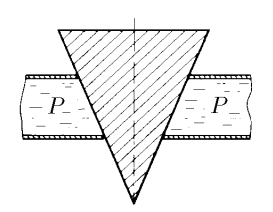
4.1.6. A conical plug simultaneously covers two holes in a flat vessel filled with a liquid at a pressure
Solution
Since the vessel is flat, the hydrostatic pressure of the liquid column can be neglected. The liquid pressure
The force exerted by the liquid on the curved surface (in this case, the lateral surface of the truncated cone) is directed perpendicular to this surface. We are interested in the vertical component of this force, which tends to push the plug out.
According to the laws of hydrostatics, the vertical component of the pressure force exerted by a uniform liquid on any surface is equal to the product of the pressure and the area of the horizontal projection of that surface.
Let's project the lateral surface of the truncated cone (the part in contact with the liquid) onto a horizontal plane. The projection is a flat annulus (ring) with an outer radius equal to the radius of the larger hole
The area of this projection (the area of the ring) is the difference between the areas of the two circles:
Thus, the required liquid pressure force acting on the plug is calculated as:
The force will be directed upwards (towards the larger hole), as the liquid presses on the walls of the cone from the outside, tending to push it towards the wider opening.