New solution

en/13.3.18.md
+23 −0
| @@ -0,0 +1,23 @@ | |||
| + | ### Statement | ||
| + | |||
| + | $13.3.18.$ [Insert the problem statement] | ||
| + | |||
| + | ### Solution | ||
| + | |||
| + |  | ||
| + | |||
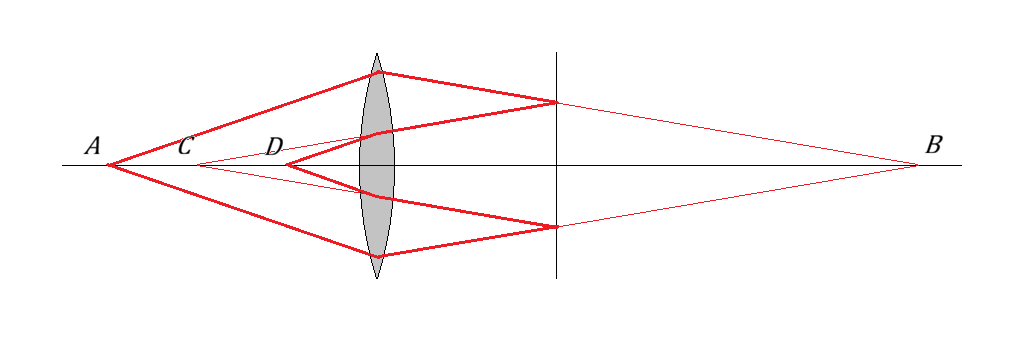
| + | a. If there were no mirror, the object at Point $A$ would have had an image at Point $B$ at the distance $af/(a-f)$ to the right of the lens (according to the thin lens equation). Instead, the mirror reflects light rays converging to Point B to Point C at the distance | ||
| + | |||
| + | \[\frac{af}{a-f}-2f=\frac{f(2f-a)}{a-f}\] | ||
| + | |||
| + | to the left of the lens (assuming no refraction by the lens at the moment). Instead, the lens refracts light rays converging to Point $C$ to Point $D$ at the distance $d$ to the left of the mirror, where | ||
| + | |||
| + | \[\frac{1}{f}=-\frac{a-f}{f(2f-a)}+\frac{1}{d}\qquad\Rightarrow\qquad d=2f-a.\] | ||
| + | |||
| + | As a reality check, when $a=f$, we have $d=f$; that is, light rays from the object becomes parallel to the principal axis after emerging from the lens and will return to the location of the object after reflection by the mirror and another refraction by the lens. Note that if any of the "distance" is negative, then the point is on the opposite side of the instrument to what is indicated; for example, a point at a negative distance to the left of the lens is on the right of the lens. This convention makes the solution valid in every possible scenario. | ||
| + | |||
| + | b. After the flat side of a planoconvex lens with focal length $f$ is silvered, the new instrument has focal length $f/2$ equal to a biconvex lens, because the reflected light rays behave symmetrically to those going through the biconvex lens. | ||
| + | |||
| + | #### Answer | ||
| + | |||
| + | [Insert a concise answer or boxed result] | ||
| @@ -0,0 +1,23 @@ | |||
| ### Statement | |||
| $13.3.18.$ [Insert the problem statement] | |||
| ### Solution | |||
|  | |||
| a. If there were no mirror, the object at Point $A$ would have had an image at Point $B$ at the distance $af/(a-f)$ to the right of the lens (according to the thin lens equation). Instead, the mirror reflects light rays converging to Point B to Point C at the distance | |||
| \[\frac{af}{a-f}-2f=\frac{f(2f-a)}{a-f}\] | |||
| to the left of the lens (assuming no refraction by the lens at the moment). Instead, the lens refracts light rays converging to Point $C$ to Point $D$ at the distance $d$ to the left of the mirror, where | |||
| \[\frac{1}{f}=-\frac{a-f}{f(2f-a)}+\frac{1}{d}\qquad\Rightarrow\qquad d=2f-a.\] | |||
| As a reality check, when $a=f$, we have $d=f$; that is, light rays from the object becomes parallel to the principal axis after emerging from the lens and will return to the location of the object after reflection by the mirror and another refraction by the lens. Note that if any of the "distance" is negative, then the point is on the opposite side of the instrument to what is indicated; for example, a point at a negative distance to the left of the lens is on the right of the lens. This convention makes the solution valid in every possible scenario. | |||
| b. After the flat side of a planoconvex lens with focal length $f$ is silvered, the new instrument has focal length $f/2$ equal to a biconvex lens, because the reflected light rays behave symmetrically to those going through the biconvex lens. | |||
| #### Answer | |||
| [Insert a concise answer or boxed result] | |||