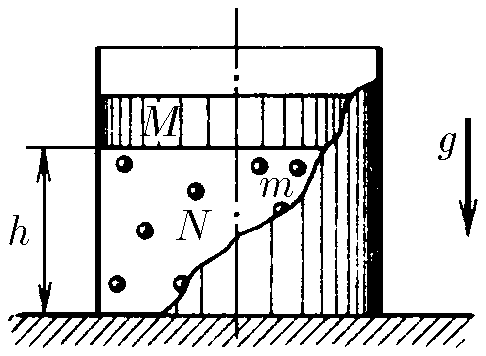
$2.2.32^*.$ In a cylinder under a piston of mass $M$, $N$ balls of mass $m$ each are bouncing, elastically striking the piston and the bottom of the cylinder. The gravity force acting on the piston is balanced by the impacts of the balls. The distance between the bottom of the cylinder and the piston is $h$. The total energy of each ball is the same. To what height will the balls bounce if the piston is quickly removed? $N \gg 1$.
−
### Solution:
+
### Solution
Note: This problem was featured in one of the qualifying rounds for the National Team of the Republic of Belarus for the International Physics Olympiad.
The piston does not fall because the momentum transferred by the balls colliding every $\Delta t$ seconds compensates for the gravity force acting on the piston.
$$
Mg = N \frac{dp}{dt}\tag{1}
$$
Since the collision is perfectly elastic, the magnitude of the ball's velocity is conserved upon impact, but its direction is reversed.
$$
dp = m(v - (-v)) = 2mv \tag{2}
$$
We find the time $\Delta t$ between two successive collisions of a single ball from kinematic considerations.
$$
v_0t - \frac{gt^2}{2} = H \tag{3}
$$
$$
v_0 - gt = v \tag{4}
$$
$$
v= \sqrt{v_0^2 - 2gh}\tag{5}
$$
From $\text{(3)}$, we express $t$.
$$
t = \frac{v_0 - \sqrt{v^2_0-2gh}}{g}\tag{6}
$$
The found $t$ is the flight time in one direction only. The time between two successive impacts of a ball on the piston is $\Delta t = 2t$. Substituting $\Delta p = 2mv$ and $\Delta t = 2t$ into equation (1), we obtain:
$$
Mg = N \frac{2m\sqrt{v_0^2 - 2gh}}{2\frac{v_0 - \sqrt{v^2_0-2gh}}{g}}\tag{7}
@@ -53,41 +47,37 @@Solution
$$
$$
−
M(v_0 - \sqrt{v^2_0-2gh}) = N m\sqrt{v_0^2 - 2gh}\tag{5}
+
M(v_0 - \sqrt{v^2_0-2gh}) = N m\sqrt{v_0^2 - 2gh}\tag{8}
From the law of conservation of energy, a ball launched with velocity $v_0$ from the ground surface will reach its maximum flight height at:
$$
−
H=\frac{v_0^2}{2g}\tag{11}
+
H=\frac{v_0^2}{2g}\tag{12}
$$
$$
−
\boxed{H=h\frac{(M+Nm)^2}{Nm(Nm+2M)}}\tag{12}
+
\boxed{H=h\frac{(M+Nm)^2}{Nm(Nm+2M)}}\tag{13}
$$
−
#### Answer:
+
#### Answer
$$
H=h\frac{(M+Nm)^2}{Nm(Nm+2M)}
$$
−
−
#### Answer
−
−
[Insert a concise answer or boxed result]
@@ -1,16 +1,10 @@
### Statement
### Statement
$2.2.31.$ [Insert the problem statement]
### Solution
### Problem:
$2.2.32^*.$ In a cylinder under a piston of mass $M$, $N$ balls of mass $m$ each are bouncing, elastically striking the piston and the bottom of the cylinder. The gravity force acting on the piston is balanced by the impacts of the balls. The distance between the bottom of the cylinder and the piston is $h$. The total energy of each ball is the same. To what height will the balls bounce if the piston is quickly removed? $N \gg 1$.
$2.2.32^*.$ In a cylinder under a piston of mass $M$, $N$ balls of mass $m$ each are bouncing, elastically striking the piston and the bottom of the cylinder. The gravity force acting on the piston is balanced by the impacts of the balls. The distance between the bottom of the cylinder and the piston is $h$. The total energy of each ball is the same. To what height will the balls bounce if the piston is quickly removed? $N \gg 1$.


### Solution:
### Solution
Note: This problem was featured in one of the qualifying rounds for the National Team of the Republic of Belarus for the International Physics Olympiad.
Note: This problem was featured in one of the qualifying rounds for the National Team of the Republic of Belarus for the International Physics Olympiad.
The piston does not fall because the momentum transferred by the balls colliding every $\Delta t$ seconds compensates for the gravity force acting on the piston.
The piston does not fall because the momentum transferred by the balls colliding every $\Delta t$ seconds compensates for the gravity force acting on the piston.
$$
$$
Mg = N \frac{dp}{dt}\tag{1}
Mg = N \frac{dp}{dt}\tag{1}
$$
$$
Since the collision is perfectly elastic, the magnitude of the ball's velocity is conserved upon impact, but its direction is reversed.
Since the collision is perfectly elastic, the magnitude of the ball's velocity is conserved upon impact, but its direction is reversed.
$$
$$
dp = m(v - (-v)) = 2mv \tag{2}
dp = m(v - (-v)) = 2mv \tag{2}
$$
$$
We find the time $\Delta t$ between two successive collisions of a single ball from kinematic considerations.
We find the time $\Delta t$ between two successive collisions of a single ball from kinematic considerations.
$$
$$
v_0t - \frac{gt^2}{2} = H \tag{3}
v_0t - \frac{gt^2}{2} = H \tag{3}
$$
$$
$$
$$
v_0 - gt = v \tag{4}
v_0 - gt = v \tag{4}
$$
$$
$$
$$
v= \sqrt{v_0^2 - 2gh}\tag{5}
v= \sqrt{v_0^2 - 2gh}\tag{5}
$$
$$
From $\text{(3)}$, we express $t$.
From $\text{(3)}$, we express $t$.
$$
$$
t = \frac{v_0 - \sqrt{v^2_0-2gh}}{g}\tag{6}
t = \frac{v_0 - \sqrt{v^2_0-2gh}}{g}\tag{6}
$$
$$
The found $t$ is the flight time in one direction only. The time between two successive impacts of a ball on the piston is $\Delta t = 2t$. Substituting $\Delta p = 2mv$ and $\Delta t = 2t$ into equation (1), we obtain:
The found $t$ is the flight time in one direction only. The time between two successive impacts of a ball on the piston is $\Delta t = 2t$. Substituting $\Delta p = 2mv$ and $\Delta t = 2t$ into equation (1), we obtain:
$$
$$
Mg = N \frac{2m\sqrt{v_0^2 - 2gh}}{2\frac{v_0 - \sqrt{v^2_0-2gh}}{g}}\tag{7}
Mg = N \frac{2m\sqrt{v_0^2 - 2gh}}{2\frac{v_0 - \sqrt{v^2_0-2gh}}{g}}\tag{7}
@@ -53,41 +47,37 @@Solution
$$
$$
$$
$$
M(v_0 - \sqrt{v^2_0-2gh}) = N m\sqrt{v_0^2 - 2gh}\tag{5}
M(v_0 - \sqrt{v^2_0-2gh}) = N m\sqrt{v_0^2 - 2gh}\tag{8}
