$2.3.18^*.$ A rope is tied to a sled and passed over a crossbar of a gate of height $h$. A boy sitting on the sled starts pulling the rope, tensioning it with a force $T$. What speed will he acquire passing under the crossbar? The initial length of the tensioned part of the rope is $2l$, and the mass of the boy with the sled is $m$. Neglect friction.
+
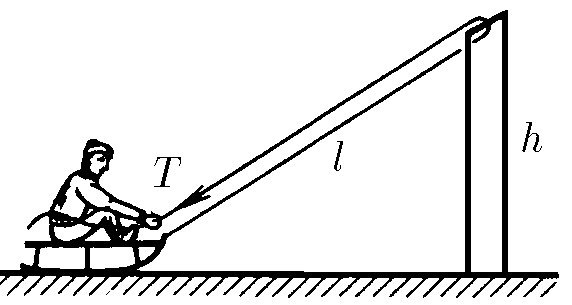
Let the horizontal distance from the gate to the sled be $x$, and the length of the rope segment from the crossbar to the sled be $L$. The horizontal speed of the sled is $v = - \frac{dx}{dt}$ (the negative sign indicates that the coordinate $x$ decreases as the sled moves forward).
Since the rope is both tied to the sled and pulled by the boy sitting on it, the total external force acting on the system along the rope is $2T$.
The horizontal projection of this force drives the sled forward:
$$F_x = 2T \cos\alpha = 2T \frac{x}{L}$$
@@ -19,7 +17,7 @@Solution
According to Newton's Second Law for the horizontal axis:
$$m \frac{dv}{dt} = 2T \frac{x}{L}$$
−
Instead of calculating the work done by a variable force, we can find the relation between $\frac{x}{L}$ and the speed using the kinematic constraint. From the Pythagorean theorem:
+
From the Pythagorean theorem:
$$L^2 = x^2 + h^2$$
Differentiating both sides with respect to time $t$ (keeping in mind that $h = \text{const}$):
$$2L \frac{dL}{dt} = 2x \frac{dx}{dt}$$
Substitute the horizontal speed $\frac{dx}{dt} = -v$:
$$L \frac{dL}{dt} = -x v \implies\frac{x}{L} = -\frac{1}{v}\frac{dL}{dt}$$
Now, substitute this relation back into the equation of motion:
Integrate both sides from the initial state (speed $v = 0$, segment length $L = l$) to the final state directly under the crossbar (speed $v = V$, segment length $L = h$):
$$\int_{0}^{V} m v \, dv = \int_{l}^{h} -2T \, dL$$
$$\frac{mV^2}{2} = -2T(h - l) = 2T(l - h)$$
Solving for the final speed $V$:
@@ -41,8 +39,4 @@Solution
$$V = \sqrt{\frac{4T(l - h)}{m}}$$
#### Answer
−
$$V = \sqrt{\frac{4T(l - h)}{m}}$$
−
−
#### Answer
−
−
[Insert a concise answer or boxed result]
+
$$V = 2\sqrt{\frac{T(l - h)}{m}}$$
@@ -1,15 +1,13 @@
### Statement
### Statement
$2.3.18.$ [Insert the problem statement]
### Solution
### Statement
$2.3.18^*.$ A rope is tied to a sled and passed over a crossbar of a gate of height $h$. A boy sitting on the sled starts pulling the rope, tensioning it with a force $T$. What speed will he acquire passing under the crossbar? The initial length of the tensioned part of the rope is $2l$, and the mass of the boy with the sled is $m$. Neglect friction.
$2.3.18^*.$ A rope is tied to a sled and passed over a crossbar of a gate of height $h$. A boy sitting on the sled starts pulling the rope, tensioning it with a force $T$. What speed will he acquire passing under the crossbar? The initial length of the tensioned part of the rope is $2l$, and the mass of the boy with the sled is $m$. Neglect friction.

Let the horizontal distance from the gate to the sled be $x$, and the length of the rope segment from the crossbar to the sled be $L$. The horizontal speed of the sled is $v = - \frac{dx}{dt}$ (the negative sign indicates that the coordinate $x$ decreases as the sled moves forward).
Let the horizontal distance from the gate to the sled be $x$, and the length of the rope segment from the crossbar to the sled be $L$. The horizontal speed of the sled is $v = - \frac{dx}{dt}$ (the negative sign indicates that the coordinate $x$ decreases as the sled moves forward).
Since the rope is both tied to the sled and pulled by the boy sitting on it, the total external force acting on the system along the rope is $2T$.
Since the rope is both tied to the sled and pulled by the boy sitting on it, the total external force acting on the system along the rope is $2T$.
The horizontal projection of this force drives the sled forward:
The horizontal projection of this force drives the sled forward:
$$F_x = 2T \cos\alpha = 2T \frac{x}{L}$$
$$F_x = 2T \cos\alpha = 2T \frac{x}{L}$$
@@ -19,7 +17,7 @@Solution
According to Newton's Second Law for the horizontal axis:
According to Newton's Second Law for the horizontal axis:
$$m \frac{dv}{dt} = 2T \frac{x}{L}$$
$$m \frac{dv}{dt} = 2T \frac{x}{L}$$
Instead of calculating the work done by a variable force, we can find the relation between $\frac{x}{L}$ and the speed using the kinematic constraint. From the Pythagorean theorem:
From the Pythagorean theorem:
$$L^2 = x^2 + h^2$$
$$L^2 = x^2 + h^2$$
Differentiating both sides with respect to time $t$ (keeping in mind that $h = \text{const}$):
Differentiating both sides with respect to time $t$ (keeping in mind that $h = \text{const}$):
$$2L \frac{dL}{dt} = 2x \frac{dx}{dt}$$
$$2L \frac{dL}{dt} = 2x \frac{dx}{dt}$$
Substitute the horizontal speed $\frac{dx}{dt} = -v$:
Substitute the horizontal speed $\frac{dx}{dt} = -v$:
$$L \frac{dL}{dt} = -x v \implies\frac{x}{L} = -\frac{1}{v}\frac{dL}{dt}$$
$$L \frac{dL}{dt} = -x v \implies\frac{x}{L} = -\frac{1}{v}\frac{dL}{dt}$$
Now, substitute this relation back into the equation of motion:
Now, substitute this relation back into the equation of motion:
Integrate both sides from the initial state (speed $v = 0$, segment length $L = l$) to the final state directly under the crossbar (speed $v = V$, segment length $L = h$):
Integrate both sides from the initial state (speed $v = 0$, segment length $L = l$) to the final state directly under the crossbar (speed $v = V$, segment length $L = h$):
$$\int_{0}^{V} m v \, dv = \int_{l}^{h} -2T \, dL$$
$$\int_{0}^{V} m v \, dv = \int_{l}^{h} -2T \, dL$$
