Edits to “Statement”, “Solution”, “Answer”

en/13.3.17.md
+3 −3
| @@ -1,10 +1,10 @@ | |||
| ### Statement | |||
| − | $13.3.17.$ | ||
| + | $13.3.17.$ Determine the maximum magnification with which a fish swimming in a spherical aquarium is visible. | ||
| ### Solution | |||
| − | 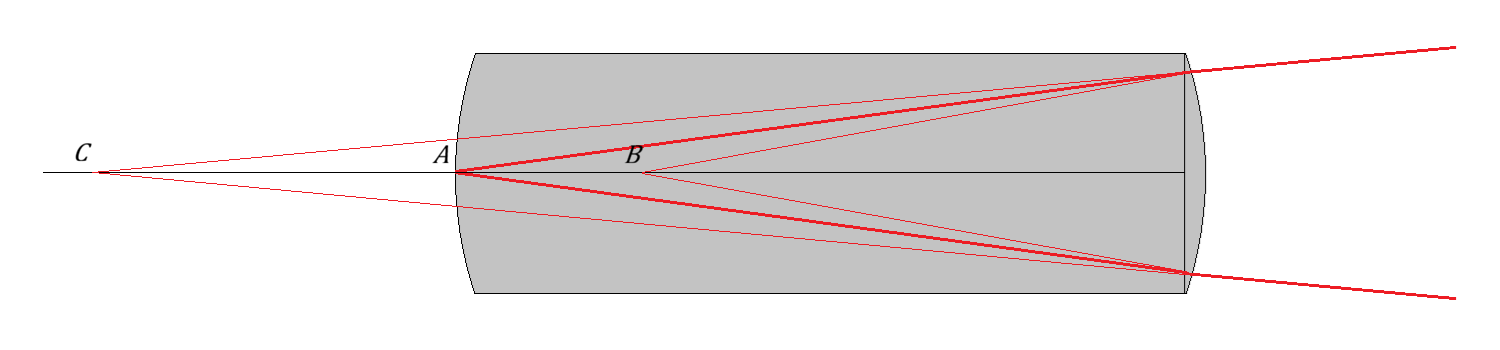 | ||
| The magnification is a result of the planoconvex water lens in front of an observer. Using the refractive index of $4/3$ for water, this lens has the focal length of $f=R/(4/3-1)=3R$, which is behind the aquarium. As a result, the magnification is largest when the fish is closest to the focal point, i.e. at Point $A$ farthest from the observer. The water between the fish and the lens serves only to bring the first image of the fish to Point $B$ with the apparent distance of $u=2R/(4/3)=3R/2$ from the lens. Thus, the magnification by the lens is | |||
| \[m=\frac{f}{u-f}=\frac{3R}{3R/2-3R}=-2.\] | |||
| Note that $v=mu=-3R$, so the (virtual) image of the fish at Point $C$ is in fact where the focal point of the lens is. | |||
| @@ -14,4 +14,4 @@Solution | |||
| #### Answer | |||
| − | [Insert a concise answer or boxed result] | ||
| + | $|m|=2$ | ||
| @@ -1,10 +1,10 @@ | |||
| ### Statement | ### Statement | ||
| $13.3.17.$ |
$13.3.17.$ Determine the maximum magnification with which a fish swimming in a spherical aquarium is visible. | ||
| ### Solution | ### Solution | ||
|  | ||
| The magnification is a result of the planoconvex water lens in front of an observer. Using the refractive index of $4/3$ for water, this lens has the focal length of $f=R/(4/3-1)=3R$, which is behind the aquarium. As a result, the magnification is largest when the fish is closest to the focal point, i.e. at Point $A$ farthest from the observer. The water between the fish and the lens serves only to bring the first image of the fish to Point $B$ with the apparent distance of $u=2R/(4/3)=3R/2$ from the lens. Thus, the magnification by the lens is | The magnification is a result of the planoconvex water lens in front of an observer. Using the refractive index of $4/3$ for water, this lens has the focal length of $f=R/(4/3-1)=3R$, which is behind the aquarium. As a result, the magnification is largest when the fish is closest to the focal point, i.e. at Point $A$ farthest from the observer. The water between the fish and the lens serves only to bring the first image of the fish to Point $B$ with the apparent distance of $u=2R/(4/3)=3R/2$ from the lens. Thus, the magnification by the lens is | ||
| \[m=\frac{f}{u-f}=\frac{3R}{3R/2-3R}=-2.\] | \[m=\frac{f}{u-f}=\frac{3R}{3R/2-3R}=-2.\] | ||
| Note that $v=mu=-3R$, so the (virtual) image of the fish at Point $C$ is in fact where the focal point of the lens is. | Note that $v=mu=-3R$, so the (virtual) image of the fish at Point $C$ is in fact where the focal point of the lens is. | ||
| @@ -14,4 +14,4 @@Solution | |||
| #### Answer | #### Answer | ||
| [Insert a concise answer or boxed result] | $|m|=2$ | ||