Edits to “Statement”, “Solution”, “Answer”

en/2.1.66.md
+4 −4
| @@ -1,18 +1,18 @@ | |||
| ### Statement | |||
| − | $2.1.66.$ [Insert the problem statement] | ||
| + | $2.1.66.$ In a circus ride, a motorcyclist moves along the inner surface of a sphere of radius $R$. As it accelerates, it begins to describe a horizontal circle in the upper hemisphere. After that, for greater effect, the lower hemisphere is removed. Determine the minimum speed of the rider if the coefficient of tire friction on the surface of the sphere is $\mu$, and the angle between the vertical and the direction to the rider from the center of the sphere is $\alpha$. | ||
| ### Solution | |||
| 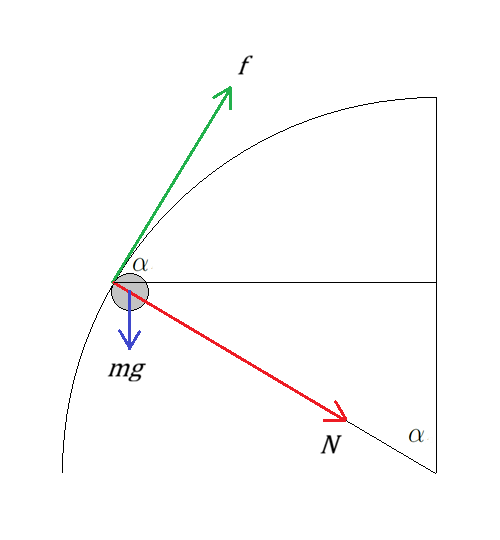 | |||
| If the rider uses minimum speed possible, the friction from the surface is maximum possible, i.e. $f=\mu N$. As the vertical component of the total force is zero, we have | |||
| − | \[f\sin\alpha-N\cos\alpha-mg=0\qquad\Rightarrow N(\mu\sin\alpha-\cos\alpha)=mg.\] | ||
| + | \[f\sin\alpha-N\cos\alpha-mg=0\qquad\Rightarrow\qquad N(\mu\sin\alpha-\cos\alpha)=mg.\] | ||
| The horizontal component of the total force serves as the centripetal force, so | |||
| − | \[f\cos\alpha+N\sin\alpha=\frac{mv^2}{R\sin\alpha}\qquad\Rightarrow N(\mu\cos\alpha+\sin\alpha)=\frac{mv^2}{R\sin\alpha}.\] | ||
| + | \[f\cos\alpha+N\sin\alpha=\frac{mv^2}{R\sin\alpha}\qquad\Rightarrow\qquad N(\mu\cos\alpha+\sin\alpha)=\frac{mv^2}{R\sin\alpha}.\] | ||
| Eliminating $N$ from both equations and solving for $v$, we have | |||
| \[v=\sqrt{\frac{gR\sin\alpha(\mu\cos\alpha+\sin\alpha)}{\mu\sin\alpha-\cos\alpha}}=\sqrt{\frac{gR\sin\alpha(\mu+\tan\alpha)}{\mu\tan\alpha-1}},\] | |||
| which is possible when $\tan\alpha>1/\mu$. | |||
| @@ -22,4 +22,4 @@Solution | |||
| #### Answer | |||
| − | [Insert a concise answer or boxed result] | ||
| + | $\sqrt{\frac{gR\sin\alpha(\mu+\tan\alpha)}{\mu\tan\alpha-1}}$ | ||
| @@ -1,18 +1,18 @@ | |||
| ### Statement | ### Statement | ||
| $2.1.66.$ [Insert the problem statement] | $2.1.66.$ In a circus ride, a motorcyclist moves along the inner surface of a sphere of radius $R$. As it accelerates, it begins to describe a horizontal circle in the upper hemisphere. After that, for greater effect, the lower hemisphere is removed. Determine the minimum speed of the rider if the coefficient of tire friction on the surface of the sphere is $\mu$, and the angle between the vertical and the direction to the rider from the center of the sphere is $\alpha$. | ||
| ### Solution | ### Solution | ||
|  |  | ||
| If the rider uses minimum speed possible, the friction from the surface is maximum possible, i.e. $f=\mu N$. As the vertical component of the total force is zero, we have | If the rider uses minimum speed possible, the friction from the surface is maximum possible, i.e. $f=\mu N$. As the vertical component of the total force is zero, we have | ||
| \[f\sin\alpha-N\cos\alpha-mg=0\qquad\Rightarrow N(\mu\sin\alpha-\cos\alpha)=mg.\] | \[f\sin\alpha-N\cos\alpha-mg=0\qquad\Rightarrow\qquad N(\mu\sin\alpha-\cos\alpha)=mg.\] | ||
| The horizontal component of the total force serves as the centripetal force, so | The horizontal component of the total force serves as the centripetal force, so | ||
| \[f\cos\alpha+N\sin\alpha=\frac{mv^2}{R\sin\alpha}\qquad\Rightarrow N(\mu\cos\alpha+\sin\alpha)=\frac{mv^2}{R\sin\alpha}.\] | \[f\cos\alpha+N\sin\alpha=\frac{mv^2}{R\sin\alpha}\qquad\Rightarrow\qquad N(\mu\cos\alpha+\sin\alpha)=\frac{mv^2}{R\sin\alpha}.\] | ||
| Eliminating $N$ from both equations and solving for $v$, we have | Eliminating $N$ from both equations and solving for $v$, we have | ||
| \[v=\sqrt{\frac{gR\sin\alpha(\mu\cos\alpha+\sin\alpha)}{\mu\sin\alpha-\cos\alpha}}=\sqrt{\frac{gR\sin\alpha(\mu+\tan\alpha)}{\mu\tan\alpha-1}},\] | \[v=\sqrt{\frac{gR\sin\alpha(\mu\cos\alpha+\sin\alpha)}{\mu\sin\alpha-\cos\alpha}}=\sqrt{\frac{gR\sin\alpha(\mu+\tan\alpha)}{\mu\tan\alpha-1}},\] | ||
| which is possible when $\tan\alpha>1/\mu$. | which is possible when $\tan\alpha>1/\mu$. | ||
| @@ -22,4 +22,4 @@Solution | |||
| #### Answer | #### Answer | ||
| [Insert a concise answer or boxed result] | $\sqrt{\frac{gR\sin\alpha(\mu+\tan\alpha)}{\mu\tan\alpha-1}}$ | ||