New solution

en/2.4.4.md
+23 −0
| @@ -0,0 +1,23 @@ | |||
| + | ### Statement | ||
| + | |||
| + | $2.4.4.$ [Insert the problem statement] | ||
| + | |||
| + | ### Solution | ||
| + | |||
| + |  | ||
| + | |||
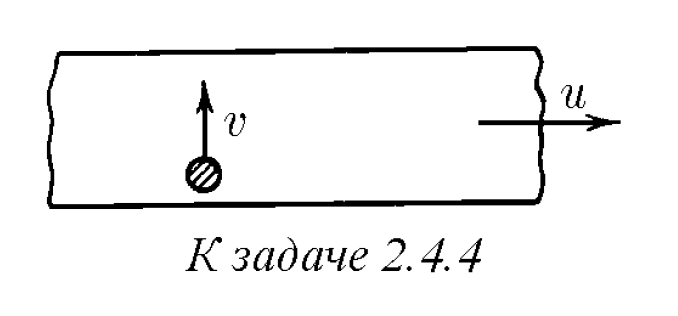
| + | It is easy to see that the change in kinetic energy of the body is $m(u^2-v^2)/2$, which is equal to the work done by friction from the belt on the body. For the work done by friction from the body on the belt, more analysis is required. We treat the situation as an inelastic collision of the body and the belt with mass $M\gg m$. From conservation of momentum, the components of the velocity of the body and the belt moving together are $u'=Mu/(M+m)$ in the same direction as $u$ and $v'=mv/(M+m)$ in the same direction as $v$. Thus, the change in kinetic energy of the belt is | ||
| + | |||
| + | \[\frac{1}{2}M(u'^2+v'^2-u^2)=\frac{1}{2}M\left(\frac{m^2(v^2-u^2)-2Mmu^2}{(M+m)^2}\right).\] | ||
| + | |||
| + | As $m^2(v^2-u^2)\ll2Mmu^2$, we drop the first term and have an approximation $-mu^2$ for the work done by friction from the body on the belt. To check the validity of this analysis, we perform it to find the change in kinetic energy of the body | ||
| + | |||
| + | \[\frac{1}{2}m(u'^2+v'^2-v^2)=\frac{1}{2}m\left(\frac{M^2(u^2-v^2)-2Mmv^2}{(M+m)^2}\right).\] | ||
| + | |||
| + | As $M^2(u^2-v^2)\gg2Mmv^2$, we drop the second term and have an approximation $m(u^2-v^2)/2$ for the work done by friction from the belt on the body in agreement with the result from an earlier approach. | ||
| + | |||
| + | Note that while frictions between the body and the belt have equal magnitude, the trajectories of the body and the belt are different, so frictions affect the energies of the body and the belt differently. | ||
| + | |||
| + | #### Answer | ||
| + | |||
| + | [Insert a concise answer or boxed result] | ||
| @@ -0,0 +1,23 @@ | |||
| ### Statement | |||
| $2.4.4.$ [Insert the problem statement] | |||
| ### Solution | |||
|  | |||
| It is easy to see that the change in kinetic energy of the body is $m(u^2-v^2)/2$, which is equal to the work done by friction from the belt on the body. For the work done by friction from the body on the belt, more analysis is required. We treat the situation as an inelastic collision of the body and the belt with mass $M\gg m$. From conservation of momentum, the components of the velocity of the body and the belt moving together are $u'=Mu/(M+m)$ in the same direction as $u$ and $v'=mv/(M+m)$ in the same direction as $v$. Thus, the change in kinetic energy of the belt is | |||
| \[\frac{1}{2}M(u'^2+v'^2-u^2)=\frac{1}{2}M\left(\frac{m^2(v^2-u^2)-2Mmu^2}{(M+m)^2}\right).\] | |||
| As $m^2(v^2-u^2)\ll2Mmu^2$, we drop the first term and have an approximation $-mu^2$ for the work done by friction from the body on the belt. To check the validity of this analysis, we perform it to find the change in kinetic energy of the body | |||
| \[\frac{1}{2}m(u'^2+v'^2-v^2)=\frac{1}{2}m\left(\frac{M^2(u^2-v^2)-2Mmv^2}{(M+m)^2}\right).\] | |||
| As $M^2(u^2-v^2)\gg2Mmv^2$, we drop the second term and have an approximation $m(u^2-v^2)/2$ for the work done by friction from the belt on the body in agreement with the result from an earlier approach. | |||
| Note that while frictions between the body and the belt have equal magnitude, the trajectories of the body and the belt are different, so frictions affect the energies of the body and the belt differently. | |||
| #### Answer | |||
| [Insert a concise answer or boxed result] | |||