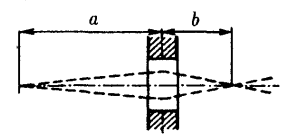
Derive the formula for a long-focus thin lens: $$\frac{1}{a} + \frac{1}{b} = \frac{1}{f}$$ where $f$ is the focal length, $a$ is the distance from the electron source to the lens, and $b$ is the distance from the point where the electrons are focused to the lens.
For problem $7.2.4$
Solution
Let us establish the geometric relations for the electron beam. We assume the paraxial approximation, meaning the angles are small enough that $\tan \theta \approx \theta$.
The beam leaves a point source on the principal axis at a distance $a$ before the lens and strikes the lens at a vertical height $y$. The angle of the incident beam relative to the principal axis is: $$\theta = \frac{y}{a}$$
According to the problem description, the lens changes the beam's angle by an amount proportional to its deviation from the axis: $$\Delta\theta = -\frac{y}{f}$$
The new angle of the beam immediately after passing through the lens is: $$\theta' = \theta + \Delta\theta = \theta - \frac{y}{f}$$
After the lens, the beam converges to a point on the principal axis at a distance $b$. Since the beam is traveling downwards from a height $y$ to $0$ over a horizontal distance $b$, its angle relative to the axis is strictly negative: $$\theta' = -\frac{y}{b}$$
Equating the two expressions for $\theta'$: $$-\frac{y}{b} = \frac{y}{a} - \frac{y}{f}$$
Since the beam height $y \neq 0$, we can divide the entire equation by $y$: $$-\frac{1}{b} = \frac{1}{a} - \frac{1}{f}$$
Rearranging the terms yields the classical thin lens equation: $$\frac{1}{a} + \frac{1}{b} = \frac{1}{f}$$