New solution

en/2.4.21.md
+165 −0
| @@ -0,0 +1,165 @@ | |||
| + | ### Statement | ||
| + | |||
| + | $2.4.21.$ [Insert the problem statement] | ||
| + | |||
| + | ### Solution | ||
| + | |||
| + | ### Statement | ||
| + | |||
| + | $2.4.21.$ Two identical blocks, connected by a spring of stiffness $k$ and length $l_0$, lie on a smooth horizontal table. A constant force $F$, directed along the spring, suddenly begins to act on the left block. Find the minimum and maximum distances between the blocks. | ||
| + | |||
| + | 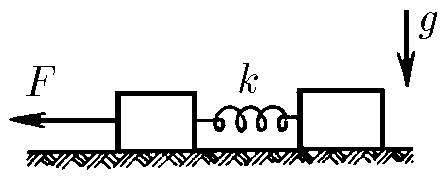 | ||
| + | |||
| + | ### Solution | ||
| + | |||
| + | Let us direct the X-axis along the table in the direction of the force $\\mathbf{F}$. | ||
| + | Since no external forces other than $\\mathbf{F}$ act on the system along the X-axis, the motion of the center of mass of the system can be determined by Newton's second law: | ||
| + | |||
| + | $$ | ||
| + | Ma = F | ||
| + | $$ | ||
| + | |||
| + | where $M = 2m$ is the mass of the system. Hence, the acceleration of the center of mass is: | ||
| + | |||
| + | $$ | ||
| + | a = \\frac{F}{2m} | ||
| + | $$ | ||
| + | |||
| + | Now let us consider the relative motion of one block with respect to the other. An elastic force $k(x - l_0)$ acts within the system, where $x$ is the current distance between the blocks. Let us shift to a frame of reference moving with the center of mass. We write Newton's second law projected onto the X-axis for the left block: | ||
| + | |||
| + | $$ | ||
| + | m\\ddot{x} = -k(x - l_0) + ma | ||
| + | $$ | ||
| + | |||
| + | Substituting the acceleration, we obtain: | ||
| + | |||
| + | $$ | ||
| + | m\\ddot{x} = -k(x - l_0) + \\frac{F}{2} | ||
| + | $$ | ||
| + | |||
| + | Let us introduce the relative coordinate $\\xi = x - l_0$ and rewrite our equation of motion: | ||
| + | |||
| + | $$ | ||
| + | m\\ddot{\\xi} = -k\\xi + \\frac{F}{2} | ||
| + | $$ | ||
| + | |||
| + | This is a linear non-homogeneous second-order differential equation, whose solution is the sum of the general solution of the homogeneous equation and a particular solution of the non-homogeneous equation. The solution of the homogeneous equation is known: | ||
| + | |||
| + | $$ | ||
| + | \\xi(t) = A \\cos(\\omega t + \\varphi), \\quad \\omega = \\sqrt{\\frac{k}{m}} | ||
| + | $$ | ||
| + | |||
| + | We will look for a particular solution in the form $\\xi_{part}(t) = D$, where $D$ is a constant. Substituting this into the equation: | ||
| + | |||
| + | $$ | ||
| + | 0 = -kD + \\frac{F}{2} | ||
| + | $$ | ||
| + | |||
| + | From which | ||
| + | |||
| + | $$ | ||
| + | D = \\frac{F}{2k} | ||
| + | $$ | ||
| + | |||
| + | Thus, the general solution of the differential equation is: | ||
| + | |||
| + | $$ | ||
| + | \\xi(t) = A \\cos(\\omega t + \\varphi) + \\frac{F}{2k} | ||
| + | $$ | ||
| + | |||
| + | The amplitude and initial phase of the oscillations are determined by the initial conditions. At the initial moment, the spring is unstretched $\\xi(0) = 0$, and the relative velocity is zero $\\dot{\\xi}(0) = 0$: | ||
| + | |||
| + | $$ | ||
| + | \\dot{\\xi}(t) = -\\omega A \\sin(\\omega t + \\varphi) | ||
| + | $$ | ||
| + | |||
| + | Substituting $t=0$, we get: | ||
| + | |||
| + | $$ | ||
| + | 0 = -\\omega A \\sin(\\varphi) | ||
| + | $$ | ||
| + | |||
| + | Hence $\\varphi = 0$. Now let's find the amplitude of the oscillations: | ||
| + | |||
| + | $$ | ||
| + | 0 = A + \\frac{F}{2k} | ||
| + | $$ | ||
| + | |||
| + | Which yields | ||
| + | |||
| + | $$ | ||
| + | A = -\\frac{F}{2k} | ||
| + | $$ | ||
| + | |||
| + | So, the solution to the differential equation with the initial conditions is: | ||
| + | |||
| + | $$ | ||
| + | \\xi(t) = -\\frac{F}{2k} \\cos(\\omega t) + \\frac{F}{2k} | ||
| + | $$ | ||
| + | |||
| + | Returning to the variable $x$: | ||
| + | |||
| + | $$ | ||
| + | x(t) = l_0 - \\frac{F}{2k} \\cos(\\omega t) + \\frac{F}{2k} | ||
| + | $$ | ||
| + | |||
| + | The minimum distance between the blocks occurs when $\\cos(\\omega t) = 1$: | ||
| + | |||
| + | $$ | ||
| + | \\boxed{l_{min} = l_0 - \\frac{F}{2k} + \\frac{F}{2k} = l_0} | ||
| + | $$ | ||
| + | |||
| + | The maximum distance between the blocks occurs when $\\cos(\\omega t) = -1$: | ||
| + | |||
| + | $$ | ||
| + | \\boxed{l_{max} = l_0 + \\frac{F}{2k} + \\frac{F}{2k} = l_0 + \\frac{F}{k}} | ||
| + | $$ | ||
| + | |||
| + | ### Alternative Solution (via CM frame) | ||
| + | |||
| + | Let us shift to a non-inertial frame of reference associated with the center of mass (CM) of the system. | ||
| + | The acceleration of the center of mass of the entire system is: | ||
| + | $$ | ||
| + | a_{cm} = \\frac{F}{2m} | ||
| + | $$ | ||
| + | |||
| + | In this frame of reference, an additional inertial force $F_{in} = -ma_{cm} = -\\frac{F}{2}$ acts on each block, directed opposite to the acceleration. | ||
| + | |||
| + | Then, in the CM frame, the following effective forces act on the blocks: | ||
| + | - On the left block: the external force $F$ and the inertial force $F/2$ in the opposite direction. The net force is $F - \\frac{F}{2} = \\frac{F}{2}$. | ||
| + | - On the right block: only the inertial force $\\frac{F}{2}$, directed in the opposite direction (away from the center of mass). | ||
| + | |||
| + | We get a perfectly symmetric picture: in the CM frame, the blocks are pulled apart by equal effective forces $F_{eff} = \\frac{F}{2}$. | ||
| + | |||
| + | Let's find the displacement of the equilibrium position in this frame. In the new equilibrium position, the elastic force balances this pulling force: | ||
| + | $$ | ||
| + | k \\Delta x_{eq} = \\frac{F}{2} \\implies \\Delta x_{eq} = \\frac{F}{2k} | ||
| + | $$ | ||
| + | |||
| + | Since the blocks were initially at rest (their relative velocity is zero), they begin their motion from the extreme point. The oscillations of a harmonic oscillator always occur symmetrically relative to the equilibrium position. | ||
| + | |||
| + | Therefore, the amplitude of these oscillations equals the distance from the initial position to the new equilibrium position: | ||
| + | $$ | ||
| + | A = \\Delta x_{eq} = \\frac{F}{2k} | ||
| + | $$ | ||
| + | |||
| + | From this, we immediately obtain the extreme lengths of the spring. | ||
| + | Minimum length (this is our initial extreme point from which the blocks started): | ||
| + | $$ | ||
| + | \\boxed{l_{min} = l_0} | ||
| + | $$ | ||
| + | |||
| + | Maximum length (the opposite extreme point on the oscillation plot): | ||
| + | $$ | ||
| + | \\boxed{l_{max} = l_0 + 2A = l_0 + 2\\left(\\frac{F}{2k}\\right) = l_0 + \\frac{F}{k}} | ||
| + | $$ | ||
| + | |||
| + | #### Answer | ||
| + | |||
| + | $l_{min}=l_{0}$ | ||
| + | |||
| + | $l_{max}=l_{0}+\\frac{F}{k}$ | ||
| + | |||
| + | #### Answer | ||
| + | |||
| + | [Insert a concise answer or boxed result] | ||
| @@ -0,0 +1,165 @@ | |||
| ### Statement | |||
| $2.4.21.$ [Insert the problem statement] | |||
| ### Solution | |||
| ### Statement | |||
| $2.4.21.$ Two identical blocks, connected by a spring of stiffness $k$ and length $l_0$, lie on a smooth horizontal table. A constant force $F$, directed along the spring, suddenly begins to act on the left block. Find the minimum and maximum distances between the blocks. | |||
|  | |||
| ### Solution | |||
| Let us direct the X-axis along the table in the direction of the force $\\mathbf{F}$. | |||
| Since no external forces other than $\\mathbf{F}$ act on the system along the X-axis, the motion of the center of mass of the system can be determined by Newton's second law: | |||
| $$ | |||
| Ma = F | |||
| $$ | |||
| where $M = 2m$ is the mass of the system. Hence, the acceleration of the center of mass is: | |||
| $$ | |||
| a = \\frac{F}{2m} | |||
| $$ | |||
| Now let us consider the relative motion of one block with respect to the other. An elastic force $k(x - l_0)$ acts within the system, where $x$ is the current distance between the blocks. Let us shift to a frame of reference moving with the center of mass. We write Newton's second law projected onto the X-axis for the left block: | |||
| $$ | |||
| m\\ddot{x} = -k(x - l_0) + ma | |||
| $$ | |||
| Substituting the acceleration, we obtain: | |||
| $$ | |||
| m\\ddot{x} = -k(x - l_0) + \\frac{F}{2} | |||
| $$ | |||
| Let us introduce the relative coordinate $\\xi = x - l_0$ and rewrite our equation of motion: | |||
| $$ | |||
| m\\ddot{\\xi} = -k\\xi + \\frac{F}{2} | |||
| $$ | |||
| This is a linear non-homogeneous second-order differential equation, whose solution is the sum of the general solution of the homogeneous equation and a particular solution of the non-homogeneous equation. The solution of the homogeneous equation is known: | |||
| $$ | |||
| \\xi(t) = A \\cos(\\omega t + \\varphi), \\quad \\omega = \\sqrt{\\frac{k}{m}} | |||
| $$ | |||
| We will look for a particular solution in the form $\\xi_{part}(t) = D$, where $D$ is a constant. Substituting this into the equation: | |||
| $$ | |||
| 0 = -kD + \\frac{F}{2} | |||
| $$ | |||
| From which | |||
| $$ | |||
| D = \\frac{F}{2k} | |||
| $$ | |||
| Thus, the general solution of the differential equation is: | |||
| $$ | |||
| \\xi(t) = A \\cos(\\omega t + \\varphi) + \\frac{F}{2k} | |||
| $$ | |||
| The amplitude and initial phase of the oscillations are determined by the initial conditions. At the initial moment, the spring is unstretched $\\xi(0) = 0$, and the relative velocity is zero $\\dot{\\xi}(0) = 0$: | |||
| $$ | |||
| \\dot{\\xi}(t) = -\\omega A \\sin(\\omega t + \\varphi) | |||
| $$ | |||
| Substituting $t=0$, we get: | |||
| $$ | |||
| 0 = -\\omega A \\sin(\\varphi) | |||
| $$ | |||
| Hence $\\varphi = 0$. Now let's find the amplitude of the oscillations: | |||
| $$ | |||
| 0 = A + \\frac{F}{2k} | |||
| $$ | |||
| Which yields | |||
| $$ | |||
| A = -\\frac{F}{2k} | |||
| $$ | |||
| So, the solution to the differential equation with the initial conditions is: | |||
| $$ | |||
| \\xi(t) = -\\frac{F}{2k} \\cos(\\omega t) + \\frac{F}{2k} | |||
| $$ | |||
| Returning to the variable $x$: | |||
| $$ | |||
| x(t) = l_0 - \\frac{F}{2k} \\cos(\\omega t) + \\frac{F}{2k} | |||
| $$ | |||
| The minimum distance between the blocks occurs when $\\cos(\\omega t) = 1$: | |||
| $$ | |||
| \\boxed{l_{min} = l_0 - \\frac{F}{2k} + \\frac{F}{2k} = l_0} | |||
| $$ | |||
| The maximum distance between the blocks occurs when $\\cos(\\omega t) = -1$: | |||
| $$ | |||
| \\boxed{l_{max} = l_0 + \\frac{F}{2k} + \\frac{F}{2k} = l_0 + \\frac{F}{k}} | |||
| $$ | |||
| ### Alternative Solution (via CM frame) | |||
| Let us shift to a non-inertial frame of reference associated with the center of mass (CM) of the system. | |||
| The acceleration of the center of mass of the entire system is: | |||
| $$ | |||
| a_{cm} = \\frac{F}{2m} | |||
| $$ | |||
| In this frame of reference, an additional inertial force $F_{in} = -ma_{cm} = -\\frac{F}{2}$ acts on each block, directed opposite to the acceleration. | |||
| Then, in the CM frame, the following effective forces act on the blocks: | |||
| - On the left block: the external force $F$ and the inertial force $F/2$ in the opposite direction. The net force is $F - \\frac{F}{2} = \\frac{F}{2}$. | |||
| - On the right block: only the inertial force $\\frac{F}{2}$, directed in the opposite direction (away from the center of mass). | |||
| We get a perfectly symmetric picture: in the CM frame, the blocks are pulled apart by equal effective forces $F_{eff} = \\frac{F}{2}$. | |||
| Let's find the displacement of the equilibrium position in this frame. In the new equilibrium position, the elastic force balances this pulling force: | |||
| $$ | |||
| k \\Delta x_{eq} = \\frac{F}{2} \\implies \\Delta x_{eq} = \\frac{F}{2k} | |||
| $$ | |||
| Since the blocks were initially at rest (their relative velocity is zero), they begin their motion from the extreme point. The oscillations of a harmonic oscillator always occur symmetrically relative to the equilibrium position. | |||
| Therefore, the amplitude of these oscillations equals the distance from the initial position to the new equilibrium position: | |||
| $$ | |||
| A = \\Delta x_{eq} = \\frac{F}{2k} | |||
| $$ | |||
| From this, we immediately obtain the extreme lengths of the spring. | |||
| Minimum length (this is our initial extreme point from which the blocks started): | |||
| $$ | |||
| \\boxed{l_{min} = l_0} | |||
| $$ | |||
| Maximum length (the opposite extreme point on the oscillation plot): | |||
| $$ | |||
| \\boxed{l_{max} = l_0 + 2A = l_0 + 2\\left(\\frac{F}{2k}\\right) = l_0 + \\frac{F}{k}} | |||
| $$ | |||
| #### Answer | |||
| $l_{min}=l_{0}$ | |||
| $l_{max}=l_{0}+\\frac{F}{k}$ | |||
| #### Answer | |||
| [Insert a concise answer or boxed result] | |||