Edit to “Solution”

en/3.5.35.md
+5 −1
| ### Statement | |||
| $3.5.35.$ Let there be an oscillation with weak damping: the damping coefficient $\gamma\ll\omega_0$. How will it affect the oscillation swing of the oscillator from a resting state to an equilibrium position at $|\omega-\omega_0|\gg\gamma$ and at $\omega=\omega_0$? Why in these cases is it appropriate to talk about the establishment of forced oscillations? What is the characteristic time of this establishment? | |||
| ### Solution | |||
| 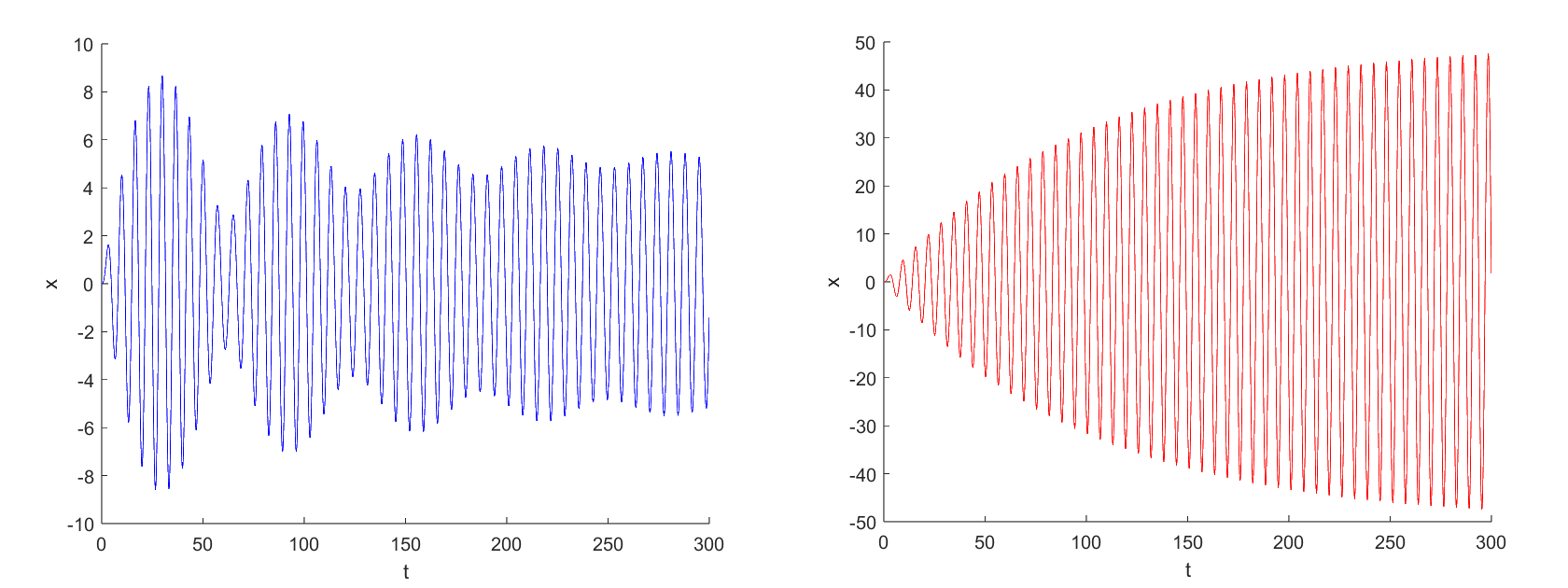 | |||
| The graphs are produced with parameters $\omega_0=1$ s$^{-1}$, $\gamma=0.01$ s$^{-1}$, $F_0/m=1$ m/s$^2$, where $F_0$ is the amplitude of external forcing. | |||
| Since the oscillator starts from rest, the magnitude of free oscillation is initially comparable to that of forced oscillation. Also, weak damping may be ignored for the first few periods. When $|\omega-\omega_0|\gg\gamma$ (in the blue graph $\omega=0.9$ s$^{-1}$), beats with period $2\pi/|\omega-\omega_0|\approx63$ s appear initially. However, as soon as the effect of damping becomes significant, free oscillation diminishes, and forced oscillation is established. | |||
| @@ -12,8 +12,12 @@Solution | |||
| When $\omega=\omega_0$ (in the red graph), we may consider the first beat as having an extremely long period. Similarly, as soon as the effect of damping becomes significant, free oscillation diminishes, and forced oscillation is established. | |||
| − | The characteristic time scale for exponential decay of free oscillation is $1/\gamma=100$ s, but it takes about $3\gamma=300$ s for free oscillation to becomes less than 5% of its initial value, and forced oscillation is firmly established. | ||
| + | The characteristic time scale for exponential decay of free oscillation is $1/\gamma=100$ s, but it takes about $3/\gamma=300$ s for free oscillation to becomes less than 5% of its initial value, and forced oscillation is firmly established. | ||
| + | |||
| + | Note that the resonance amplitude in the red graph is roughly $10$ times that in the blue graph, which is in good agreement with linear dependence of near-rosonance amplitude on | ||
| + | |||
| + | \[\frac{1}{\sqrt{(\omega-\omega_0)^2+\gamma^2}}.\] | ||
| #### Answer | |||
| See the solution. | |||
| ### Statement | ### Statement | ||
| $3.5.35.$ Let there be an oscillation with weak damping: the damping coefficient $\gamma\ll\omega_0$. How will it affect the oscillation swing of the oscillator from a resting state to an equilibrium position at $|\omega-\omega_0|\gg\gamma$ and at $\omega=\omega_0$? Why in these cases is it appropriate to talk about the establishment of forced oscillations? What is the characteristic time of this establishment? | $3.5.35.$ Let there be an oscillation with weak damping: the damping coefficient $\gamma\ll\omega_0$. How will it affect the oscillation swing of the oscillator from a resting state to an equilibrium position at $|\omega-\omega_0|\gg\gamma$ and at $\omega=\omega_0$? Why in these cases is it appropriate to talk about the establishment of forced oscillations? What is the characteristic time of this establishment? | ||
| ### Solution | ### Solution | ||
|  |  | ||
| The graphs are produced with parameters $\omega_0=1$ s$^{-1}$, $\gamma=0.01$ s$^{-1}$, $F_0/m=1$ m/s$^2$, where $F_0$ is the amplitude of external forcing. | The graphs are produced with parameters $\omega_0=1$ s$^{-1}$, $\gamma=0.01$ s$^{-1}$, $F_0/m=1$ m/s$^2$, where $F_0$ is the amplitude of external forcing. | ||
| Since the oscillator starts from rest, the magnitude of free oscillation is initially comparable to that of forced oscillation. Also, weak damping may be ignored for the first few periods. When $|\omega-\omega_0|\gg\gamma$ (in the blue graph $\omega=0.9$ s$^{-1}$), beats with period $2\pi/|\omega-\omega_0|\approx63$ s appear initially. However, as soon as the effect of damping becomes significant, free oscillation diminishes, and forced oscillation is established. | Since the oscillator starts from rest, the magnitude of free oscillation is initially comparable to that of forced oscillation. Also, weak damping may be ignored for the first few periods. When $|\omega-\omega_0|\gg\gamma$ (in the blue graph $\omega=0.9$ s$^{-1}$), beats with period $2\pi/|\omega-\omega_0|\approx63$ s appear initially. However, as soon as the effect of damping becomes significant, free oscillation diminishes, and forced oscillation is established. | ||
| @@ -12,8 +12,12 @@Solution | |||
| When $\omega=\omega_0$ (in the red graph), we may consider the first beat as having an extremely long period. Similarly, as soon as the effect of damping becomes significant, free oscillation diminishes, and forced oscillation is established. | When $\omega=\omega_0$ (in the red graph), we may consider the first beat as having an extremely long period. Similarly, as soon as the effect of damping becomes significant, free oscillation diminishes, and forced oscillation is established. | ||
| The characteristic time scale for exponential decay of free oscillation is $1/\gamma=100$ s, but it takes about $3\gamma=300$ s for free oscillation to becomes less than 5% of its initial value, and forced oscillation is firmly established. | The characteristic time scale for exponential decay of free oscillation is $1/\gamma=100$ s, but it takes about $3/\gamma=300$ s for free oscillation to becomes less than 5% of its initial value, and forced oscillation is firmly established. | ||
| Note that the resonance amplitude in the red graph is roughly $10$ times that in the blue graph, which is in good agreement with linear dependence of near-rosonance amplitude on | |||
| \[\frac{1}{\sqrt{(\omega-\omega_0)^2+\gamma^2}}.\] | |||
| #### Answer | #### Answer | ||
| See the solution. | See the solution. | ||