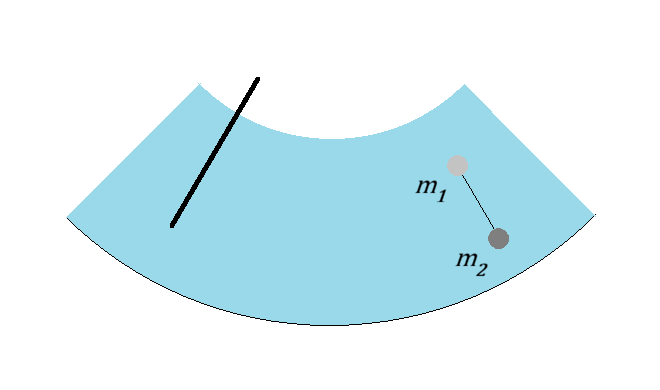
a. The rotation of the spaceship creates an outward pseudo-gravitational field $\omega^2r$, where $r$ is the distance from the axis of the spaceship. Thus, the surface of the pool is a part of a cylinder with the same axis of symmetry as the spaceship. Archimedes' Principles still holds in this situation, and astronauts can still float and swim in the pool. Let $a$ be the cross-section of the stick. Then, a short element $dr$ of the stick has mass $\rho a\,dr$, where $\rho$ is the density of the stick, and will experience outward gravitational force $\rho a\omega^2r\,dr$ and (if submerged in the pool) inward buoyancy force $\rho_wa\omega^2r\,dr$, where $\rho_w$ is the density of water. Since the stick is stationary, gravity and buoyancy have the same magnitude, i.e.
b. Suppose mass $m_1$ with density $\rho_1<\rho_w$ and mass $m_2$ with density $\rho_2>\rho_w$ are linked by a thread of length $2d$. Since $m_1$ is pulled inward and $m_2$ is pushed outward, they will align in a radial direction. Let $D$ be the distance between the midpoint of the thread and the axis of the space ship when the system is in equilibrium (if possible). Then, the outward push on $m_2$ and the inward pull on $m_1$ have the same magnitude, i.e.
if the midpoint of the thread is at a distance $r>D$, then the outward push on $m_2$ is stronger than the inward pull on $m_1$, and the system will sink toward the wall of the spacecraft. On the other hand, if the midpoint of the thread is at a distance $r<D$, then the outward push on $m_2$ is weaker than the inward pull on $m_1$, and the system will float toward the free surface. If the inequality in the assumption is reversed, then the equilibrium when the midpoint of the thread is at the distance $D$ from the axis of the spacecraft is stable.