| b. In the pool one can observe the following interesting phenomenon: two balls | | b. In the pool one can observe the following interesting phenomenon: two balls |
| of different densities connected by a thread move either to the free surface or | | of different densities connected by a thread move either to the free surface or |
| to the wall of the spaceship, depending on "depth", if the density of one ball is more and the density of the other is less than the water density. Explain this phenomenon. | | to the wall of the spaceship, depending on "depth", if the density of one ball is more and the density of the other is less than the water density. Explain this phenomenon. |
| | | |
| ### Solution | | ### Solution |
| | | |
|  | |  |
| | | |
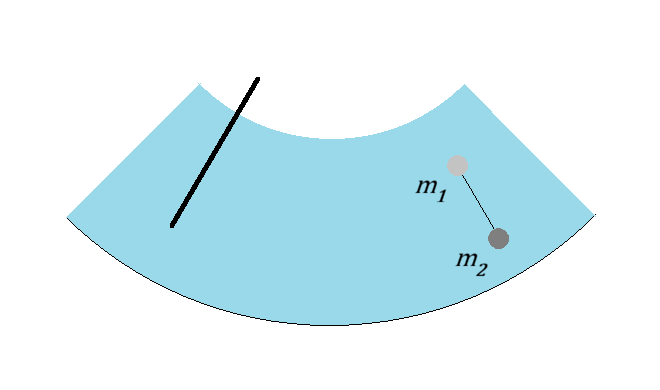
| a. The rotation of the spaceship creates an outward pseudo-gravitational field $\omega^2r$, where $r$ is the distance from the axis of the spaceship. Thus, the surface of the pool is a part of a cylinder with the same axis of symmetry as the spaceship. Archimedes' Principle still holds in this situation, and astronauts can still float and swim in the pool. Let $a$ be the cross-section of the stick. Then, a short element $dr$ of the stick has mass $\rho a\,dr$, where $\rho$ is the density of the stick, and will experience outward gravitational force $\rho a\omega^2r\,dr$ and (if submerged in the pool) inward buoyancy force $\rho_wa\omega^2r\,dr$, where $\rho_w$ is the density of water. Since the stick is stationary, gravity and buoyancy have the same magnitude, i.e. | | a. The rotation of the spaceship creates an outward pseudo-gravitational field $\omega^2r$, where $r$ is the distance from the axis of the spaceship. Thus, the surface of the pool is a part of a cylinder with the same axis of symmetry as the spaceship. Archimedes' Principle still holds in this situation, and astronauts can still float and swim in the pool. Let $a$ be the cross-section of the stick. Then, a short element $dr$ of the stick has mass $\rho a\,dr$, where $\rho$ is the density of the stick, and will experience outward gravitational force $\rho a\omega^2r\,dr$ and (if submerged in the pool) inward buoyancy force $\rho_wa\omega^2r\,dr$, where $\rho_w$ is the density of water. Since the stick is stationary, gravity and buoyancy have the same magnitude, i.e. |
| | | |
| \[\int_{R-H-\Delta}^{R-H+l-\Delta}\rho a\omega^2r\,dr=\int_{R-H}^{R-H+l-\Delta}\rho_wa\omega^2r\,dr.\] | | \[\int_{R-H-\Delta}^{R-H+l-\Delta}\rho a\omega^2r\,dr=\int_{R-H}^{R-H+l-\Delta}\rho_wa\omega^2r\,dr.\] |
| | | |
| Consequently, | | Consequently, |
| | | |
| \[\rho=\rho_w\cdot\frac{(l-\Delta)[2(R-H)+l-\Delta]}{l[2(R-H-\Delta)+l]}.\] | | \[\rho=\rho_w\cdot\frac{(l-\Delta)[2(R-H)+l-\Delta]}{l[2(R-H-\Delta)+l]}.\] |
| | | |
| b. Suppose mass $m_1$ with density $\rho_1<\rho_w$ and mass $m_2$ with density $\rho_2>\rho_w$ are linked by a thread of length $2d$. Since $m_1$ is pulled inward and $m_2$ is pushed outward, they will align in a radial direction. Let $D$ be the distance between the midpoint of the thread and the axis of the space ship when the system is in equilibrium (if possible). Then, the outward push on $m_2$ and the inward pull on $m_1$ have the same magnitude, i.e. | | b. Suppose mass $m_1$ with density $\rho_1<\rho_w$ and mass $m_2$ with density $\rho_2>\rho_w$ are linked by a thread of length $2d$. Since $m_1$ is pulled inward and $m_2$ is pushed outward, they will align in a radial direction. Let $D$ be the distance between the midpoint of the thread and the axis of the space ship when the system is in equilibrium (if possible). Then, the outward push on $m_2$ and the inward pull on $m_1$ have the same magnitude, i.e. |
| | | |
| \[m_2\left(1-\frac{\rho_w}{\rho_2}\right)\omega^2(D+d)=m_1\left(\frac{\rho_w}{\rho_1}-1\right)\omega^2(D-d),\] | | \[m_2\left(1-\frac{\rho_w}{\rho_2}\right)\omega^2(D+d)=m_1\left(\frac{\rho_w}{\rho_1}-1\right)\omega^2(D-d),\] |
| | | |
| which can be solved to obtain an expression for $D$. Under the assumption that | | which can be solved to obtain an expression for $D$. Under the assumption that |
| | | |
| \[m_2\left(1-\frac{\rho_w}{\rho_2}\right)>m_1\left(\frac{\rho_w}{\rho_1}-1\right),\] | | \[m_2\left(1-\frac{\rho_w}{\rho_2}\right)>m_1\left(\frac{\rho_w}{\rho_1}-1\right),\] |
| | | |
| if the midpoint of the thread is at a distance $r>D$, then the outward push on $m_2$ is stronger than the inward pull on $m_1$, and the system will sink toward the wall of the spacecraft. On the other hand, if the midpoint of the thread is at a distance $r<D$, then the outward push on $m_2$ is weaker than the inward pull on $m_1$, and the system will float toward the free surface. If the inequality in the assumption is reversed, then the equilibrium where the midpoint of the thread is at the distance $r=D$ is stable. | | if the midpoint of the thread is at a distance $r>D$, then the outward push on $m_2$ is stronger than the inward pull on $m_1$, and the system will sink toward the wall of the spacecraft. On the other hand, if the midpoint of the thread is at a distance $r<D$, then the outward push on $m_2$ is weaker than the inward pull on $m_1$, and the system will float toward the free surface. If the inequality in the assumption is reversed, then the equilibrium where the midpoint of the thread is at the distance $r=D$ is stable. |
| | | |
| #### Answer | | #### Answer |
| | | |
| $\rho=\rho_w\cdot\frac{(l-\Delta)[2(R-H)+l-\Delta]}{l[2(R-H-\Delta)+l]}$ | | $\rho=\rho_w\cdot\frac{(l-\Delta)[2(R-H)+l-\Delta]}{l[2(R-H-\Delta)+l]}$ |
