New solution

en/5.6.19.md
+98 −0
| @@ -0,0 +1,98 @@ | |||
| + | ### Statement | ||
| + | |||
| + | $5.6.19.$ [Insert the problem statement] | ||
| + | |||
| + | ### Solution | ||
| + | |||
| + | ### Statement | ||
| + | |||
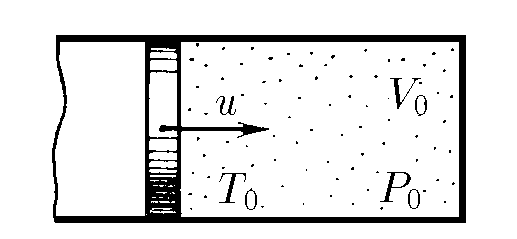
| + | $5.6.19.$ A piston of mass $M$, enclosing a volume $V_{0}$ of a monatomic gas at pressure $P_{0}$ and temperature $T_{0}$, moves with velocity $u$. Determine the temperature and volume of the gas at maximum compression. The system is thermally insulated, and the heat capacities of the piston and the vessel are negligible. | ||
| + | |||
| + |  | ||
| + | |||
| + | ### Solution | ||
| + | |||
| + | Let us write the first law of thermodynamics: | ||
| + | |||
| + | $$ | ||
| + | \\Delta U = Q + A | ||
| + | $$ | ||
| + | |||
| + | Since the system is thermally insulated, $Q=0$. The gas increases its internal energy due to the work done by the piston during adiabatic compression. This work is equal to the change in the kinetic energy of the piston. At maximum compression, the velocity of the piston at the end of the process is 0, meaning all the kinetic energy of the piston is transferred into the internal energy of the gas: | ||
| + | |||
| + | $$ | ||
| + | \\Delta U = A = \\frac{1}{2}Mu^{2} \\tag{1} | ||
| + | $$ | ||
| + | |||
| + | For $\\nu$ moles of a monatomic ideal gas, the change in internal energy is: | ||
| + | |||
| + | $$ | ||
| + | \\Delta U = \\frac{3}{2}\\nu R(T-T_{0}) \\tag{2} | ||
| + | $$ | ||
| + | |||
| + | Equating (1) and (2): | ||
| + | |||
| + | $$ | ||
| + | \\frac{3}{2}\\nu R(T-T_{0}) = \\frac{1}{2}Mu^{2} | ||
| + | $$ | ||
| + | |||
| + | Expressing $T$ from this equation: | ||
| + | |||
| + | $$ | ||
| + | T = T_{0} + \\frac{Mu^{2}}{3\\nu R} = T_{0}\\left( 1+ \\frac{Mu^{2}}{3\\nu RT_{0}} \\right) \\tag{3} | ||
| + | $$ | ||
| + | |||
| + | Using the ideal gas law: $P_{0}V_{0}=\\nu RT_{0}$. Then expression (3) can be rewritten as: | ||
| + | |||
| + | $$ | ||
| + | T = T_{0}\\left( 1+ \\frac{Mu^{2}}{3P_{0}V_{0}} \\right) \\tag{4} | ||
| + | $$ | ||
| + | |||
| + | Since the process is adiabatic, we use the adiabatic equation: | ||
| + | |||
| + | $$ | ||
| + | TV^{\\gamma-1} = \\mathrm{const} | ||
| + | $$ | ||
| + | |||
| + | where $\\gamma = \\frac{5}{3}$ is the adiabatic index for a monatomic ideal gas. | ||
| + | |||
| + | For the initial and final states, the equation takes the form: | ||
| + | |||
| + | $$ | ||
| + | T_{0}V_{0}^{\\gamma-1} = TV^{\\gamma-1} | ||
| + | $$ | ||
| + | $$ | ||
| + | V = V_{0}\\left( \\frac{T}{T_{0}} \\right)^{\\frac{1}{1-\\gamma}} \\tag{5} | ||
| + | $$ | ||
| + | |||
| + | Substitute (4) into (5): | ||
| + | |||
| + | $$ | ||
| + | V = V_{0}\\left( \\frac{T_{0}\\left( 1+ \\frac{Mu^{2}}{3P_{0}V_{0}}\\right)}{T_{0}} \\right)^{\\frac{1}{1-\\gamma}} = V_{0}\\left( \\frac{3P_{0}V_{0}+Mu^{2}}{3P_{0}V_{0}} \\right)^{\\frac{1}{1-\\gamma}} = V_{0}\\left( \\frac{3P_{0}V_{0}}{3P_{0}V_{0}+Mu^{2}} \\right)^{\\frac{1}{\\gamma-1}} | ||
| + | $$ | ||
| + | |||
| + | The exponent is: | ||
| + | |||
| + | $$ | ||
| + | \\frac{1}{\\gamma-1} = \\frac{1}{\\frac{5}{3}-1} = \\frac{3}{2} | ||
| + | $$ | ||
| + | |||
| + | Finally: | ||
| + | |||
| + | $$ | ||
| + | V = V_{0}\\left( \\frac{3P_{0}V_{0}}{3P_{0}V_{0}+Mu^{2}} \\right)^{\\frac{3}{2}} | ||
| + | $$ | ||
| + | |||
| + | #### Answer | ||
| + | |||
| + | $$ | ||
| + | T = T_{0}\\left( 1+\\frac{Mu^{2}}{3P_{0}V_{0}} \\right) | ||
| + | $$ | ||
| + | |||
| + | $$ | ||
| + | V = V_{0}\\left( \\frac{3P_{0}V_{0}}{3P_{0}V_{0}+Mu^{2}} \\right)^{\\frac{3}{2}} | ||
| + | $$ | ||
| + | |||
| + | #### Answer | ||
| + | |||
| + | [Insert a concise answer or boxed result] | ||
| @@ -0,0 +1,98 @@ | |||
| ### Statement | |||
| $5.6.19.$ [Insert the problem statement] | |||
| ### Solution | |||
| ### Statement | |||
| $5.6.19.$ A piston of mass $M$, enclosing a volume $V_{0}$ of a monatomic gas at pressure $P_{0}$ and temperature $T_{0}$, moves with velocity $u$. Determine the temperature and volume of the gas at maximum compression. The system is thermally insulated, and the heat capacities of the piston and the vessel are negligible. | |||
|  | |||
| ### Solution | |||
| Let us write the first law of thermodynamics: | |||
| $$ | |||
| \\Delta U = Q + A | |||
| $$ | |||
| Since the system is thermally insulated, $Q=0$. The gas increases its internal energy due to the work done by the piston during adiabatic compression. This work is equal to the change in the kinetic energy of the piston. At maximum compression, the velocity of the piston at the end of the process is 0, meaning all the kinetic energy of the piston is transferred into the internal energy of the gas: | |||
| $$ | |||
| \\Delta U = A = \\frac{1}{2}Mu^{2} \\tag{1} | |||
| $$ | |||
| For $\\nu$ moles of a monatomic ideal gas, the change in internal energy is: | |||
| $$ | |||
| \\Delta U = \\frac{3}{2}\\nu R(T-T_{0}) \\tag{2} | |||
| $$ | |||
| Equating (1) and (2): | |||
| $$ | |||
| \\frac{3}{2}\\nu R(T-T_{0}) = \\frac{1}{2}Mu^{2} | |||
| $$ | |||
| Expressing $T$ from this equation: | |||
| $$ | |||
| T = T_{0} + \\frac{Mu^{2}}{3\\nu R} = T_{0}\\left( 1+ \\frac{Mu^{2}}{3\\nu RT_{0}} \\right) \\tag{3} | |||
| $$ | |||
| Using the ideal gas law: $P_{0}V_{0}=\\nu RT_{0}$. Then expression (3) can be rewritten as: | |||
| $$ | |||
| T = T_{0}\\left( 1+ \\frac{Mu^{2}}{3P_{0}V_{0}} \\right) \\tag{4} | |||
| $$ | |||
| Since the process is adiabatic, we use the adiabatic equation: | |||
| $$ | |||
| TV^{\\gamma-1} = \\mathrm{const} | |||
| $$ | |||
| where $\\gamma = \\frac{5}{3}$ is the adiabatic index for a monatomic ideal gas. | |||
| For the initial and final states, the equation takes the form: | |||
| $$ | |||
| T_{0}V_{0}^{\\gamma-1} = TV^{\\gamma-1} | |||
| $$ | |||
| $$ | |||
| V = V_{0}\\left( \\frac{T}{T_{0}} \\right)^{\\frac{1}{1-\\gamma}} \\tag{5} | |||
| $$ | |||
| Substitute (4) into (5): | |||
| $$ | |||
| V = V_{0}\\left( \\frac{T_{0}\\left( 1+ \\frac{Mu^{2}}{3P_{0}V_{0}}\\right)}{T_{0}} \\right)^{\\frac{1}{1-\\gamma}} = V_{0}\\left( \\frac{3P_{0}V_{0}+Mu^{2}}{3P_{0}V_{0}} \\right)^{\\frac{1}{1-\\gamma}} = V_{0}\\left( \\frac{3P_{0}V_{0}}{3P_{0}V_{0}+Mu^{2}} \\right)^{\\frac{1}{\\gamma-1}} | |||
| $$ | |||
| The exponent is: | |||
| $$ | |||
| \\frac{1}{\\gamma-1} = \\frac{1}{\\frac{5}{3}-1} = \\frac{3}{2} | |||
| $$ | |||
| Finally: | |||
| $$ | |||
| V = V_{0}\\left( \\frac{3P_{0}V_{0}}{3P_{0}V_{0}+Mu^{2}} \\right)^{\\frac{3}{2}} | |||
| $$ | |||
| #### Answer | |||
| $$ | |||
| T = T_{0}\\left( 1+\\frac{Mu^{2}}{3P_{0}V_{0}} \\right) | |||
| $$ | |||
| $$ | |||
| V = V_{0}\\left( \\frac{3P_{0}V_{0}}{3P_{0}V_{0}+Mu^{2}} \\right)^{\\frac{3}{2}} | |||
| $$ | |||
| #### Answer | |||
| [Insert a concise answer or boxed result] | |||