Statement
2.1.54. Electrons moving in a circle of any radius around a charged thread have the same speed
Solution
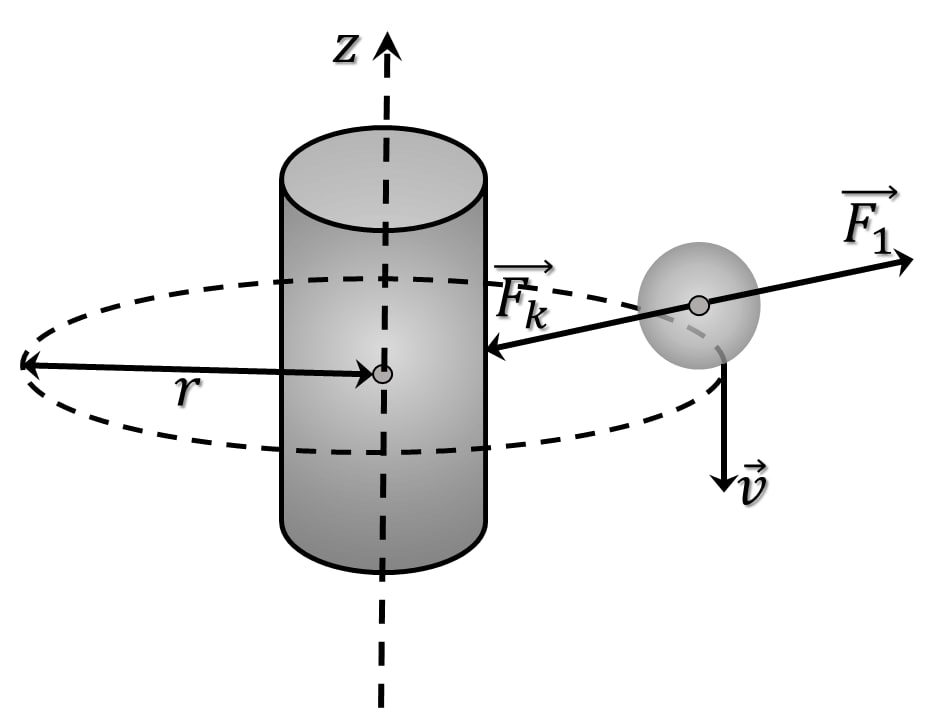
1. A stationary circular orbit of an electron (a negatively charged particle with rest mass
2. This force is directly proportional to the square of the linear velocity of the particle and inversely proportional to the distance to the axis of rotation:
Thus, since the speed
3. If the speed of the electron suddenly decreases (
Due to this excess attractive force, the electron will be pulled inward, decreasing its orbital radius. Conversely, if the speed suddenly increases, the required force will exceed the Coulomb force, and the electron will move outward. Since the force field is locally uniform over a very short initial distance, the initial segments of these trajectories will resemble parabolas tangent to the original circle from the inside (for decreased speed) and from the outside (for increased speed).
Answer
Close to parabolas tangent to the circle from the inside; from the outside.