New solution

en/13.3.6.md
+94 −0
| @@ -0,0 +1,94 @@ | |||
| + | ### Statement | ||
| + | |||
| + | $13.3.6.$ [Insert the problem statement] | ||
| + | |||
| + | ### Solution | ||
| + | |||
| + | ### Statement | ||
| + | |||
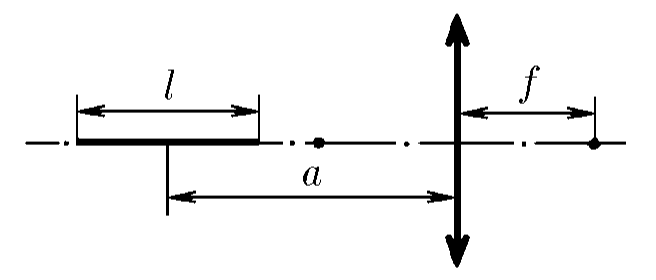
| + | $13.3.6.$ An object in the form of a segment of length $l$ is located along the optical axis of a converging lens with focal length $f$, which produces a real image of all its points. The middle of the segment is located at a distance $a$ from the lens. Determine the longitudinal magnification of the object. | ||
| + | |||
| + |  | ||
| + | |||
| + | ### Solution | ||
| + | |||
| + | According to the figure, the distance from the left end of the object to the lens will be: | ||
| + | |||
| + | $$ | ||
| + | a_{1}=a+\frac{l}{2} \tag{1} | ||
| + | $$ | ||
| + | |||
| + | The distance from the right end of the object to the lens will be: | ||
| + | |||
| + | $$ | ||
| + | a_{2}=a-\frac{l}{2} \tag{2} | ||
| + | $$ | ||
| + | |||
| + | Using the thin lens formula, we find the distances between the lens and the images of these ends of the object: | ||
| + | |||
| + | $$ | ||
| + | \frac{1}{a_{1}}+\frac{1}{b_{1}}=\frac{1}{f} | ||
| + | $$ | ||
| + | $$ | ||
| + | b_{1}=\frac{a_{1}f}{a_{1}-f} \tag{3} | ||
| + | $$ | ||
| + | |||
| + | Similarly for $b_{2}$: | ||
| + | |||
| + | $$ | ||
| + | b_{2}=\frac{a_{2}f}{a_{2}-f} \tag{4} | ||
| + | $$ | ||
| + | |||
| + | Since $a_{1}> a_{2}$, then $b_{2}> b_{1}$. | ||
| + | |||
| + | The longitudinal magnification of the object, by definition, is: | ||
| + | |||
| + | $$ | ||
| + | k=\frac{b_{2}-b_{1}}{l} \tag{5} | ||
| + | $$ | ||
| + | |||
| + | Substituting (1) into (3), we find $b_{1}$: | ||
| + | |||
| + | $$ | ||
| + | b_{1}=\frac{(a+\frac{l}{2})f}{(a-f)+\frac{l}{2}} | ||
| + | $$ | ||
| + | |||
| + | Substituting (2) into (4), we find $b_{2}$: | ||
| + | |||
| + | $$ | ||
| + | b_{2}=\frac{(a-\frac{l}{2})f}{(a-f)-\frac{l}{2}} | ||
| + | $$ | ||
| + | |||
| + | Substituting the expressions for $b_{1}$ and $b_{2}$ into formula (5): | ||
| + | |||
| + | $$ | ||
| + | k=\frac{1}{l}\cdot \left( \frac{(a-\frac{l}{2})f}{(a-f)-\frac{l}{2}}-\frac{(a+\frac{l}{2})f}{(a-f)+\frac{l}{2}} \right) | ||
| + | $$ | ||
| + | |||
| + | Finding a common denominator and simplifying: | ||
| + | |||
| + | $$ | ||
| + | k=\frac{f}{l}\cdot \frac{(a-\frac{l}{2})(a+\frac{l}{2})-f(a-\frac{l}{2})-(a-\frac{l}{2})(a+\frac{l}{2})+f(a+\frac{l}{2})}{(a-f)^{2}-\frac{l^{2}}{4}} | ||
| + | $$ | ||
| + | $$ | ||
| + | k=\frac{f}{l}\cdot \frac{-f(a-\frac{l}{2})+f(a+\frac{l}{2})}{(a-f)^{2}-\frac{l^{2}}{4}} | ||
| + | $$ | ||
| + | $$ | ||
| + | k=\frac{f}{l}\cdot \frac{fl}{(a-f)^{2}-\frac{l^{2}}{4}} | ||
| + | $$ | ||
| + | |||
| + | Finally: | ||
| + | |||
| + | $$ | ||
| + | k=\frac{f^{2}}{(a-f)^{2}-\frac{l^{2}}{4}} | ||
| + | $$ | ||
| + | |||
| + | #### Answer | ||
| + | |||
| + | $$ | ||
| + | k=\frac{f^{2}}{(a-f)^{2}-\frac{l^{2}}{4}} | ||
| + | $$ | ||
| + | |||
| + | #### Answer | ||
| + | |||
| + | [Insert a concise answer or boxed result] | ||
| @@ -0,0 +1,94 @@ | |||
| ### Statement | |||
| $13.3.6.$ [Insert the problem statement] | |||
| ### Solution | |||
| ### Statement | |||
| $13.3.6.$ An object in the form of a segment of length $l$ is located along the optical axis of a converging lens with focal length $f$, which produces a real image of all its points. The middle of the segment is located at a distance $a$ from the lens. Determine the longitudinal magnification of the object. | |||
|  | |||
| ### Solution | |||
| According to the figure, the distance from the left end of the object to the lens will be: | |||
| $$ | |||
| a_{1}=a+\frac{l}{2} \tag{1} | |||
| $$ | |||
| The distance from the right end of the object to the lens will be: | |||
| $$ | |||
| a_{2}=a-\frac{l}{2} \tag{2} | |||
| $$ | |||
| Using the thin lens formula, we find the distances between the lens and the images of these ends of the object: | |||
| $$ | |||
| \frac{1}{a_{1}}+\frac{1}{b_{1}}=\frac{1}{f} | |||
| $$ | |||
| $$ | |||
| b_{1}=\frac{a_{1}f}{a_{1}-f} \tag{3} | |||
| $$ | |||
| Similarly for $b_{2}$: | |||
| $$ | |||
| b_{2}=\frac{a_{2}f}{a_{2}-f} \tag{4} | |||
| $$ | |||
| Since $a_{1}> a_{2}$, then $b_{2}> b_{1}$. | |||
| The longitudinal magnification of the object, by definition, is: | |||
| $$ | |||
| k=\frac{b_{2}-b_{1}}{l} \tag{5} | |||
| $$ | |||
| Substituting (1) into (3), we find $b_{1}$: | |||
| $$ | |||
| b_{1}=\frac{(a+\frac{l}{2})f}{(a-f)+\frac{l}{2}} | |||
| $$ | |||
| Substituting (2) into (4), we find $b_{2}$: | |||
| $$ | |||
| b_{2}=\frac{(a-\frac{l}{2})f}{(a-f)-\frac{l}{2}} | |||
| $$ | |||
| Substituting the expressions for $b_{1}$ and $b_{2}$ into formula (5): | |||
| $$ | |||
| k=\frac{1}{l}\cdot \left( \frac{(a-\frac{l}{2})f}{(a-f)-\frac{l}{2}}-\frac{(a+\frac{l}{2})f}{(a-f)+\frac{l}{2}} \right) | |||
| $$ | |||
| Finding a common denominator and simplifying: | |||
| $$ | |||
| k=\frac{f}{l}\cdot \frac{(a-\frac{l}{2})(a+\frac{l}{2})-f(a-\frac{l}{2})-(a-\frac{l}{2})(a+\frac{l}{2})+f(a+\frac{l}{2})}{(a-f)^{2}-\frac{l^{2}}{4}} | |||
| $$ | |||
| $$ | |||
| k=\frac{f}{l}\cdot \frac{-f(a-\frac{l}{2})+f(a+\frac{l}{2})}{(a-f)^{2}-\frac{l^{2}}{4}} | |||
| $$ | |||
| $$ | |||
| k=\frac{f}{l}\cdot \frac{fl}{(a-f)^{2}-\frac{l^{2}}{4}} | |||
| $$ | |||
| Finally: | |||
| $$ | |||
| k=\frac{f^{2}}{(a-f)^{2}-\frac{l^{2}}{4}} | |||
| $$ | |||
| #### Answer | |||
| $$ | |||
| k=\frac{f^{2}}{(a-f)^{2}-\frac{l^{2}}{4}} | |||
| $$ | |||
| #### Answer | |||
| [Insert a concise answer or boxed result] | |||