Edits to “Statement”, “Solution”, “Answer”

en/14.2.4.md
+8 −2
| @@ -1,11 +1,17 @@ | |||
| ### Statement | |||
| − | $14.2.4.$ | ||
| + | $14.2.4.$ Protons are accelerated by a voltage of 30 kV, and then, passing through a | ||
| + | gas target, they partially transform (practically without braking), capturing | ||
| + | electrons, into fast neutral hydrogen atoms. The frequency of stationary hydrogen atoms is $3.2 · 10^{15} Hz$. How much will the frequency of electromagnetic | ||
| + | waves emitted by moving hydrogen atoms perpendicular to the direction of | ||
| + | their movement change? | ||
| ### Solution | |||
| + | 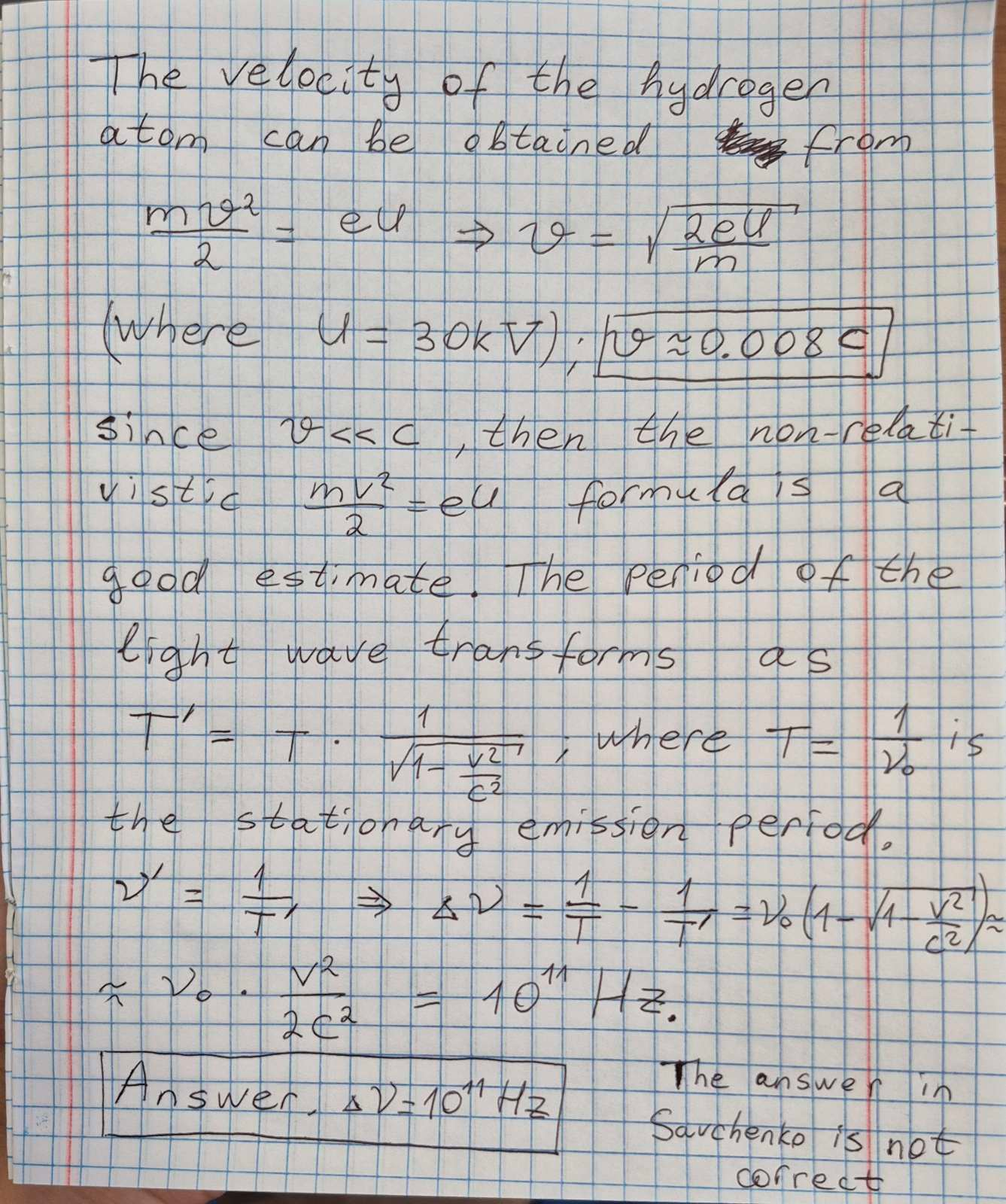 | ||
| + | |||
| #### Answer | |||
| − | [Insert a concise answer or boxed result] | ||
| + | $\Delta \nu = 10^{11} Hz$ | ||
| @@ -1,11 +1,17 @@ | |||
| ### Statement | ### Statement | ||
| $14.2.4.$ |
$14.2.4.$ Protons are accelerated by a voltage of 30 kV, and then, passing through a | ||
| gas target, they partially transform (practically without braking), capturing | |||
| electrons, into fast neutral hydrogen atoms. The frequency of stationary hydrogen atoms is $3.2 · 10^{15} Hz$. How much will the frequency of electromagnetic | |||
| waves emitted by moving hydrogen atoms perpendicular to the direction of | |||
| their movement change? | |||
| ### Solution | ### Solution | ||
|  | |||
| #### Answer | #### Answer | ||
| [Insert a concise answer or boxed result] | $\Delta \nu = 10^{11} Hz$ | ||