| @@ -1,21 +1,21 @@ |
| ### Statement |
| ### Statement |
| |
| |
| $3.3.7.$ [Insert the problem statement] |
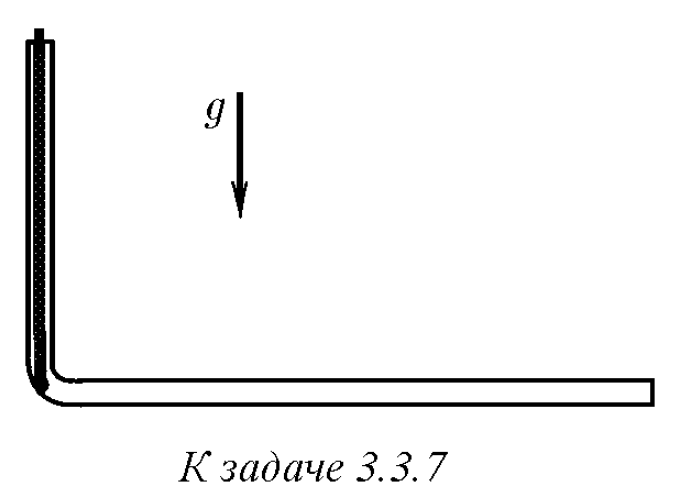
| $3.3.7.$ A smooth uniform rope of length $l$ is held in a vertical elbow of a bent pipe so that its lower end touches the horizontal part of the pipe. The rope is released. In what time will it be completely in the horizontal elbow? Neglect the friction. How will this time change if a part of the rope was already in the horizontal knee at the beginning? |
| |
| |
| ### Solution |
| ### Solution |
| |
| |
|  |
|  |
| |
| |
| Let $x$ be the length of the vertical part of the rope. (We may think of $x$ as the distance of the right endpoint of the rope from where it will be when the rope is completely horizontal.) The mass of the vertical part of the rope is $mx/l$, where $m$ is the mass of the entire rope, and its center of mass is $x/2$ high. Consequently, the gravitational potential energy of the rope is |
| Let $x$ be the length of the vertical part of the rope. (We may think of $x$ as the distance of the right endpoint of the rope from where it will be when the rope is completely horizontal.) The mass of the vertical part of the rope is $mx/l$, where $m$ is the mass of the entire rope, and its center of mass is $x/2$ high. Consequently, the gravitational potential energy of the rope is |
| |
| |
| \[\frac{m\omega^2x^2}{2}=\frac{mgx^2}{2l}\qquad\Rightarrow\qquad\omege=\sqrt{\frac{g}{l}}.\] |
| \[\frac{m\omega^2x^2}{2}=\frac{mgx^2}{2l}\qquad\Rightarrow\qquad\omega=\sqrt{\frac{g}{l}}.\] |
| |
| |
| The motion of the rope from when it is released to when it is completely horizontal is a quarter of a period of this motion, so |
| The motion of the rope from when it is released to when it is completely horizontal is a quarter of the period of this motion, so |
| |
| |
| \[\frac{T}{4}=\frac{\pi}{2\omega}=\frac{\pi}{2}\sqrt{l}{g}.\] |
| \[\frac{T}{4}=\frac{\pi}{2\omega}=\frac{\pi}{2}\sqrt{\frac{l}{g}}.\] |
| |
| |
| Note that the motion of the rope remains simple harmonic withe the same (quarter) period as long as there is a point on the rope at the bend of the pipe. Thus, releasing the rope when a part of it is already horizontal does not change the time it takes to become completely horizontal, because the (quarter) period of simple harmonic motion is independent of its amplitude. |
| Note that the motion of the rope remains simple harmonic withe the same (quarter) period as long as there is a point on the rope at the bend of the pipe. Thus, releasing the rope when a part of it is already horizontal does not change the time it takes to become completely horizontal, because the (quarter) period of simple harmonic motion is independent of its amplitude. |
| |
| |
| #### Answer |
| #### Answer |
| |
| |
| [Insert a concise answer or boxed result] |
| $\frac{\pi}{2}\sqrt{\frac{l}{g}}$ regardless of whether there is a horizontal part of the rope when it is released. |
