New solution

en/5.5.10.md
+17 −0
| @@ -0,0 +1,17 @@ | |||
| + | ### Statement | ||
| + | |||
| + | $5.5.10.$ [Insert the problem statement] | ||
| + | |||
| + | ### Solution | ||
| + | |||
| + |  | ||
| + | |||
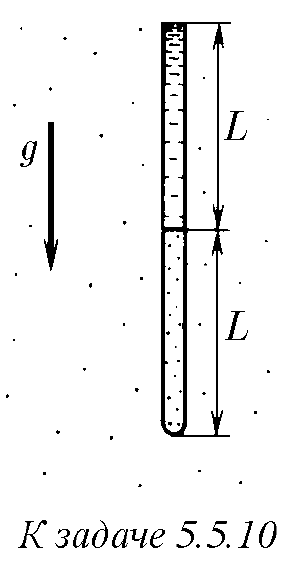
| + | At temperature $T_0$, the pressure of the gas is $2L$ mmHg and its volume is $aL$ mm$^3$, where $a$ mm$^2$ is the cross-section area of the tube. Suppose that the temperature of the gas is $T$ when the volume $ax$ mm$^3$ of mercury has overflown off the tube. Then the pressure of the gas is $2L-x$ mmHg and its volume is $a(L+x)$ mm$^3$. From ideal gas law, | ||
| + | |||
| + | \[\frac{2L\cdot aL}{T_0}=\frac{(2L-x)\cdota(L-x)}{T}\qquad\Rightarrow\qquad T=T_0\cdot\frac{(2L-x)(L+x)}{2L^2},\] | ||
| + | |||
| + | which has maximum value of $9T_0/8$, when $x=L/2$. Thus, the gas must be heated to at least this temperature in order for it to displace all the mercury in the tube. | ||
| + | |||
| + | #### Answer | ||
| + | |||
| + | [Insert a concise answer or boxed result] | ||
| @@ -0,0 +1,17 @@ | |||
| ### Statement | |||
| $5.5.10.$ [Insert the problem statement] | |||
| ### Solution | |||
|  | |||
| At temperature $T_0$, the pressure of the gas is $2L$ mmHg and its volume is $aL$ mm$^3$, where $a$ mm$^2$ is the cross-section area of the tube. Suppose that the temperature of the gas is $T$ when the volume $ax$ mm$^3$ of mercury has overflown off the tube. Then the pressure of the gas is $2L-x$ mmHg and its volume is $a(L+x)$ mm$^3$. From ideal gas law, | |||
| \[\frac{2L\cdot aL}{T_0}=\frac{(2L-x)\cdota(L-x)}{T}\qquad\Rightarrow\qquad T=T_0\cdot\frac{(2L-x)(L+x)}{2L^2},\] | |||
| which has maximum value of $9T_0/8$, when $x=L/2$. Thus, the gas must be heated to at least this temperature in order for it to displace all the mercury in the tube. | |||
| #### Answer | |||
| [Insert a concise answer or boxed result] | |||