Edits to “Statement”, “Solution”, “Answer”

en/6.1.14.md
+4 −8
| @@ -1,11 +1,5 @@ | |||
| ### Statement | |||
| − | $6.1.14.$ [Insert the problem statement] | ||
| − | |||
| − | ### Solution | ||
| − | |||
| − | ### Statement | ||
| − | |||
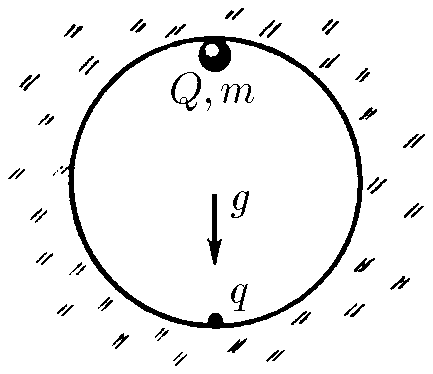
| $6.1.14.$ What minimum charge $q$ must be fixed at the lowest point of a spherical cavity of radius $R$ so that a small ball of mass $m$ and charge $Q$ is in stable equilibrium at the highest point of the cavity in a gravitational field? | |||
|  | |||
| ### Solution | |||
| If we solve this problem using the equilibrium condition | |||
| $$ | |||
| F_k=mg, | |||
| $$ | |||
| you will get an incorrect answer, because such an equilibrium would be unstable. | |||
| To verify stability, it is necessary to displace the ball by a small angle $\alpha\longrightarrow0$; $(\sin{\alpha}\approx\alpha)$ and consider for which $q$ a restoring force will arise. | |||
| It should be noted that for small displacements, the Coulomb force can be considered constant | |||
| $$ | |||
| F_k=\text{const}=\frac{1}{4\pi\varepsilon_0}\frac{qQ}{4R^2} | |||
| $$ | |||
| 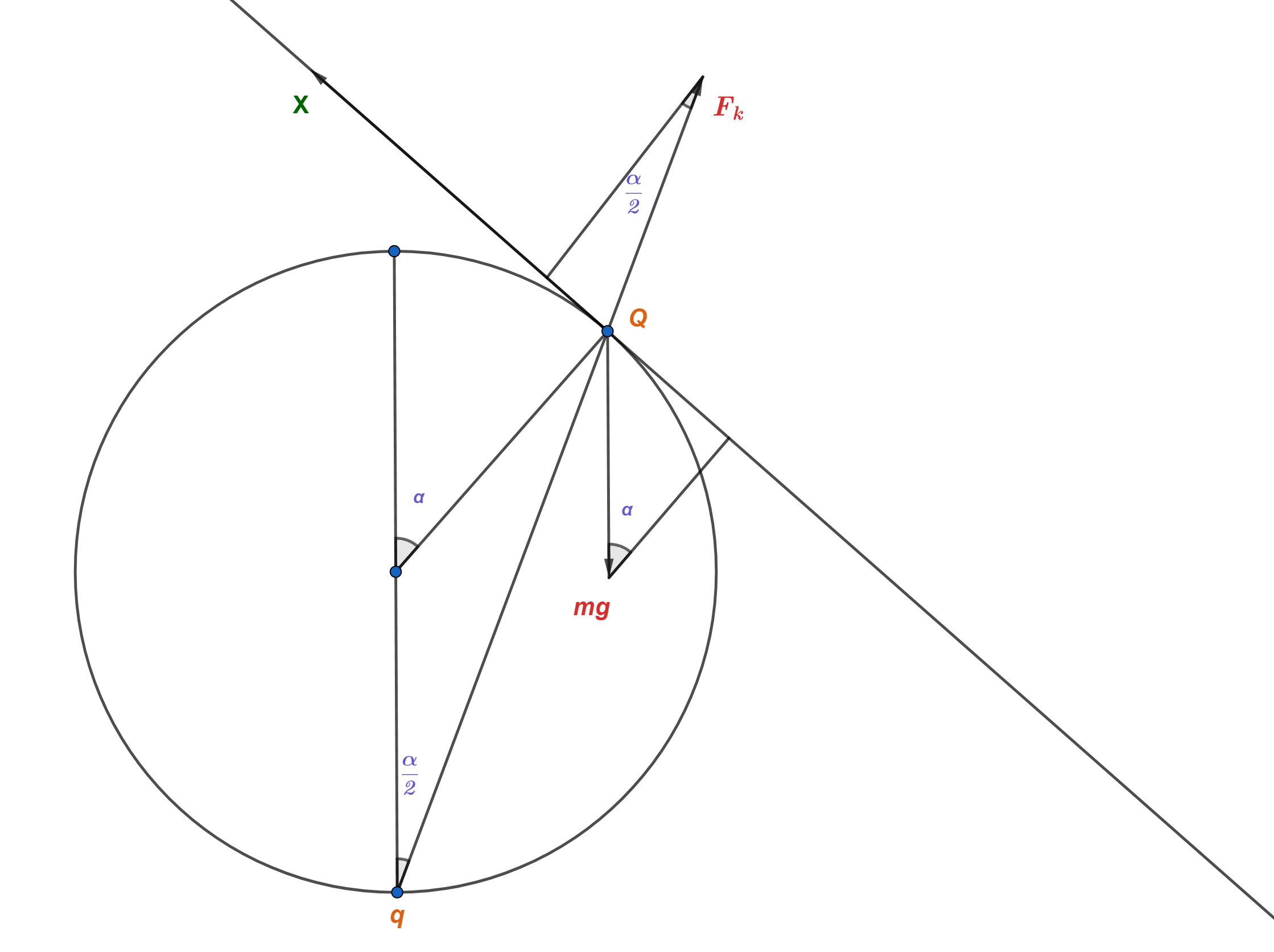 | |||
| Let us consider the projections of forces onto the $Ox$ axis, parallel to the tangent to the sphere at the point of contact with the ball (inclined at an angle $\alpha$ to the horizontal): | |||
| $$ | |||
| (mg)_x=-mg \cdot \sin{\alpha} | |||
| $$ | |||
| $$ | |||
| (N)_x=0 | |||
| $$ | |||
| $$ | |||
| (F_k)_x=F_k \cdot \sin{\alpha /2} | |||
| $$ | |||
| In this case, the Coulomb force must be significantly greater than $mg$, i.e., the ball will not fall down but can roll down the wall, which means the equilibrium will be stable if the sum of the projections of all forces onto $Ox$ is greater than zero | |||
| $$ | |||
| F_k \cdot \sin{\alpha /2}-mg \cdot \sin{\alpha}=0 | |||
| $$ | |||
| $$ | |||
| F_k=mg \cdot \frac{\alpha}{\alpha /2} | |||
| $$ | |||
| $$ | |||
| \frac{1}{4\pi\varepsilon_0}\frac{qQ}{4R^2}=2mg | |||
| $$ | |||
| $$ | |||
| @@ -62,6 +56,8 @@Solution | |||
| q=\frac{32\pi\varepsilon_0mgR^2}{Q} | |||
| $$ | |||
| − | #### Answer | ||
| + | #### Answer | ||
| − | [Insert a concise answer or boxed result] | ||
| + | $$ | ||
| + | q=\frac{32\pi\varepsilon_0mgR^2}{Q} | ||
| + | $$ | ||
| @@ -1,11 +1,5 @@ | |||
| ### Statement | ### Statement | ||
| $6.1.14.$ [Insert the problem statement] | |||
| ### Solution | |||
| ### Statement | |||
| $6.1.14.$ What minimum charge $q$ must be fixed at the lowest point of a spherical cavity of radius $R$ so that a small ball of mass $m$ and charge $Q$ is in stable equilibrium at the highest point of the cavity in a gravitational field? | $6.1.14.$ What minimum charge $q$ must be fixed at the lowest point of a spherical cavity of radius $R$ so that a small ball of mass $m$ and charge $Q$ is in stable equilibrium at the highest point of the cavity in a gravitational field? | ||
|  |  | ||
| ### Solution | ### Solution | ||
| If we solve this problem using the equilibrium condition | If we solve this problem using the equilibrium condition | ||
| $$ | $$ | ||
| F_k=mg, | F_k=mg, | ||
| $$ | $$ | ||
| you will get an incorrect answer, because such an equilibrium would be unstable. | you will get an incorrect answer, because such an equilibrium would be unstable. | ||
| To verify stability, it is necessary to displace the ball by a small angle $\alpha\longrightarrow0$; $(\sin{\alpha}\approx\alpha)$ and consider for which $q$ a restoring force will arise. | To verify stability, it is necessary to displace the ball by a small angle $\alpha\longrightarrow0$; $(\sin{\alpha}\approx\alpha)$ and consider for which $q$ a restoring force will arise. | ||
| It should be noted that for small displacements, the Coulomb force can be considered constant | It should be noted that for small displacements, the Coulomb force can be considered constant | ||
| $$ | $$ | ||
| F_k=\text{const}=\frac{1}{4\pi\varepsilon_0}\frac{qQ}{4R^2} | F_k=\text{const}=\frac{1}{4\pi\varepsilon_0}\frac{qQ}{4R^2} | ||
| $$ | $$ | ||
|  |  | ||
| Let us consider the projections of forces onto the $Ox$ axis, parallel to the tangent to the sphere at the point of contact with the ball (inclined at an angle $\alpha$ to the horizontal): | Let us consider the projections of forces onto the $Ox$ axis, parallel to the tangent to the sphere at the point of contact with the ball (inclined at an angle $\alpha$ to the horizontal): | ||
| $$ | $$ | ||
| (mg)_x=-mg \cdot \sin{\alpha} | (mg)_x=-mg \cdot \sin{\alpha} | ||
| $$ | $$ | ||
| $$ | $$ | ||
| (N)_x=0 | (N)_x=0 | ||
| $$ | $$ | ||
| $$ | $$ | ||
| (F_k)_x=F_k \cdot \sin{\alpha /2} | (F_k)_x=F_k \cdot \sin{\alpha /2} | ||
| $$ | $$ | ||
| In this case, the Coulomb force must be significantly greater than $mg$, i.e., the ball will not fall down but can roll down the wall, which means the equilibrium will be stable if the sum of the projections of all forces onto $Ox$ is greater than zero | In this case, the Coulomb force must be significantly greater than $mg$, i.e., the ball will not fall down but can roll down the wall, which means the equilibrium will be stable if the sum of the projections of all forces onto $Ox$ is greater than zero | ||
| $$ | $$ | ||
| F_k \cdot \sin{\alpha /2}-mg \cdot \sin{\alpha}=0 | F_k \cdot \sin{\alpha /2}-mg \cdot \sin{\alpha}=0 | ||
| $$ | $$ | ||
| $$ | $$ | ||
| F_k=mg \cdot \frac{\alpha}{\alpha /2} | F_k=mg \cdot \frac{\alpha}{\alpha /2} | ||
| $$ | $$ | ||
| $$ | $$ | ||
| \frac{1}{4\pi\varepsilon_0}\frac{qQ}{4R^2}=2mg | \frac{1}{4\pi\varepsilon_0}\frac{qQ}{4R^2}=2mg | ||
| $$ | $$ | ||
| $$ | $$ | ||
| @@ -62,6 +56,8 @@Solution | |||
| q=\frac{32\pi\varepsilon_0mgR^2}{Q} | q=\frac{32\pi\varepsilon_0mgR^2}{Q} | ||
| $$ | $$ | ||
| #### Answer | #### Answer | ||
| [Insert a concise answer or boxed result] | $$ | ||
| q=\frac{32\pi\varepsilon_0mgR^2}{Q} | |||
| $$ | |||