New solution

en/2.3.33.md
+21 −0
| @@ -0,0 +1,21 @@ | |||
| + | ### Statement | ||
| + | |||
| + | $2.3.33.$ [Insert the problem statement] | ||
| + | |||
| + | ### Solution | ||
| + | |||
| + |  | ||
| + | |||
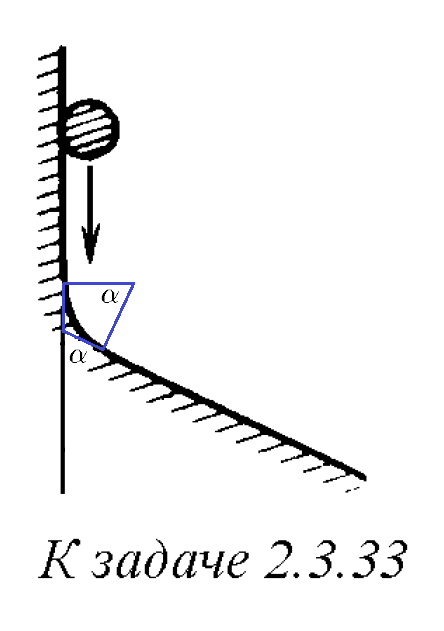
| + | Assume that the speed $v$ of the body is much larger than $\sqrt(gr)$, where $r$ the radius of curvature of the bend, so that the gravitational field $g$ has negligible effect on centripetal acceleration. Consequently, the normal force | ||
| + | |||
| + | \[N=\frac{mv^2}{r}=\frac{2K}{r},\] | ||
| + | |||
| + | where $K$ is the kinetic energy of the body. The change in kinetic energy is due to the work done by friction, i.e. | ||
| + | |||
| + | \[dK=-\mu Nr\,d\theta=-2\mu K\,d\theta,\] | ||
| + | |||
| + | where $d\theta$ is a small angle subtended by a small arc of the bend. Integrating, we have $K(\theta)=K_0e^{-2\mu\theta}$. In the figure, the angle subtended by the bend is $\alpha$, so $K=K_0e^{-2\mu\alpha}$ at the end of the bend. | ||
| + | |||
| + | #### Answer | ||
| + | |||
| + | [Insert a concise answer or boxed result] | ||
| @@ -0,0 +1,21 @@ | |||
| ### Statement | |||
| $2.3.33.$ [Insert the problem statement] | |||
| ### Solution | |||
|  | |||
| Assume that the speed $v$ of the body is much larger than $\sqrt(gr)$, where $r$ the radius of curvature of the bend, so that the gravitational field $g$ has negligible effect on centripetal acceleration. Consequently, the normal force | |||
| \[N=\frac{mv^2}{r}=\frac{2K}{r},\] | |||
| where $K$ is the kinetic energy of the body. The change in kinetic energy is due to the work done by friction, i.e. | |||
| \[dK=-\mu Nr\,d\theta=-2\mu K\,d\theta,\] | |||
| where $d\theta$ is a small angle subtended by a small arc of the bend. Integrating, we have $K(\theta)=K_0e^{-2\mu\theta}$. In the figure, the angle subtended by the bend is $\alpha$, so $K=K_0e^{-2\mu\alpha}$ at the end of the bend. | |||
| #### Answer | |||
| [Insert a concise answer or boxed result] | |||