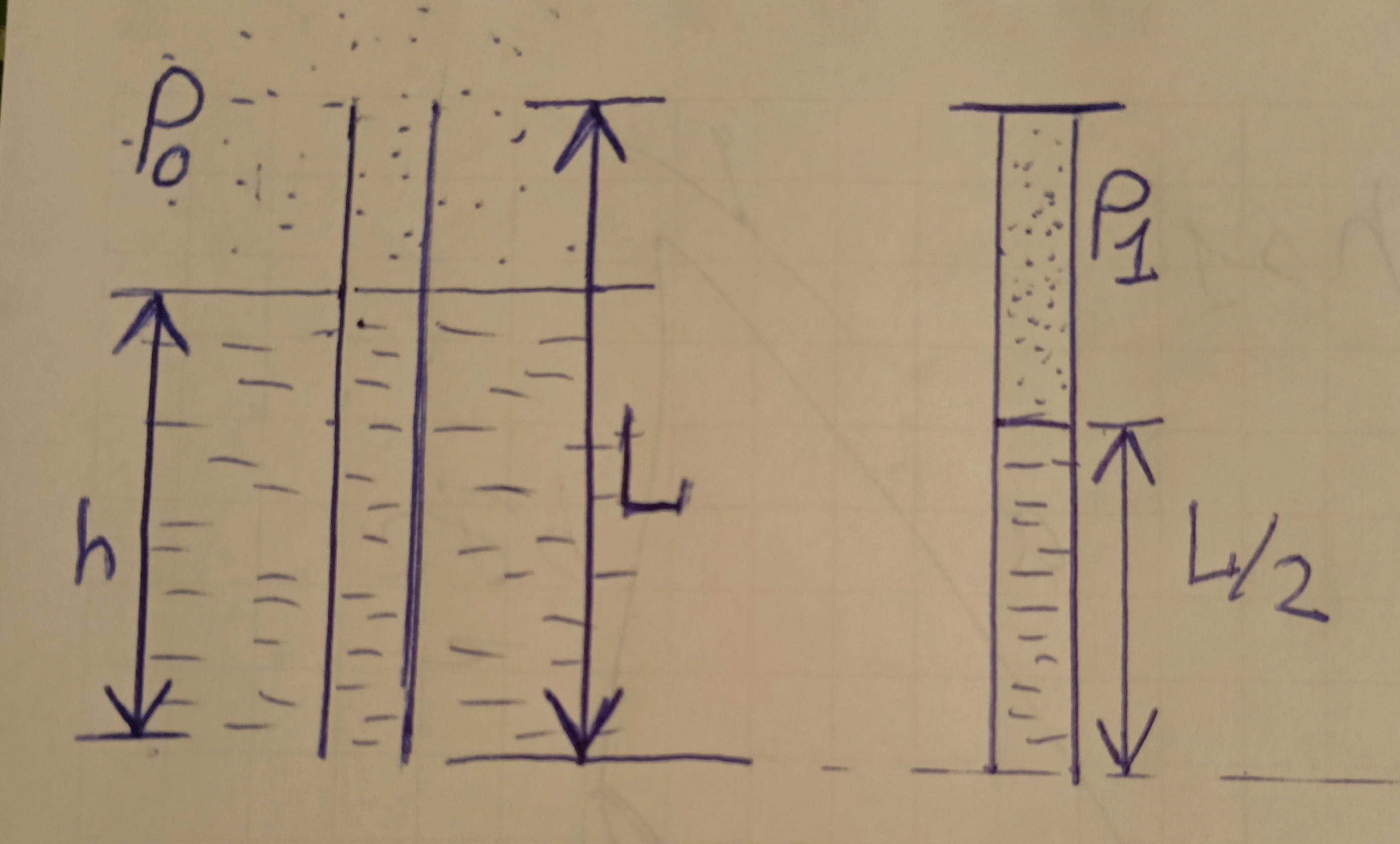
5.5.6. To what depth in a liquid of density $\rho$ must an open tube of length $L$ be submerged so that, after closing the upper opening, a column of liquid of height $L/2$ can be withdrawn? Atmospheric pressure is $p_0$.
Solution
For problem $5.5.6$
Let $h$ be the submerged depth of the tube. Since the tube is open while being submerged, the air inside remains at atmospheric pressure $p_0$, and the liquid level inside the tube aligns with the liquid level outside. Thus, the initial length of the trapped air column is $L - h$, and its initial volume is $V_0 = (L-h)S$, where $S$ is the cross-sectional area of the tube.
When the top of the tube is closed and it is pulled out of the liquid, a liquid column of height $L/2$ remains inside. This means the trapped air now occupies a length of $L/2$, giving a final volume $V_1 = \frac{L}{2}S$.
Let $p_1$ be the final pressure of the trapped air. The liquid column withdrawn is in equilibrium, so the downward forces (gravity and air pressure inside) must balance the upward force (atmospheric pressure from below): $$mg + p_1 S = p_0 S$$ $$\rho \frac{L}{2} g S + p_1 S = p_0 S$$ $$p_1 = p_0 - \frac{1}{2}\rho g L$$
Assuming the temperature remains constant, we can apply the Boyle-Mariotte law to the trapped air: $$p_0 V_0 = p_1 V_1$$ $$p_0 (L - h) S = p_1 \frac{L}{2} S$$ $$p_1 = p_0 \frac{2(L - h)}{L}$$
Equating the two expressions for $p_1$: $$p_0 \frac{2(L - h)}{L} = p_0 - \frac{1}{2}\rho g L$$ $$2p_0 - \frac{2p_0 h}{L} = p_0 - \frac{1}{2}\rho g L$$
Rearranging the terms (and correcting the sign error from the handwritten notes): $$\frac{2p_0 h}{L} = p_0 + \frac{1}{2}\rho g L$$ $$h = \frac{L}{2p_0} \left( p_0 + \frac{1}{2}\rho g L \right)$$ $$h = \frac{L}{2} + \frac{\rho g L^2}{4p_0} = \frac{L}{2} \left( 1 + \frac{\rho g L}{2p_0} \right)$$
Answer
$$h = \frac{L}{2} \left( 1 + \frac{\rho g L}{2p_0} \right)$$