New solution

en/2.3.6.md
+81 −0
| @@ -0,0 +1,81 @@ | |||
| + | ### Statement | ||
| + | |||
| + | $2.3.6.$ [Insert the problem statement] | ||
| + | |||
| + | ### Solution | ||
| + | |||
| + | ### Statement | ||
| + | |||
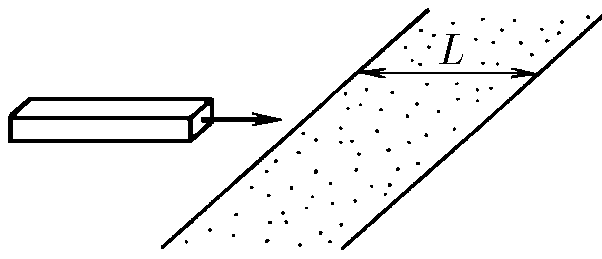
| + | $2.3.6.$ A uniform block sliding on a smooth horizontal surface enters a rough section of this surface of width $L$, the friction coefficient of which is $\mu$. At what initial velocity will it overcome this section? | ||
| + | |||
| + |  | ||
| + | |||
| + | ### Solution | ||
| + | |||
| + | #### Approach 1: Point Mass Approximation ($l \ll L$) | ||
| + | |||
| + | If we assume the length of the block $l$ is negligibly small compared to the width of the rough section $L$ ($l \ll L$), we can treat the block as a point mass. | ||
| + | |||
| + | In this case, a constant sliding friction force acts on the entire mass of the block throughout its motion over the rough patch: | ||
| + | $$F_{fr} = \mu mg$$ | ||
| + | |||
| + | By the work-energy theorem, the change in kinetic energy equals the work done by friction. To just overcome the section, the final velocity should be zero at distance $L$: | ||
| + | $$\Delta K = A_{fr}$$ | ||
| + | $$0 - \frac{mv_0^2}{2} = -F_{fr} L$$ | ||
| + | $$\frac{mv_0^2}{2} = \mu mgL$$ | ||
| + | |||
| + | Canceling the mass $m$ and expressing the initial velocity $v_0$, we get the condition for passing the strip: | ||
| + | $$v_0 \ge \sqrt{2\mu gL}$$ | ||
| + | |||
| + | --- | ||
| + | |||
| + | #### Approach 2: Extended Body Analysis | ||
| + | |||
| + | Now let us solve the problem rigorously, taking into account the actual length of the block $l$ (assuming $l \le L$ for simplicity) and its uniform linear mass density $\lambda = \frac{m}{l}$. | ||
| + | |||
| + | The movement of the block across the rough patch consists of three distinct stages, during which the friction force is not constant: | ||
| + | |||
| + | **1. Entering the rough section:** | ||
| + | As the block slides onto the rough surface by a distance $x$ (where $0 \le x \le l$), only a fraction of its mass is on the patch. | ||
| + | The friction force increases linearly: | ||
| + | $$F_1(x) = \mu (\lambda x) g = \mu \frac{m}{l} g x$$ | ||
| + | The work done by friction during this stage is: | ||
| + | $$A_1 = \int_0^l -F_1(x) \, dx = -\mu \frac{m}{l} g \int_0^l x \, dx = -\frac{1}{2} \mu mgl$$ | ||
| + | |||
| + | **2. Moving entirely on the rough section:** | ||
| + | The block is now fully on the patch and moves a distance of $(L - l)$. The entire mass is subject to friction, so the force is constant: | ||
| + | $$F_2 = \mu mg$$ | ||
| + | The work done during this stage is: | ||
| + | $$A_2 = -F_2(L - l) = -\mu mg(L - l)$$ | ||
| + | |||
| + | **3. Exiting the rough section:** | ||
| + | The block begins to slide off the patch. Let $y$ be the distance the front of the block has traveled beyond the rough section ($0 \le y \le l$). The length of the block still remaining on the patch is $(l - y)$. | ||
| + | The friction force decreases linearly: | ||
| + | $$F_3(y) = \mu \lambda (l - y) g = \mu \frac{m}{l} g (l - y)$$ | ||
| + | The work done by friction as it exits is: | ||
| + | $$A_3 = \int_0^l -F_3(y) \, dy = -\mu \frac{m}{l} g \int_0^l (l - y) \, dy = -\frac{1}{2} \mu mgl$$ | ||
| + | |||
| + | **Total Work:** | ||
| + | Summing the work done across all three stages gives the total work done by friction: | ||
| + | $$A_{total} = A_1 + A_2 + A_3$$ | ||
| + | $$A_{total} = -\frac{1}{2}\mu mgl - \mu mg(L - l) - \frac{1}{2}\mu mgl$$ | ||
| + | $$A_{total} = -\mu mgl - \mu mgL + \mu mgl = -\mu mgL$$ | ||
| + | |||
| + | Applying the work-energy theorem for the total displacement: | ||
| + | $$0 - \frac{mv_0^2}{2} = -\mu mgL$$ | ||
| + | $$v_0 \ge \sqrt{2\mu gL}$$ | ||
| + | |||
| + | --- | ||
| + | |||
| + | #### Why the Results Match | ||
| + | |||
| + | Even though the friction force on an extended body is variable (increasing as it enters and decreasing as it exits), the final result is identical to the point mass approximation. | ||
| + | |||
| + | Physically, the "missing" work done by friction when the block is entering the patch (because the force is ramping up) is exactly compensated by the "extra" work done by friction as the block exits the patch (because the force is ramping down). The total work done strictly depends on the displacement of the center of mass over the frictional region, meaning the point mass assumption serves as a perfectly valid and mathematically sound shortcut. | ||
| + | |||
| + | #### Answer | ||
| + | $$v_0 \ge \sqrt{2\mu gL}$$ | ||
| + | |||
| + | #### Answer | ||
| + | |||
| + | [Insert a concise answer or boxed result] | ||
| @@ -0,0 +1,81 @@ | |||
| ### Statement | |||
| $2.3.6.$ [Insert the problem statement] | |||
| ### Solution | |||
| ### Statement | |||
| $2.3.6.$ A uniform block sliding on a smooth horizontal surface enters a rough section of this surface of width $L$, the friction coefficient of which is $\mu$. At what initial velocity will it overcome this section? | |||
|  | |||
| ### Solution | |||
| #### Approach 1: Point Mass Approximation ($l \ll L$) | |||
| If we assume the length of the block $l$ is negligibly small compared to the width of the rough section $L$ ($l \ll L$), we can treat the block as a point mass. | |||
| In this case, a constant sliding friction force acts on the entire mass of the block throughout its motion over the rough patch: | |||
| $$F_{fr} = \mu mg$$ | |||
| By the work-energy theorem, the change in kinetic energy equals the work done by friction. To just overcome the section, the final velocity should be zero at distance $L$: | |||
| $$\Delta K = A_{fr}$$ | |||
| $$0 - \frac{mv_0^2}{2} = -F_{fr} L$$ | |||
| $$\frac{mv_0^2}{2} = \mu mgL$$ | |||
| Canceling the mass $m$ and expressing the initial velocity $v_0$, we get the condition for passing the strip: | |||
| $$v_0 \ge \sqrt{2\mu gL}$$ | |||
| --- | |||
| #### Approach 2: Extended Body Analysis | |||
| Now let us solve the problem rigorously, taking into account the actual length of the block $l$ (assuming $l \le L$ for simplicity) and its uniform linear mass density $\lambda = \frac{m}{l}$. | |||
| The movement of the block across the rough patch consists of three distinct stages, during which the friction force is not constant: | |||
| **1. Entering the rough section:** | |||
| As the block slides onto the rough surface by a distance $x$ (where $0 \le x \le l$), only a fraction of its mass is on the patch. | |||
| The friction force increases linearly: | |||
| $$F_1(x) = \mu (\lambda x) g = \mu \frac{m}{l} g x$$ | |||
| The work done by friction during this stage is: | |||
| $$A_1 = \int_0^l -F_1(x) \, dx = -\mu \frac{m}{l} g \int_0^l x \, dx = -\frac{1}{2} \mu mgl$$ | |||
| **2. Moving entirely on the rough section:** | |||
| The block is now fully on the patch and moves a distance of $(L - l)$. The entire mass is subject to friction, so the force is constant: | |||
| $$F_2 = \mu mg$$ | |||
| The work done during this stage is: | |||
| $$A_2 = -F_2(L - l) = -\mu mg(L - l)$$ | |||
| **3. Exiting the rough section:** | |||
| The block begins to slide off the patch. Let $y$ be the distance the front of the block has traveled beyond the rough section ($0 \le y \le l$). The length of the block still remaining on the patch is $(l - y)$. | |||
| The friction force decreases linearly: | |||
| $$F_3(y) = \mu \lambda (l - y) g = \mu \frac{m}{l} g (l - y)$$ | |||
| The work done by friction as it exits is: | |||
| $$A_3 = \int_0^l -F_3(y) \, dy = -\mu \frac{m}{l} g \int_0^l (l - y) \, dy = -\frac{1}{2} \mu mgl$$ | |||
| **Total Work:** | |||
| Summing the work done across all three stages gives the total work done by friction: | |||
| $$A_{total} = A_1 + A_2 + A_3$$ | |||
| $$A_{total} = -\frac{1}{2}\mu mgl - \mu mg(L - l) - \frac{1}{2}\mu mgl$$ | |||
| $$A_{total} = -\mu mgl - \mu mgL + \mu mgl = -\mu mgL$$ | |||
| Applying the work-energy theorem for the total displacement: | |||
| $$0 - \frac{mv_0^2}{2} = -\mu mgL$$ | |||
| $$v_0 \ge \sqrt{2\mu gL}$$ | |||
| --- | |||
| #### Why the Results Match | |||
| Even though the friction force on an extended body is variable (increasing as it enters and decreasing as it exits), the final result is identical to the point mass approximation. | |||
| Physically, the "missing" work done by friction when the block is entering the patch (because the force is ramping up) is exactly compensated by the "extra" work done by friction as the block exits the patch (because the force is ramping down). The total work done strictly depends on the displacement of the center of mass over the frictional region, meaning the point mass assumption serves as a perfectly valid and mathematically sound shortcut. | |||
| #### Answer | |||
| $$v_0 \ge \sqrt{2\mu gL}$$ | |||
| #### Answer | |||
| [Insert a concise answer or boxed result] | |||