New solution

en/3.7.16.md
+13 −0
| @@ -0,0 +1,13 @@ | |||
| + | ### Statement | ||
| + | |||
| + | $3.7.16.$ [Insert the problem statement] | ||
| + | |||
| + | ### Solution | ||
| + | |||
| + |  | ||
| + | |||
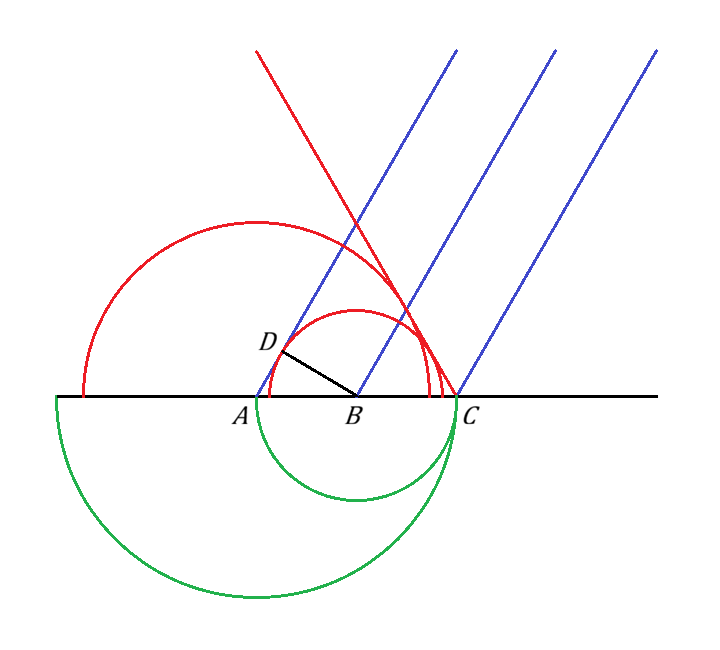
| + | The blue lines in the figure are the same wavefront at different equally-spaced time points. The incident angle is $\angle DAB=\alpha$. When the wavefront reaches the interface of the two media at $A$, $B$, $C$, these points become sources of new spherical waves. (The figure shows the moment when the wavefront has just reached $C$.) If the incident angle is critical, then the green spherical waves in the second medium are internally tangent and no envelope is formed. Since the red spherical wave originating from $B$ is tangent to the first blue line (as the speed of the wavefront equals the speed of sound) and the ratio of the radii of the red and green spherical waves is $c_1/c_2$, we have $\sin\alpha=BD/BA=c_1/c_2$. Thus, the critical angle is $\arcsin(c_1/c_2)$. | ||
| + | |||
| + | #### Answer | ||
| + | |||
| + | [Insert a concise answer or boxed result] | ||
| @@ -0,0 +1,13 @@ | |||
| ### Statement | |||
| $3.7.16.$ [Insert the problem statement] | |||
| ### Solution | |||
|  | |||
| The blue lines in the figure are the same wavefront at different equally-spaced time points. The incident angle is $\angle DAB=\alpha$. When the wavefront reaches the interface of the two media at $A$, $B$, $C$, these points become sources of new spherical waves. (The figure shows the moment when the wavefront has just reached $C$.) If the incident angle is critical, then the green spherical waves in the second medium are internally tangent and no envelope is formed. Since the red spherical wave originating from $B$ is tangent to the first blue line (as the speed of the wavefront equals the speed of sound) and the ratio of the radii of the red and green spherical waves is $c_1/c_2$, we have $\sin\alpha=BD/BA=c_1/c_2$. Thus, the critical angle is $\arcsin(c_1/c_2)$. | |||
| #### Answer | |||
| [Insert a concise answer or boxed result] | |||