Edits to “Statement”, “Solution”, “Answer”

en/3.7.15.md
+3 −3
| @@ -1,13 +1,13 @@ | |||
| ### Statement | |||
| − | $3.7.15.$ [Insert the problem statement] | ||
| + | $3.7.15.$ When an airplane flies at subsonic speed, the noise of its engines can be heard on the ground. When a plane flies by at supersonic speed, you will first hear a loud popping noise and then the noise of the engines. What is it related to? | ||
| ### Solution | |||
| − | 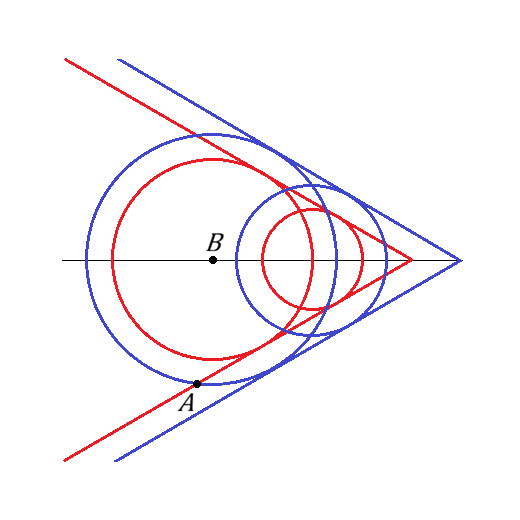 | ||
| Since the speed of the plane exceeds the speed of sound, a spherical wave emitted at a later time is not contained in another spherical wave emitted at an earlier time. As a result, an envelope (i.e. shock wave) of these spherical waves is formed in the shape of a cone. In the figure, the shock wave (red) reaches an observer at $A$ as a loud popping noise before a spherical wave (blue) emitted from $B$ arrives as the noise of the engines a short moment later, by which time the shock wave (blue) has already passed the observer. | |||
| #### Answer | |||
| − | [Insert a concise answer or boxed result] | ||
| + | See the solution. | ||
| @@ -1,13 +1,13 @@ | |||
| ### Statement | ### Statement | ||
| $3.7.15.$ [Insert the problem statement] | $3.7.15.$ When an airplane flies at subsonic speed, the noise of its engines can be heard on the ground. When a plane flies by at supersonic speed, you will first hear a loud popping noise and then the noise of the engines. What is it related to? | ||
| ### Solution | ### Solution | ||
|  | ||
| Since the speed of the plane exceeds the speed of sound, a spherical wave emitted at a later time is not contained in another spherical wave emitted at an earlier time. As a result, an envelope (i.e. shock wave) of these spherical waves is formed in the shape of a cone. In the figure, the shock wave (red) reaches an observer at $A$ as a loud popping noise before a spherical wave (blue) emitted from $B$ arrives as the noise of the engines a short moment later, by which time the shock wave (blue) has already passed the observer. | Since the speed of the plane exceeds the speed of sound, a spherical wave emitted at a later time is not contained in another spherical wave emitted at an earlier time. As a result, an envelope (i.e. shock wave) of these spherical waves is formed in the shape of a cone. In the figure, the shock wave (red) reaches an observer at $A$ as a loud popping noise before a spherical wave (blue) emitted from $B$ arrives as the noise of the engines a short moment later, by which time the shock wave (blue) has already passed the observer. | ||
| #### Answer | #### Answer | ||
| [Insert a concise answer or boxed result] | See the solution. | ||