13.2.15. a. Find the focal length of a biconvex lens with a radius of curvature of $30 \text{ cm}$, made of glass with a refractive index of $1.6$. What is the optical power of the lens?
b. One surface of a lens made of glass with a refractive index of $1.6$ is flat, the other is spherical. The optical power of the lens is $1 \text{ D}$. Determine the radius of curvature of the spherical surface of the lens.
Solution
The optical power of a thin lens $D$ and its focal length $F$ are calculated using the universal formula: $$D = \frac{1}{F} = \left(\frac{n_{\text{l}}}{n_{\text{m}}} - 1\right) \left( \pm \frac{1}{R_1} \pm \frac{1}{R_2} \right)$$ where $n_{\text{l}}$ is the refractive index of the lens material, and $n_{\text{m}}$ is the refractive index of the surrounding medium. The "$+$" sign in the brackets is used if the surface is convex, and the "$-$" sign if the surface is concave. The values of the radii of curvature $R_1$ and $R_2$ are substituted by their absolute values. Since the medium is not specified in the problem, we assume the lens is in air ($n_{\text{m}} = 1$). The refractive index of glass is $n_{\text{l}} = 1.6$.
Part a)
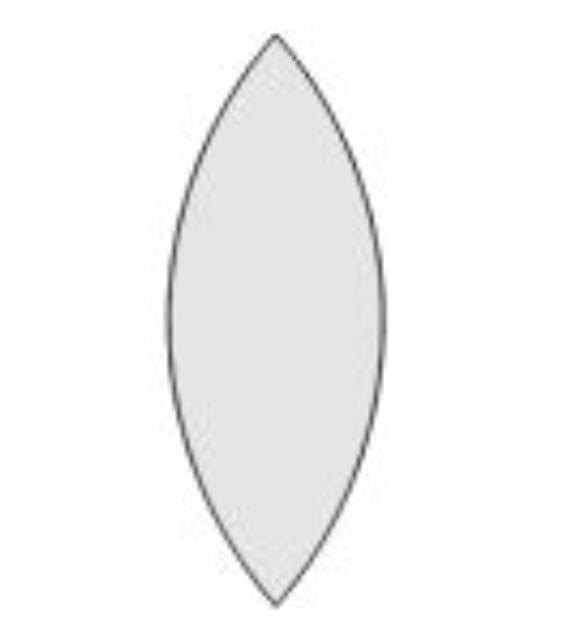
Biconvex lens
The lens is biconvex, so both of its surfaces are convex. We place a "$+$" sign before both terms with radii. According to the problem, $R_1 = R_2 = R = 0.3 \text{ m}$. Optical power of the lens: $$D = \left(\frac{n_{\text{l}}}{1} - 1\right) \left( \frac{1}{R} + \frac{1}{R} \right) = \frac{2(n_{\text{l}} - 1)}{R}$$ Substituting the values: $$D = \frac{2(1.6 - 1)}{0.3} = \frac{1.2}{0.3} = 4 \text{ D}$$ Focal length: $$F = \frac{1}{D} = \frac{1}{4} = 0.25 \text{ m} = 25 \text{ cm}$$
Part b)
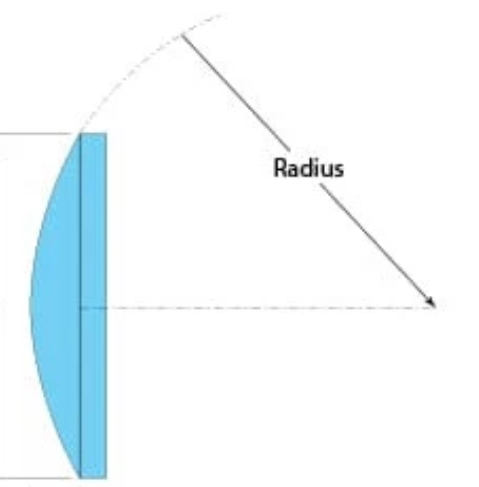
Plano-convex lens
The lens is plano-spherical. Since the optical power of the lens is positive ($D = 1 \text{ D} > 0$), the lens is converging. It follows that its spherical surface must be convex (if it were concave, the lens would be diverging). For a flat surface, the radius of curvature is $R_1 \to \infty$, so $\frac{1}{R_1} = 0$. Taking into account the "$+$" sign for the second, convex surface, the lens formula takes the form: $$D = (n_{\text{l}} - 1) \left( 0 + \frac{1}{R_2} \right) = \frac{n_{\text{l}} - 1}{R_2}$$ Expressing the required radius of curvature $R_2$: $$R_2 = \frac{n_{\text{l}} - 1}{D}$$ Substituting the values: $$R_2 = \frac{1.6 - 1}{1} = 0.6 \text{ m} = 60 \text{ cm}$$
Answer
a. $F = 0.25 \text{ m}$;$D = 4 \text{ D}$ b. $R = 0.6 \text{ m}$