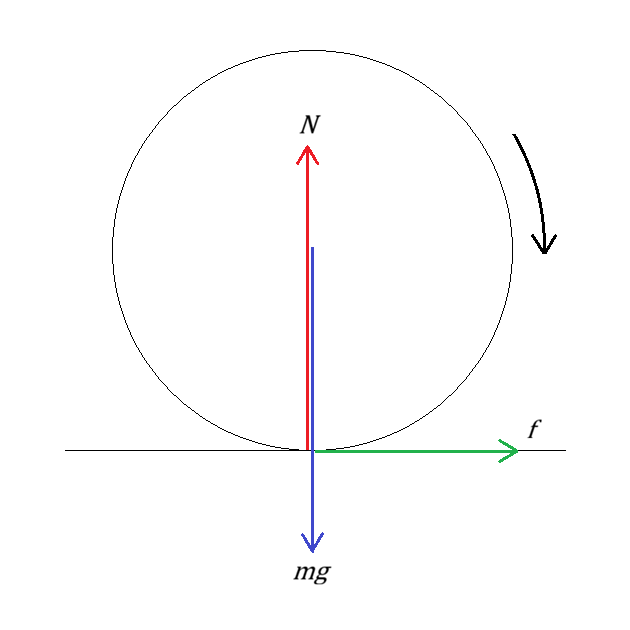
2.7.21∗. A thin ring of radius $R$ and mass $m$ was spun up to an angular velocity $\omega_0$ and placed vertically on a horizontal plane. How will the ring move if the coefficient of friction of the ring on the plane is equal to $\mu$? Determine the time dependence of the axis velocity and the angular velocity of rotation. After what time will the slippage stop? How much of the initial energy will be converted to heat?
Solution
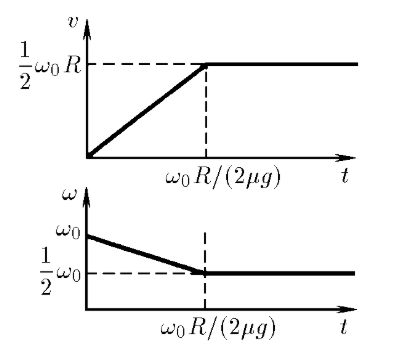
For problem $2.7.21$
The ring will roll without slipping when the speed of its center of mass $v$ is equal to $\omega R$, where $\omega$ is the angular speed of rotation of the ring around its axis. This is achieved by friction $f=\mu N=\mu mg$, which increases the ring's linear momentum and at the same time decreases its angular momentum. After time interval $t$, linear impulse from friction is $\mu mgt$, and $v=\mu gt$. Similarly, angular impulse from friction is $-\mu mgRt$, and
We also obtain the final speed of the center of mass $v_*=\omega_0R/2$ and the final angular speed of rotation of the ring around its axis $\omega_*=\omega_0/2$. Heat generated from lost kinetic energy is