| @@ -1,23 +1,17 @@ |
| ### Statement |
| ### Statement |
| |
| |
| $3.9.19.$ [Insert the problem statement] |
| |
| |
| |
| ### Solution |
| |
| |
| |
| ### Statement |
| |
| |
| |
| $3.9.19.$ Why is the hollow body of a violin and cello made figured? How does the tone of the sound depend on its dimensions? |
| $3.9.19.$ Why is the hollow body of a violin and cello made figured? How does the tone of the sound depend on its dimensions? |
| |
| |
| ### Solution |
| ### Solution |
| |
| |
| <b>1. Figured shape of the body:</b> |
| <b>1. Figured shape of the body:</b> |
| If the body had a simple, geometrically symmetrical shape (e.g., a parallelepiped, cylinder, or sphere), it would produce a small number of highly pronounced natural frequencies (standing waves). This would cause the instrument to act as a narrow-band filter: it would loudly resonate only on specific notes, while others would sound muffled. |
| If the body had a simple, geometrically symmetrical shape (e.g., a parallelepiped, cylinder, or sphere), it would produce a small number of highly pronounced natural frequencies (standing waves). This would cause the instrument to act as a narrow-band filter: it would loudly resonate only on specific notes, while others would sound muffled. |
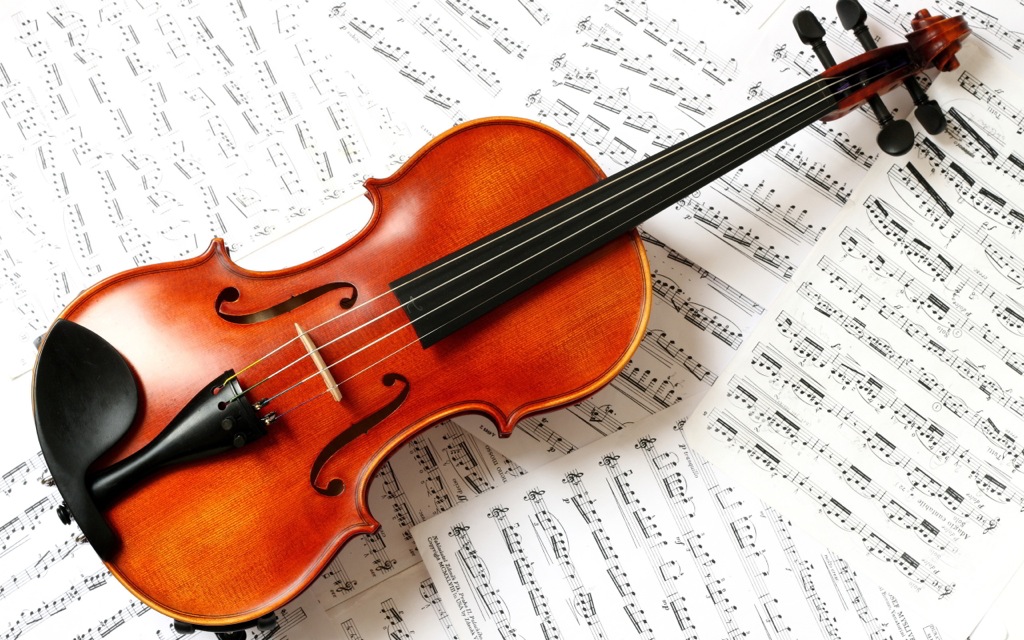
| The complex (figured) shape with non-parallel soundboards and curves breaks spatial symmetry. This creates a vast number of closely spaced resonant frequencies (vibration modes). As a result, the body acts as a broadband resonator that responds evenly to sounds of almost any frequency, making the tone of the instrument smooth and rich in overtones. |
| The complex (figured) shape with non-parallel soundboards and curves breaks spatial symmetry. This creates a vast number of closely spaced resonant frequencies (vibration modes). As a result, the body acts as a broadband resonator that responds evenly to sounds of almost any frequency, making the tone of the instrument smooth and rich in overtones. |
| |
| |
| |
|  |
| |
| |
| <b>2. Dependence of tone on dimensions:</b> |
| <b>2. Dependence of tone on dimensions:</b> |
| The body of the instrument acts as a volume acoustic resonator (Helmholtz resonator) and simultaneously as a system of vibrating plates. To form an effective standing wave, the linear dimension of the resonator $L$ must be comparable to the acoustic wavelength $\lambda$. |
| The body of the instrument acts as a volume acoustic resonator (Helmholtz resonator) and simultaneously as a system of vibrating plates. To form an effective standing wave, the linear dimension of the resonator $L$ must be comparable to the acoustic wavelength $\lambda$. |
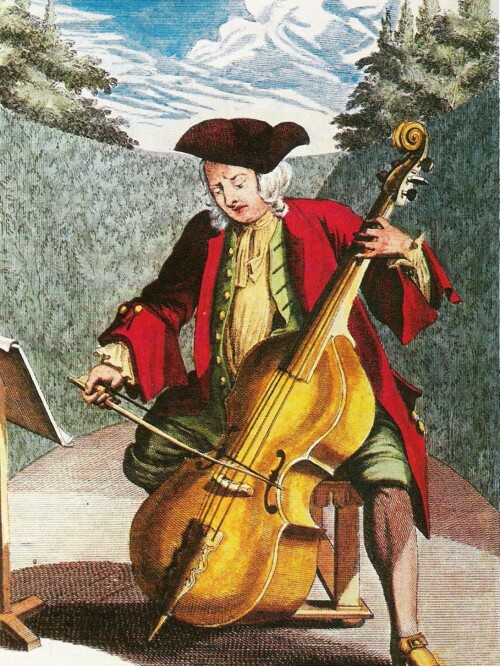
| Since the frequency $\nu$ and wavelength are related by $\nu = \frac{v}{\lambda}$ (where $v$ is the speed of sound), increasing the dimensions of the body allows it to support longer standing waves, which correspond to a **lower frequency**. Therefore, the larger the instrument and its internal volume, the more efficiently it radiates low-frequency acoustic waves, resulting in a lower (deeper) fundamental tone (compare a violin, a cello, and a double bass). |
| Since the frequency $\nu$ and wavelength are related by $\nu = \frac{v}{\lambda}$ (where $v$ is the speed of sound), increasing the dimensions of the body allows it to support longer standing waves, which correspond to a lower frequency. Therefore, the larger the instrument and its internal volume, the more efficiently it radiates low-frequency acoustic waves, resulting in a lower (deeper) fundamental tone (compare a violin, a cello, and a double bass). |
| |
| |
| #### Answer |
|  |
| |
| |
| [Insert a concise answer or boxed result] |
| |
