$13.1.20^*.$ What shape should the reflecting surface be so that it collects all parallel rays at one point, regardless of the beam width?
### Solution
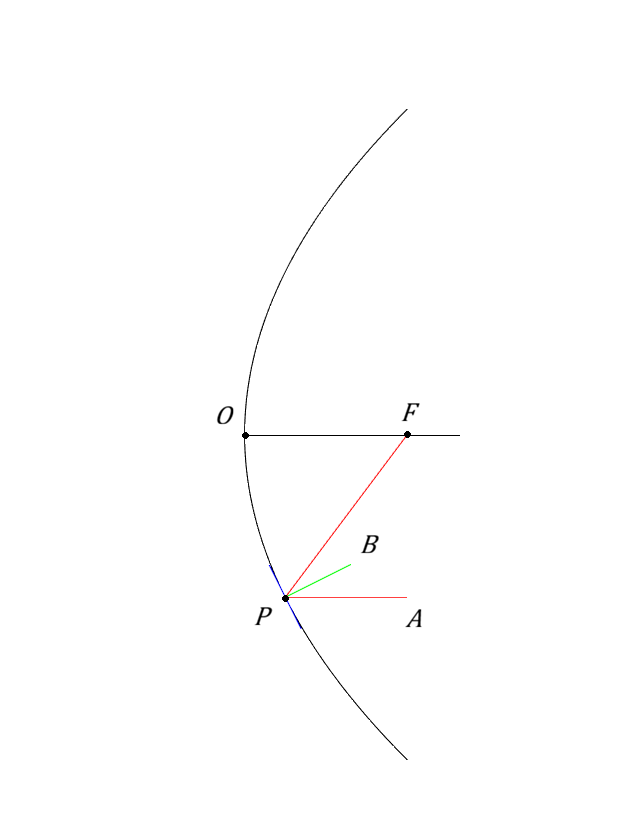
We show that a parabolic surface will collect all light rays parallel to its axis of symmetry to its focal point as follows. Suppose that the equation of the parabola in the figure is $y^2=4cx$, so its focal point is at $F(c,0)$. Let $P(a^2/(4c),a)$ be any point on the parabola. (In the figure, $a$ is negative.) Then the slope of the tangent line (shown in blue) at $P$ is
Consequently, $\angle APF=2\cdot\angle APB$; that is, the red lines obey the law of reflection. Therefore, an arbitrary light ray parallel to the axis of symmetry of the parabola is collected at its focal point.
+
### Analytical Derivation using Fermat's Principle
+
+
To rigorously prove that the shape must be a parabola without assuming it beforehand, we can use Fermat's Principle. For all parallel rays to converge at a single focal point in the same phase, the total optical path length of each ray from the incident flat wavefront to the focus must be constant.
+
+
Let us set up the coordinate system to match the geometric proof. We place the vertex of the required reflecting surface at the origin $O(0,0)$ and the unknown focal point at $F(c,0)$ on the $x$-axis (where $c > 0$).
+
For the rays to strike the concave side of the surface, let the parallel beam travel from right to left (in the $-x$ direction). We choose a vertical line $x = H$ (where $H > c$, far to the right) as our initial flat wavefront.
+
+
Let us consider two rays:
+
1. The central ray traveling along the $x$-axis. It travels a distance $H$ from the wavefront to the vertex $(0,0)$, and then reflects back to the focus $F(c,0)$, traveling an additional distance $c$. Its total optical path is:
+
$$L_0 = H + c$$
+
2. An arbitrary ray striking the surface at point $P(x, y)$. It travels a distance $(H - x)$ from the wavefront to the surface, and then reflects to the focus. The distance from $P(x, y)$ to $F(c, 0)$ is $\sqrt{(x-c)^2 + y^2}$. Its total path is:
+
$$L = (H - x) + \sqrt{(x-c)^2 + y^2}$$
+
+
For perfect focusing, Fermat's principle requires these path lengths to be equal ($L = L_0$):
+
$$(H - x) + \sqrt{(x-c)^2 + y^2} = H + c$$
+
+
Cancel $H$ and move $x$ to the right side:
+
$$\sqrt{(x-c)^2 + y^2} = x + c$$
+
+
(Notice how this equation algebraically states that the distance to the focus on the left equals the distance to the line $x = -c$ on the right — the directrix naturally emerges here!)
+
+
Squaring both sides to eliminate the square root:
+
$$(x-c)^2 + y^2 = (x+c)^2$$
+
$$x^2 - 2cx + c^2 + y^2 = x^2 + 2cx + c^2$$
+
+
Canceling $x^2$ and $c^2$ on both sides yields:
+
$$-2cx + y^2 = 2cx \implies y^2 = 4cx$$
+
+
This algebraic derivation naturally yields the exact canonical equation of the parabola ($y^2 = 4cx$) used in the proof above. This proves from first principles that a paraboloid of revolution is the only unique surface shape that focuses parallel rays to a single point.
+
+
#### Answer
Parabolic surface
### Statement
### Statement
$13.1.20^*.$ What shape should the reflecting surface be so that it collects all parallel rays at one point, regardless of the beam width?
$13.1.20^*.$ What shape should the reflecting surface be so that it collects all parallel rays at one point, regardless of the beam width?
### Solution
### Solution


We show that a parabolic surface will collect all light rays parallel to its axis of symmetry to its focal point as follows. Suppose that the equation of the parabola in the figure is $y^2=4cx$, so its focal point is at $F(c,0)$. Let $P(a^2/(4c),a)$ be any point on the parabola. (In the figure, $a$ is negative.) Then the slope of the tangent line (shown in blue) at $P$ is
We show that a parabolic surface will collect all light rays parallel to its axis of symmetry to its focal point as follows. Suppose that the equation of the parabola in the figure is $y^2=4cx$, so its focal point is at $F(c,0)$. Let $P(a^2/(4c),a)$ be any point on the parabola. (In the figure, $a$ is negative.) Then the slope of the tangent line (shown in blue) at $P$ is
Consequently, $\angle APF=2\cdot\angle APB$; that is, the red lines obey the law of reflection. Therefore, an arbitrary light ray parallel to the axis of symmetry of the parabola is collected at its focal point.
Consequently, $\angle APF=2\cdot\angle APB$; that is, the red lines obey the law of reflection. Therefore, an arbitrary light ray parallel to the axis of symmetry of the parabola is collected at its focal point.
### Analytical Derivation using Fermat's Principle
To rigorously prove that the shape must be a parabola without assuming it beforehand, we can use Fermat's Principle. For all parallel rays to converge at a single focal point in the same phase, the total optical path length of each ray from the incident flat wavefront to the focus must be constant.
Let us set up the coordinate system to match the geometric proof. We place the vertex of the required reflecting surface at the origin $O(0,0)$ and the unknown focal point at $F(c,0)$ on the $x$-axis (where $c > 0$).
For the rays to strike the concave side of the surface, let the parallel beam travel from right to left (in the $-x$ direction). We choose a vertical line $x = H$ (where $H > c$, far to the right) as our initial flat wavefront.
Let us consider two rays:
1. The central ray traveling along the $x$-axis. It travels a distance $H$ from the wavefront to the vertex $(0,0)$, and then reflects back to the focus $F(c,0)$, traveling an additional distance $c$. Its total optical path is:
$$L_0 = H + c$$
2. An arbitrary ray striking the surface at point $P(x, y)$. It travels a distance $(H - x)$ from the wavefront to the surface, and then reflects to the focus. The distance from $P(x, y)$ to $F(c, 0)$ is $\sqrt{(x-c)^2 + y^2}$. Its total path is:
$$L = (H - x) + \sqrt{(x-c)^2 + y^2}$$
For perfect focusing, Fermat's principle requires these path lengths to be equal ($L = L_0$):
$$(H - x) + \sqrt{(x-c)^2 + y^2} = H + c$$
Cancel $H$ and move $x$ to the right side:
$$\sqrt{(x-c)^2 + y^2} = x + c$$
(Notice how this equation algebraically states that the distance to the focus on the left equals the distance to the line $x = -c$ on the right — the directrix naturally emerges here!)
Squaring both sides to eliminate the square root:
$$(x-c)^2 + y^2 = (x+c)^2$$
$$x^2 - 2cx + c^2 + y^2 = x^2 + 2cx + c^2$$
Canceling $x^2$ and $c^2$ on both sides yields:
$$-2cx + y^2 = 2cx \implies y^2 = 4cx$$
This algebraic derivation naturally yields the exact canonical equation of the parabola ($y^2 = 4cx$) used in the proof above. This proves from first principles that a paraboloid of revolution is the only unique surface shape that focuses parallel rays to a single point.
