| @@ -1,33 +1,33 @@ |
| ### Statement |
| ### Statement |
| |
| |
| $11.2.15.$ [Insert the problem statement] |
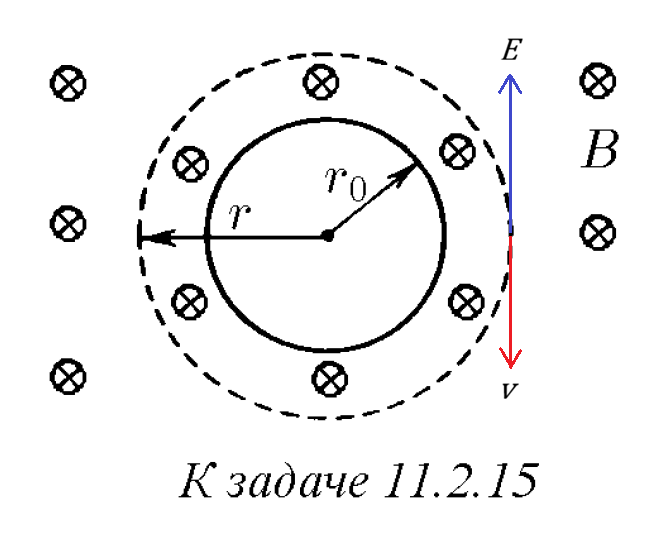
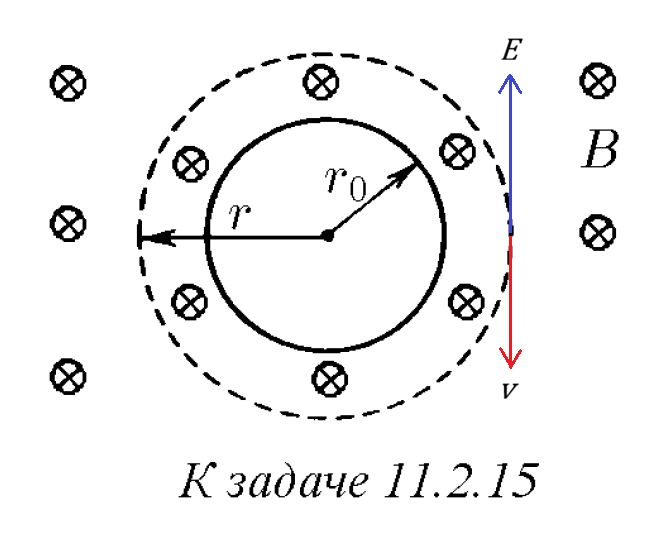
| $11.2.15.$ Outside a cylinder of radius $r_0$, the induction of a uniform magnetic field increases linearly in time: $B=\alpha t$. How should the induction of a uniform magnetic field inside the cylinder change over time so that the electron moves along a circle of radius $r>r_0$? At $t=0$, the electron is at rest. |
| |
| |
| ### Solution |
| ### Solution |
| |
| |
|  |
|  |
| |
| |
| The magnetic force $evB$ provides centripetal acceleration to the electron, so |
| The magnetic force $evB$ provides centripetal acceleration to the electron, so |
| |
| |
| \[evB=\frac{mv^2}{r}\qquad\Rightarrow\qquad v=\frac{eBr}{m},\] |
| \[evB=\frac{mv^2}{r}\qquad\Rightarrow\qquad v=\frac{eBr}{m},\] |
| |
| |
| where $-e$, $m$, and $v$ are the charge, mass, and speed of the electron around the circle, respectively. Since $B=\alpha t$, the tangential acceleration of the electron |
| where $-e$, $m$, and $v$ are the charge, mass, and speed of the electron around the circle, respectively. Since $B=\alpha t$, the tangential acceleration of the electron is |
| |
| |
| \[a=\frac{dv}{dt}=\frac{d}{dt}\left(\frac{eBr}{m}\right)=\frac{e\alpha r}{m}\] |
| \[a=\frac{dv}{dt}=\frac{d}{dt}\left(\frac{eBr}{m}\right)=\frac{e\alpha r}{m}.\] |
| |
| |
| It is caused by induced electric field $E$ as a result of changing magnetic flux. Thus, |
| It is caused by induced electric field $E$ as a result of changing magnetic flux. Thus, |
| |
| |
| \[a=\frac{eE}{m}\qquad\Rightarrow\qquad E=\alpha r.\] |
| \[a=\frac{eE}{m}\qquad\Rightarrow\qquad E=\alpha r.\] |
| |
| |
| Let $B'$ be the magnetic field inside the cylinder in the same direction as $B$. By the law of induction, |
| Let $B'$ be the magnetic field inside the cylinder in the same direction as $B$. By the law of induction, |
| |
| |
| \[E\cdot2\pi r=\frac{d}{dt}(B'\cdot\pi r_0^2+B\cdot\pi(r^2-r_0^2)).\] |
| \[E\cdot2\pi r=\frac{d}{dt}[B'\cdot\pi r_0^2+B\cdot\pi(r^2-r_0^2)].\] |
| |
| |
| As a result, |
| As a result, |
| |
| |
| \[\frac{dB'}{dt}=\alpha\left[\left(\frac{r}{r_0}\right)^2+1\right].\] |
| \[\frac{dB'}{dt}=\alpha\left[\left(\frac{r}{r_0}\right)^2+1\right].\] |
| |
| |
| Since $B'$ is initially zero, we have $B'=\alpha t[(r/r_0)^2+1]$. |
| Since $B'$ is initially zero, we have $B'=\alpha[(r/r_0)^2+1]t$. |
| |
| |
| #### Answer |
| #### Answer |
| |
| |
| [Insert a concise answer or boxed result] |
| $\alpha[(r/r_0)^2+1]t$ |
