New solution

en/4.3.17.md
+15 −0
| @@ -0,0 +1,15 @@ | |||
| + | ### Statement | ||
| + | |||
| + | $4.3.17.$ [Insert the problem statement] | ||
| + | |||
| + | ### Solution | ||
| + | |||
| + |  | ||
| + | |||
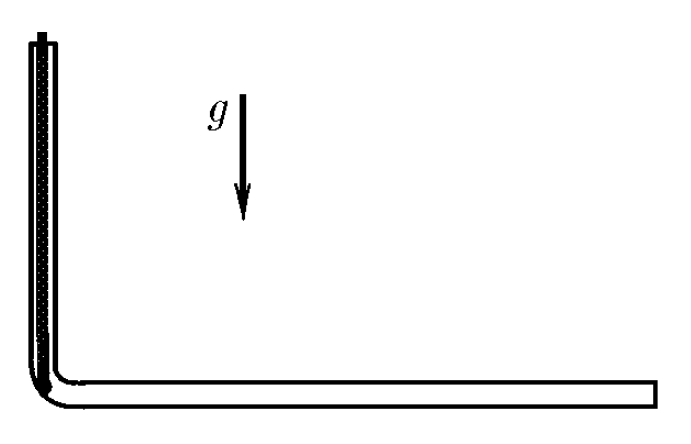
| + | If the fluid is inviscid and incompressible, then this problem is equivalent to Problem 3.3.7, where a rope is released into a smooth L-shaped tube whose cross-section is slightly larger than the rope. (Indeed, the figure used here is from that problem, because the horizontal part is sufficiently long.) Let $h$ be the height of the vertical part of the fluid. (We may think of $h$ as the distance of the right (i.e. lower) endpoint of the fluid from where it will be when the fluid is completely horizontal.) The mass of the vertical part of the fluid is $\rho ah$, where $a$ is the area of the cross-section of the tube, and its center of mass is $h/2$ high. Consequently, the gravitational potential energy of the fluid $\rho agh^2/2=mgh^2/(2l)$, where $m$ is the mass of the entire fluid, has the form $m\omega^2h^2/2$ of simple harmonic motion with $\omega=\sqrt{g/l}$. Thus, we may consider the motion of the fluid from its initial position to when it is completely horizontal as a quarter period $\pi/(2\omega)=\pi\sqrt{l/g}/2$ of the SHM, so $h=l\cos(\sqrt{g/l}t)$ for $0\le t\le\pi\sqrt{l/g}/2$. | ||
| + | |||
| + | When $h=l/2$, the acceleration of the fluid is $\omega^2h=g/2$. As a result, the rightward pressure force at the distance $x\le l/2$ from the right endpoint of the fluid is half the weight $\rho axg$ of the fluid of length $x$, so the pressure is $\rho gx/2$. On the other hand, the fluid of length $x$ from the left (i.e. upper) endpoint of the fluid experiences gravity $\rho axg$ and the upward pressure force which must be a half of $\rho axg$ in order for the fluid to move with acceleration $g/2$, so the pressure is $\rho gx/2$ as well. | ||
| + | |||
| + | #### Answer | ||
| + | |||
| + | [Insert a concise answer or boxed result] | ||
| @@ -0,0 +1,15 @@ | |||
| ### Statement | |||
| $4.3.17.$ [Insert the problem statement] | |||
| ### Solution | |||
|  | |||
| If the fluid is inviscid and incompressible, then this problem is equivalent to Problem 3.3.7, where a rope is released into a smooth L-shaped tube whose cross-section is slightly larger than the rope. (Indeed, the figure used here is from that problem, because the horizontal part is sufficiently long.) Let $h$ be the height of the vertical part of the fluid. (We may think of $h$ as the distance of the right (i.e. lower) endpoint of the fluid from where it will be when the fluid is completely horizontal.) The mass of the vertical part of the fluid is $\rho ah$, where $a$ is the area of the cross-section of the tube, and its center of mass is $h/2$ high. Consequently, the gravitational potential energy of the fluid $\rho agh^2/2=mgh^2/(2l)$, where $m$ is the mass of the entire fluid, has the form $m\omega^2h^2/2$ of simple harmonic motion with $\omega=\sqrt{g/l}$. Thus, we may consider the motion of the fluid from its initial position to when it is completely horizontal as a quarter period $\pi/(2\omega)=\pi\sqrt{l/g}/2$ of the SHM, so $h=l\cos(\sqrt{g/l}t)$ for $0\le t\le\pi\sqrt{l/g}/2$. | |||
| When $h=l/2$, the acceleration of the fluid is $\omega^2h=g/2$. As a result, the rightward pressure force at the distance $x\le l/2$ from the right endpoint of the fluid is half the weight $\rho axg$ of the fluid of length $x$, so the pressure is $\rho gx/2$. On the other hand, the fluid of length $x$ from the left (i.e. upper) endpoint of the fluid experiences gravity $\rho axg$ and the upward pressure force which must be a half of $\rho axg$ in order for the fluid to move with acceleration $g/2$, so the pressure is $\rho gx/2$ as well. | |||
| #### Answer | |||
| [Insert a concise answer or boxed result] | |||