New solution

en/8.4.8.md
+27 −0
| @@ -0,0 +1,27 @@ | |||
| + | ### Statement | ||
| + | |||
| + | $8.4.8.$ [Insert the problem statement] | ||
| + | |||
| + | ### Solution | ||
| + | |||
| + |  | ||
| + | |||
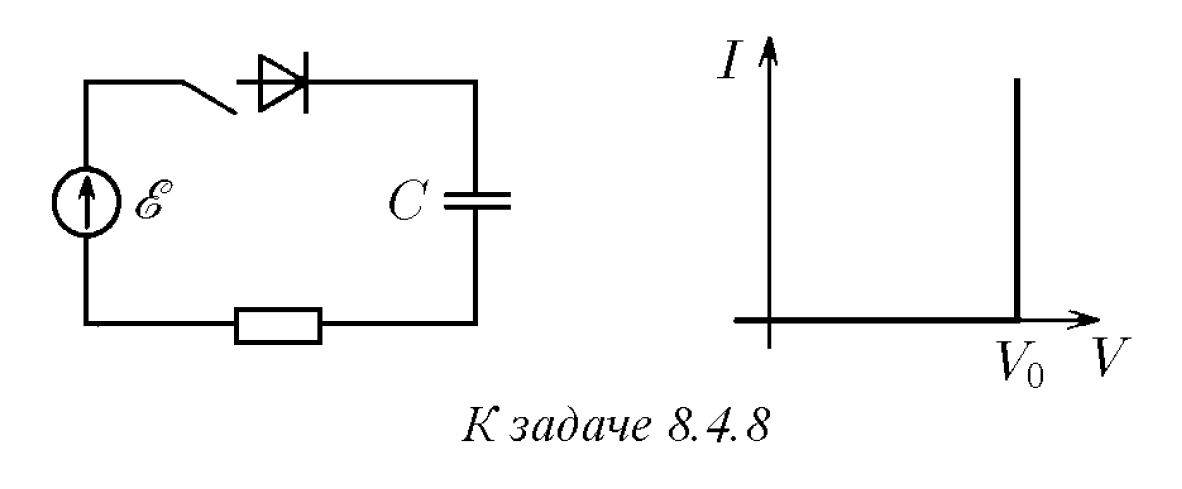
| + | Clearly, if $\mathcal{E}\le V_0$, then there is no current in the circuit and hence no heat generated in the resistor. If $\mathcal{E}>V_0$, then the charge $q$ collected on the capacitor satisfies the differential equation | ||
| + | |||
| + | \[\dot qR+\frac{q}{C}=\mathcal{E}-V_0,\] | ||
| + | |||
| + | where the terms on the left are voltage drops across the resistor and the capacitor, respectively. Solving this equation subject to the condition that $q$ is initially zero, we get | ||
| + | |||
| + | \[q=C(\mathcal{E}-V_0)(1-e^{-t/(RC)}),\] | ||
| + | |||
| + | so the current in the circuit is | ||
| + | |||
| + | \[I=\dot q=\frac{\mathcal{E}-V_0}{R}\cdot e^{-t/(RC)}.\] | ||
| + | |||
| + | Thus, the heat generated in the resistor is | ||
| + | |||
| + | \[\int_0^\infty I^2R\,dt=\frac{(\mathcal{E}-V_0)^2}{R}\int_0^\infty e^{-2t/(RC)}=\frac{C(\mathcal{E}-V_0)^2}{2}.\] | ||
| + | |||
| + | #### Answer | ||
| + | |||
| + | [Insert a concise answer or boxed result] | ||
| @@ -0,0 +1,27 @@ | |||
| ### Statement | |||
| $8.4.8.$ [Insert the problem statement] | |||
| ### Solution | |||
|  | |||
| Clearly, if $\mathcal{E}\le V_0$, then there is no current in the circuit and hence no heat generated in the resistor. If $\mathcal{E}>V_0$, then the charge $q$ collected on the capacitor satisfies the differential equation | |||
| \[\dot qR+\frac{q}{C}=\mathcal{E}-V_0,\] | |||
| where the terms on the left are voltage drops across the resistor and the capacitor, respectively. Solving this equation subject to the condition that $q$ is initially zero, we get | |||
| \[q=C(\mathcal{E}-V_0)(1-e^{-t/(RC)}),\] | |||
| so the current in the circuit is | |||
| \[I=\dot q=\frac{\mathcal{E}-V_0}{R}\cdot e^{-t/(RC)}.\] | |||
| Thus, the heat generated in the resistor is | |||
| \[\int_0^\infty I^2R\,dt=\frac{(\mathcal{E}-V_0)^2}{R}\int_0^\infty e^{-2t/(RC)}=\frac{C(\mathcal{E}-V_0)^2}{2}.\] | |||
| #### Answer | |||
| [Insert a concise answer or boxed result] | |||