Edits to “Statement”, “Solution”, “Answer”

en/3.7.12.md
+5 −5
| @@ -1,10 +1,10 @@ | |||
| ### Statement | |||
| − | $3.7.12.$ [Insert the problem statement] | ||
| + | $3.7.12.$ According to the Huygens principle, each section of the wave front is the source of secondary spherical waves. The envelope of the secondary waves gives a new wave front. Based on the Huygens principle, show that in a homogeneous medium, a flat sound wave front travels at the speed of sound. How does a cylindrical front propagate? | ||
| ### Solution | |||
| − | 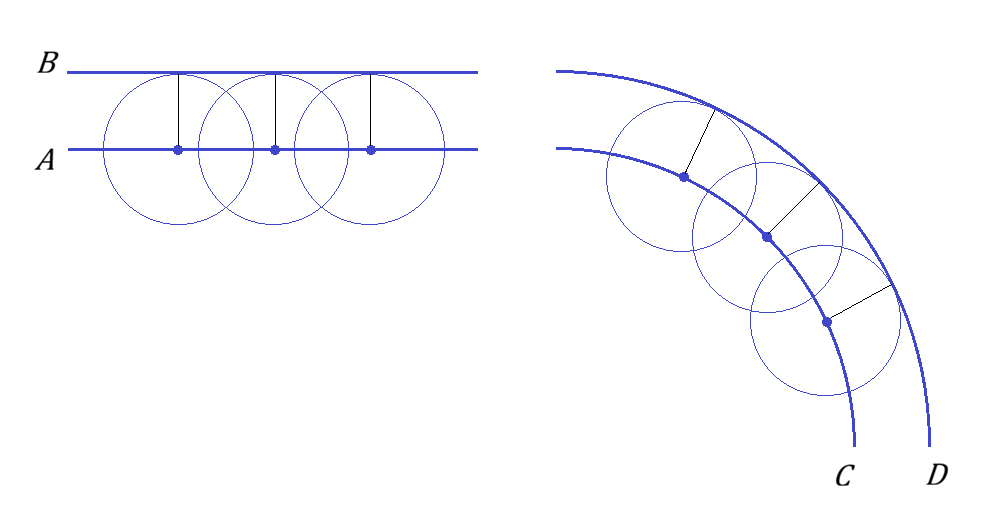 | ||
| Geometrically, it is clear that the distance from the wavefront (i.e. the envelope) to the centers of spherical waves of the same radius is exactly that radius. Thus, the wavefront travels the same distance as the spherical waves during the same time interval and must have the speed of sound. | |||
| Analytically, we describe spherical waves with two parameters and find their envelope as follows. Let $z=z_0$ be the equation of the planar wavefront $A$. Then, the spherical waves emitted from this wavefront are given by | |||
| \[F(x,y,z,u,v)=(x-u)^2+(y-v)^2+(z-z_0)^2-(ct)^2=0,\] | |||
| where $c$ is the speed of sound. The envelope satisfies this equation and two additional equations | |||
| \[\frac{\partial}{\partial u}F(x,y,z,u,v)=0\qquad\Rightarrow\qquad x=u\] | |||
| and | |||
| @@ -20,7 +20,7 @@Solution | |||
| \[\frac{\partial}{\partial v}F(x,y,z,u,v)=0\qquad\Rightarrow\qquad y=v.\] | |||
| − | Using these results in the equation $F(x,y,z,u,v)=0$, we have $z=z_0+ct$ as the equation of the envelope $B$, which means that the wavefront is a plane moving with the speed | ||
| + | Using these results in the equation $F(x,y,z,u,v)=0$, we have $z=z_0+ct$ as the equation of the envelope $B$, which means that the wavefront is a plane moving with the speed of sound as well. | ||
| For cylindrical waves, let $x^2+y^2=r^2$ be the equation of the cylindrical wavefront $C$ with radius $r$. Then, the spherical waves emitted from this wavefront are given by | |||
| \[F(x,y,z,\theta,w)=(x-r\cos\theta)^2+(y-r\sin\theta)^2+(z-w)^2-(ct)^2=0.\] | |||
| The envelope satisfies this equation and two additional equations | |||
| \[\frac{\partial}{\partial\theta}F(x,y,z,\theta,w)=0\qquad\Rightarrow\qquad x\sin\theta=y\cos\theta,\] | |||
| which means that $x=R\cos\theta$ and $y=R\sin\theta$ for a soon-to-be-determined $R$, and | |||
| @@ -34,9 +34,9 @@Solution | |||
| \[\frac{\partial}{\partial w}F(x,y,z,\theta,w)=0\qquad\Rightarrow\qquad z=w.\] | |||
| − | Using these results in the equation $F(x,y,z,theta,w)=0$, we have $R=r+ct$ and hence $x^2+y^2=R^2=(r+ct)^2$ as the equation of the envelope $D$, which means that the wavefront is a cylindrical surface moving with the speed | ||
| + | Using these results in the equation $F(x,y,z,\theta,w)=0$, we have $R=r+ct$ and hence $x^2+y^2=R^2=(r+ct)^2$ as the equation of the envelope $D$, which means that the wavefront is a cylindrical surface moving with the speed of sound as well. | ||
| #### Answer | |||
| − | [Insert a concise answer or boxed result] | ||
| + | See the solution. | ||
| @@ -1,10 +1,10 @@ | |||
| ### Statement | ### Statement | ||
| $3.7.12.$ [Insert the problem statement] | $3.7.12.$ According to the Huygens principle, each section of the wave front is the source of secondary spherical waves. The envelope of the secondary waves gives a new wave front. Based on the Huygens principle, show that in a homogeneous medium, a flat sound wave front travels at the speed of sound. How does a cylindrical front propagate? | ||
| ### Solution | ### Solution | ||
|  | ||
| Geometrically, it is clear that the distance from the wavefront (i.e. the envelope) to the centers of spherical waves of the same radius is exactly that radius. Thus, the wavefront travels the same distance as the spherical waves during the same time interval and must have the speed of sound. | Geometrically, it is clear that the distance from the wavefront (i.e. the envelope) to the centers of spherical waves of the same radius is exactly that radius. Thus, the wavefront travels the same distance as the spherical waves during the same time interval and must have the speed of sound. | ||
| Analytically, we describe spherical waves with two parameters and find their envelope as follows. Let $z=z_0$ be the equation of the planar wavefront $A$. Then, the spherical waves emitted from this wavefront are given by | Analytically, we describe spherical waves with two parameters and find their envelope as follows. Let $z=z_0$ be the equation of the planar wavefront $A$. Then, the spherical waves emitted from this wavefront are given by | ||
| \[F(x,y,z,u,v)=(x-u)^2+(y-v)^2+(z-z_0)^2-(ct)^2=0,\] | \[F(x,y,z,u,v)=(x-u)^2+(y-v)^2+(z-z_0)^2-(ct)^2=0,\] | ||
| where $c$ is the speed of sound. The envelope satisfies this equation and two additional equations | where $c$ is the speed of sound. The envelope satisfies this equation and two additional equations | ||
| \[\frac{\partial}{\partial u}F(x,y,z,u,v)=0\qquad\Rightarrow\qquad x=u\] | \[\frac{\partial}{\partial u}F(x,y,z,u,v)=0\qquad\Rightarrow\qquad x=u\] | ||
| and | and | ||
| @@ -20,7 +20,7 @@Solution | |||
| \[\frac{\partial}{\partial v}F(x,y,z,u,v)=0\qquad\Rightarrow\qquad y=v.\] | \[\frac{\partial}{\partial v}F(x,y,z,u,v)=0\qquad\Rightarrow\qquad y=v.\] | ||
| Using these results in the equation $F(x,y,z,u,v)=0$, we have $z=z_0+ct$ as the equation of the envelope $B$, which means that the wavefront is a plane moving with the speed |
Using these results in the equation $F(x,y,z,u,v)=0$, we have $z=z_0+ct$ as the equation of the envelope $B$, which means that the wavefront is a plane moving with the speed of sound as well. | ||
| For cylindrical waves, let $x^2+y^2=r^2$ be the equation of the cylindrical wavefront $C$ with radius $r$. Then, the spherical waves emitted from this wavefront are given by | For cylindrical waves, let $x^2+y^2=r^2$ be the equation of the cylindrical wavefront $C$ with radius $r$. Then, the spherical waves emitted from this wavefront are given by | ||
| \[F(x,y,z,\theta,w)=(x-r\cos\theta)^2+(y-r\sin\theta)^2+(z-w)^2-(ct)^2=0.\] | \[F(x,y,z,\theta,w)=(x-r\cos\theta)^2+(y-r\sin\theta)^2+(z-w)^2-(ct)^2=0.\] | ||
| The envelope satisfies this equation and two additional equations | The envelope satisfies this equation and two additional equations | ||
| \[\frac{\partial}{\partial\theta}F(x,y,z,\theta,w)=0\qquad\Rightarrow\qquad x\sin\theta=y\cos\theta,\] | \[\frac{\partial}{\partial\theta}F(x,y,z,\theta,w)=0\qquad\Rightarrow\qquad x\sin\theta=y\cos\theta,\] | ||
| which means that $x=R\cos\theta$ and $y=R\sin\theta$ for a soon-to-be-determined $R$, and | which means that $x=R\cos\theta$ and $y=R\sin\theta$ for a soon-to-be-determined $R$, and | ||
| @@ -34,9 +34,9 @@Solution | |||
| \[\frac{\partial}{\partial w}F(x,y,z,\theta,w)=0\qquad\Rightarrow\qquad z=w.\] | \[\frac{\partial}{\partial w}F(x,y,z,\theta,w)=0\qquad\Rightarrow\qquad z=w.\] | ||
| Using these results in the equation $F(x,y,z,theta,w)=0$, we have $R=r+ct$ and hence $x^2+y^2=R^2=(r+ct)^2$ as the equation of the envelope $D$, which means that the wavefront is a cylindrical surface moving with the speed |
Using these results in the equation $F(x,y,z,\theta,w)=0$, we have $R=r+ct$ and hence $x^2+y^2=R^2=(r+ct)^2$ as the equation of the envelope $D$, which means that the wavefront is a cylindrical surface moving with the speed of sound as well. | ||
| #### Answer | #### Answer | ||
| [Insert a concise answer or boxed result] | See the solution. | ||