| @@ -1,23 +1,23 @@ |
| ### Statement |
| ### Statement |
| |
| |
| $5.4.9.$ [Insert the problem statement] |
| $5.4.9.$ Rarefied gas is located between two long coaxial cylinders of radius $r_1$ and $r_2$. The inner cylinder rotates at a constant angular velocity $\omega$. Estimate the angular velocity of the outer cylinder. |
| |
| |
| ### Solution |
| ### Solution |
| |
| |
|  |
|  |
| |
| |
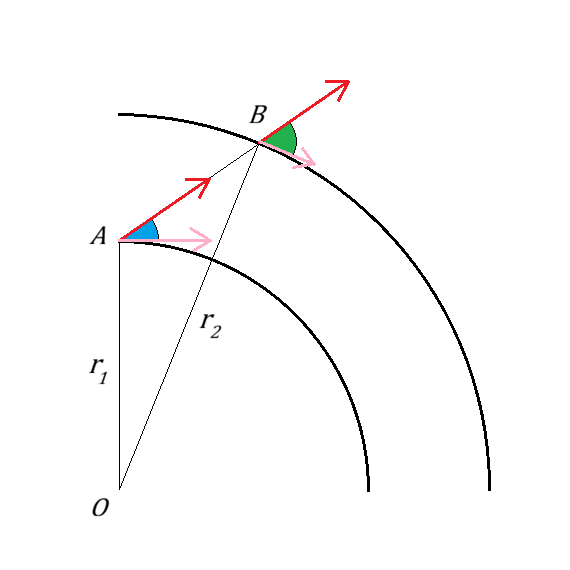
| We can get an estimate of the angular speed $\omega'$ of the outer cylinder as follows. In steady state, an average gas molecule must have tangential velocities of $\omega r_1$ and $\omega' r_2$ at the inner and the outer cylinders, respectively. We consider the motion of one such molecule whose velocity (shown in red) has magnitude $v$ and whose tangential velocity at each point is shown in pink. If the velocity vector makes an angle $\alpha$ (shown in blue) with the tangent to the inner cylinder, then $v=\omega r_1\sec\alpha$. Similarly, if the velocity vector makes an angle $\beta$ (shown in green) with the tangent to the outer cylinder, then $v=\omega'r_2\sec\beta$. Equating these two expressions for $v$, we have |
| We can get an estimate of the angular speed $\omega'$ of the outer cylinder as follows. In steady state, an average gas molecule must have tangential velocities of $\omega\,r_1$ and $\omega'\,r_2$ at the inner and the outer cylinders, respectively. We consider the motion of one such molecule whose velocity (shown in red) has magnitude $v$ and whose tangential velocity at each point is shown in pink. If the velocity vector makes an angle $\alpha$ (shown in blue) with the tangent to the inner cylinder, then $v=\omega\,r_1\sec\alpha$. Similarly, if the velocity vector makes an angle $\beta$ (shown in green) with the tangent to the outer cylinder, then $v=\omega'\,r_2\sec\beta$. Equating these two expressions for $v$, we have |
| |
| |
| \[\omega r_1\sec\alpha=\omega'r_2\sec\beta\qquad\Rightarrow\qquad\omega'=\omega\cdot\frac{r_1}{r_2}\cdot\frac{\cos\beta}{\cos\alpha}.\] |
| \[\omega\,r_1\sec\alpha=\omega'\,r_2\sec\beta\qquad\Rightarrow\qquad\omega'=\omega\cdot\frac{r_1}{r_2}\cdot\frac{\cos\beta}{\cos\alpha}.\] |
| |
| |
| Using the law of sines in $\triangle OAB$, we have |
| Using the law of sines in $\triangle OAB$, we have |
| |
| |
| \[\frac{r_1}{\sin(90^\circ-\beta)}=\frac{r_2}{\sin(90^\circ+\alpha)}\quad\Rightarrow\quad\frac{\cos\beta}{\cos\alpha}=\frac{r_1}{r_2},\] |
| \[\frac{r_1}{\sin(90^\circ-\beta)}=\frac{r_2}{\sin(90^\circ+\alpha)}\quad\Rightarrow\quad\frac{\cos\beta}{\cos\alpha}=\frac{r_1}{r_2},\] |
| |
| |
| and thus $\omega'=\omega(r_1/r_2)^2$. |
| and thus $\omega'=\omega\,(r_1/r_2)^2$. |
| |
| |
| Interestingly, if the gas is \underline{not} rarefied and this problem is treated as a Taylor-Coulette flow, we still obtain the same answer. |
| Interestingly, if the gas is NOT rarefied and this problem is treated as a Taylor-Coulette flow, we still obtain the same answer. |
| |
| |
| #### Answer |
| #### Answer |
| |
| |
| [Insert a concise answer or boxed result] |
| $\omega\,(r_1/r_2)^2$ |
