| @@ -1,23 +1,27 @@ |
| ### Statement |
| ### Statement |
| |
| |
| $2.3.8.$ [Insert the problem statement] |
| |
| |
| |
| ### Solution |
| |
| |
| |
| ### Statement |
| |
| |
| |
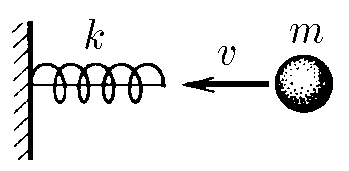
| $2.3.8.$ A spring of stiffness $k$ is attached at one end to a fixed wall. A ball of mass $m$ strikes its other end along the spring with an initial velocity $v$. What is the maximum compression deformation of the spring? Answer the same question for the case when the spring is pre-compressed and held by an inextensible thread connecting its ends (the initial deformation of the spring is $x_0$). |
| $2.3.8.$ A spring of stiffness $k$ is attached at one end to a fixed wall. A ball of mass $m$ strikes its other end along the spring with an initial velocity $v$. What is the maximum compression deformation of the spring? Answer the same question for the case when the spring is pre-compressed and held by an inextensible thread connecting its ends (the initial deformation of the spring is $x_0$). |
| |
| |
| |
|  |
| |
| |
| ### Solution |
| ### Solution |
| |
| |
| <b>Case a)</b> |
| <b>Case a)</b> |
| |
| |
| |
|  |
| |
| |
| Since the spring is attached to a fixed wall, we can use the law of conservation of energy. The maximum potential energy of the compressed spring is equal to the initial kinetic energy of the ball: |
| Since the spring is attached to a fixed wall, we can use the law of conservation of energy. The maximum potential energy of the compressed spring is equal to the initial kinetic energy of the ball: |
| $$E_{\text{kin}} = E_{\text{pot}}$$ |
| $$E_{\text{kin}} = E_{\text{pot}}$$ |
| $$\frac{mv^2}{2} = \frac{kx^2}{2}$$ |
| $$\frac{mv^2}{2} = \frac{kx^2}{2}$$ |
| From this, we find the maximum compression of the spring for case a: |
| From this, we find the maximum compression of the spring for case a: |
| $$x = v\sqrt{\frac{m}{k}} \quad (a)$$ |
| $$x = v\sqrt{\frac{m}{k}} \quad (a)$$ |
| |
| |
| |
| |
| |
| |
| <b>Case b)</b> |
| <b>Case b)</b> |
| |
| |
| |
|  |
| |
| |
| For the second case, the spring initially has some potential energy $\frac{kx_0^2}{2}$. |
| For the second case, the spring initially has some potential energy $\frac{kx_0^2}{2}$. |
| The total energy of the system is conserved. The final potential energy of the fully compressed spring is equal to the sum of the initial kinetic energy of the ball and the initial potential energy of the spring: |
| The total energy of the system is conserved. The final potential energy of the fully compressed spring is equal to the sum of the initial kinetic energy of the ball and the initial potential energy of the spring: |
| $$\frac{kx^2}{2} - \frac{kx_0^2}{2} = \frac{mv^2}{2}$$ |
| $$\frac{kx^2}{2} - \frac{kx_0^2}{2} = \frac{mv^2}{2}$$ |
| Divide both sides of the equation by the spring stiffness $k$: | | Divide both sides of the equation by the spring stiffness $k$: |
| $$x^2 = x_0^2 + \frac{m}{k}v^2$$ | | $$x^2 = x_0^2 + \frac{m}{k}v^2$$ |
| From this, we find the maximum compression of the spring: | | From this, we find the maximum compression of the spring: |
| $$x = \sqrt{x_0^2 + \frac{m}{k}v^2} \quad (b)$$ | | $$x = \sqrt{x_0^2 + \frac{m}{k}v^2} \quad (b)$$ |
| | | |
| <i>Note that for $x_0 = 0$, we get expression (a).</i> | | <i>Note that for $x_0 = 0$, we get expression (a).</i> |
