| @@ -1,15 +1,13 @@ |
| ### Statement |
| ### Statement |
| |
| |
| $2.3.16.$ [Insert the problem statement] |
| |
| |
| |
| ### Solution |
| |
| |
| |
| ### Statement |
| |
| |
| |
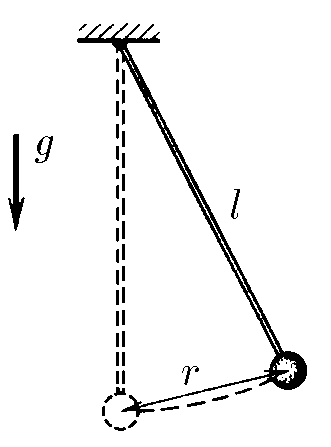
| $2.3.16.$ A weight suspended on a thread of length $l$ was deflected by a distance $r$ from the equilibrium point and released. What is its maximum velocity? |
| $2.3.16.$ A weight suspended on a thread of length $l$ was deflected by a distance $r$ from the equilibrium point and released. What is its maximum velocity? |
| |
| |
| |
|  |
| |
| |
| ### Solution |
| ### Solution |
| |
| |
| |
|  |
| |
| |
| Let's consider the geometry of the system. Let the maximum deflection angle of the thread be $2\alpha$. The distance $r$ is the chord between the initial deflection point $D$ and the lowest equilibrium point $C$. |
| Let's consider the geometry of the system. Let the maximum deflection angle of the thread be $2\alpha$. The distance $r$ is the chord between the initial deflection point $D$ and the lowest equilibrium point $C$. |
| The vertical height change $h$ (which corresponds to $BC$ in the diagram) can be expressed in two ways: |
| The vertical height change $h$ (which corresponds to $BC$ in the diagram) can be expressed in two ways: |
| $$h = l(1 - \cos 2\alpha) = r \sin\alpha$$ |
| $$h = l(1 - \cos 2\alpha) = r \sin\alpha$$ |
| | | |
| Using the trigonometric identity $1 - \cos 2\alpha = 2 \sin^2\alpha$, we get: | | Using the trigonometric identity $1 - \cos 2\alpha = 2 \sin^2\alpha$, we get: |
| $$2l \sin^2\alpha = r \sin\alpha$$ | | $$2l \sin^2\alpha = r \sin\alpha$$ |
| From this, we express the sine of half the deflection angle $\alpha$: | | From this, we express the sine of half the deflection angle $\alpha$: |
| $$\sin\alpha = \frac{r}{2l} \quad \text{(a)}$$ | | $$\sin\alpha = \frac{r}{2l} \quad \text{(a)}$$ |
| | | |
| From the law of conservation of energy, the kinetic energy $E_{\text{kin}}$ will be maximal at the lowest point $C$, where the potential energy is minimal. The maximum kinetic energy equals the initial potential energy: | | From the law of conservation of energy, the kinetic energy $E_{\text{kin}}$ will be maximal at the lowest point $C$, where the potential energy is minimal. The maximum kinetic energy equals the initial potential energy: |
| $$\frac{mv_{\text{max}}^2}{2} = mgh = mgr \sin\alpha$$ | | $$\frac{mv_{\text{max}}^2}{2} = mgh = mgr \sin\alpha$$ |
| Canceling the mass $m$: | | Canceling the mass $m$: |
| $$\frac{v_{\text{max}}^2}{2} = gr \sin\alpha$$ | | $$\frac{v_{\text{max}}^2}{2} = gr \sin\alpha$$ |
| | | |
| Expressing the maximum velocity of the weight: | | Expressing the maximum velocity of the weight: |
| $$v_{\text{max}} = \sqrt{2gr \sin\alpha} \quad \text{(b)}$$ | | $$v_{\text{max}} = \sqrt{2gr \sin\alpha} \quad \text{(b)}$$ |
| | | |
| Substitute the angle expression from (a) into equation (b): | | Substitute the angle expression from (a) into equation (b): |
| $$v_{\text{max}} = \sqrt{2g \cdot r \frac{r}{2l}} = r\sqrt{\frac{g}{l}}$$ | | $$v_{\text{max}} = \sqrt{2g \cdot r \frac{r}{2l}} = r\sqrt{\frac{g}{l}}$$ |
