Edits to “Statement”, “Answer”

en/2.3.17.md
+2 −10
| @@ -1,13 +1,9 @@ | |||
| ### Statement | |||
| − | $2.3.17.$ [Insert the problem statement] | ||
| − | |||
| − | ### Solution | ||
| − | |||
| − | ### Statement | ||
| − | |||
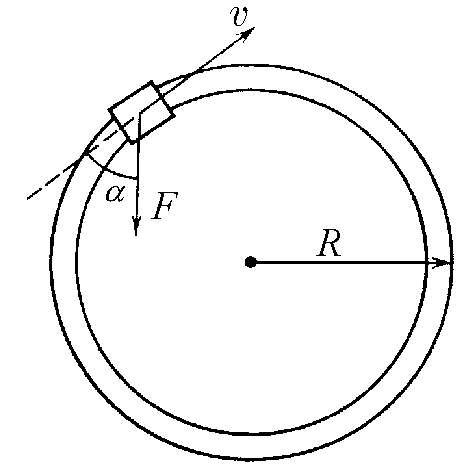
| $2.3.17.$ A cart of mass $m$ rolls with velocity $v$ along rails forming a horizontal circular path of radius $R$. A worker runs after it and begins to stop it by pulling a cable tied to the cart with a force $F$ at an angle of $\pi - \alpha$ to the direction of the cart's velocity. How many revolutions around the circle will the cart make before stopping? Neglect friction. | |||
| + |  | ||
| + | |||
| ### Solution | |||
| The cart will stop when all its initial kinetic energy is spent on the work done by the stopping force $F$. | |||
| The projection of the force acting directly against the velocity of the cart is $F \cos\alpha$ (since the angle with the velocity vector is $\pi - \alpha$). | |||
| Equating the initial kinetic energy to the magnitude of the work done: | |||
| $$\frac{mv^2}{2} = \int F \cos\alpha \, ds$$ | |||
| Since the force is constant, we can take it out of the integral and integrate over the entire path distance $S = 2\pi n R$, where $n$ is the number of full revolutions: | |||
| $$\frac{mv^2}{2} = F \cos\alpha \cdot 2\pi n R$$ | |||
| From this, we express the number of revolutions $n$ around the circle before stopping: | |||
| $$n = \frac{mv^2}{4\pi F R \cos\alpha}$$ | |||
| where $n$ is the required number of full revolutions of the cart until it stops. | |||
| @@ -24,7 +20,3 @@Solution | |||
| #### Answer | |||
| $$n = \frac{mv^2}{4\pi F R \cos\alpha}$$ | |||
| − | |||
| − | #### Answer | ||
| − | |||
| − | [Insert a concise answer or boxed result] | ||
| @@ -1,13 +1,9 @@ | |||
| ### Statement | ### Statement | ||
| $2.3.17.$ [Insert the problem statement] | |||
| ### Solution | |||
| ### Statement | |||
| $2.3.17.$ A cart of mass $m$ rolls with velocity $v$ along rails forming a horizontal circular path of radius $R$. A worker runs after it and begins to stop it by pulling a cable tied to the cart with a force $F$ at an angle of $\pi - \alpha$ to the direction of the cart's velocity. How many revolutions around the circle will the cart make before stopping? Neglect friction. | $2.3.17.$ A cart of mass $m$ rolls with velocity $v$ along rails forming a horizontal circular path of radius $R$. A worker runs after it and begins to stop it by pulling a cable tied to the cart with a force $F$ at an angle of $\pi - \alpha$ to the direction of the cart's velocity. How many revolutions around the circle will the cart make before stopping? Neglect friction. | ||
|  | |||
| ### Solution | ### Solution | ||
| The cart will stop when all its initial kinetic energy is spent on the work done by the stopping force $F$. | The cart will stop when all its initial kinetic energy is spent on the work done by the stopping force $F$. | ||
| The projection of the force acting directly against the velocity of the cart is $F \cos\alpha$ (since the angle with the velocity vector is $\pi - \alpha$). | The projection of the force acting directly against the velocity of the cart is $F \cos\alpha$ (since the angle with the velocity vector is $\pi - \alpha$). | ||
| Equating the initial kinetic energy to the magnitude of the work done: | Equating the initial kinetic energy to the magnitude of the work done: | ||
| $$\frac{mv^2}{2} = \int F \cos\alpha \, ds$$ | $$\frac{mv^2}{2} = \int F \cos\alpha \, ds$$ | ||
| Since the force is constant, we can take it out of the integral and integrate over the entire path distance $S = 2\pi n R$, where $n$ is the number of full revolutions: | Since the force is constant, we can take it out of the integral and integrate over the entire path distance $S = 2\pi n R$, where $n$ is the number of full revolutions: | ||
| $$\frac{mv^2}{2} = F \cos\alpha \cdot 2\pi n R$$ | $$\frac{mv^2}{2} = F \cos\alpha \cdot 2\pi n R$$ | ||
| From this, we express the number of revolutions $n$ around the circle before stopping: | From this, we express the number of revolutions $n$ around the circle before stopping: | ||
| $$n = \frac{mv^2}{4\pi F R \cos\alpha}$$ | $$n = \frac{mv^2}{4\pi F R \cos\alpha}$$ | ||
| where $n$ is the required number of full revolutions of the cart until it stops. | where $n$ is the required number of full revolutions of the cart until it stops. | ||
| @@ -24,7 +20,3 @@Solution | |||
| #### Answer | #### Answer | ||
| $$n = \frac{mv^2}{4\pi F R \cos\alpha}$$ | $$n = \frac{mv^2}{4\pi F R \cos\alpha}$$ | ||
| #### Answer | |||
| [Insert a concise answer or boxed result] | |||