Edits to “Statement”, “Solution”, “Answer”

en/2.1.57.md
+4 −10
| @@ -1,15 +1,13 @@ | |||
| ### Statement | |||
| − | $2.1.57.$ [Insert the problem statement] | ||
| − | |||
| − | ### Solution | ||
| − | |||
| − | ### Statement | ||
| − | |||
| $2.1.57.$ A small bead is threaded onto a smooth wire ring of radius $R$ positioned vertically. The ring rotates with an angular velocity $\omega$ about a vertical axis passing through its diameter. Where is the bead located? | |||
| + | 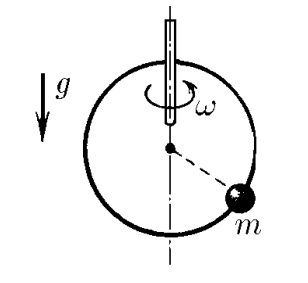 | ||
| + | |||
| ### Solution | |||
| + |  | ||
| + | |||
| Let's write Newton's second law for the bead on the vertical and horizontal axes, projecting the reaction force $T$ of the ring: | |||
| $$T \sin\alpha = m a_{\text{cp}}$$ | |||
| $$mg - T \cos\alpha = 0$$ | |||
| From this, we obtain: | |||
| $$mg \tan\alpha = m a_{\text{cp}} \quad (1)$$ | |||
| Let's find the centripetal acceleration through the angular velocity of rotation $\omega$: | |||
| $$a_{\text{cp}} = \omega^2 r = \omega^2 R \sin\alpha$$ | |||
| Substitute this into (1): | |||
| $$mg \frac{\sin\alpha}{\cos\alpha} = m \omega^2 R \sin\alpha$$ | |||
| $$g = \omega^2 R \cos\alpha$$ | |||
| From which we find $\cos\alpha$: | |||
| $$\cos\alpha = \frac{g}{\omega^2 R}$$ | |||
| Considering the domain of the cosine function: | |||
| $$-1 \le \cos\alpha \le 1$$ | |||
| If $g > \omega^2 R$, the angular velocity will not be enough to lift the body to any angle, and the body will take a stable position at the lowest point of its trajectory, corresponding to: | |||
| $$\alpha = 0$$ | |||
| @@ -36,7 +34,3 @@Solution | |||
| #### Answer | |||
| $\cos\alpha = \frac{g}{\omega^2 R}$ for $\frac{g}{\omega^2 R} \le 1$; | |||
| $\alpha = 0$ for $\frac{g}{\omega^2 R} > 1$ | |||
| − | |||
| − | #### Answer | ||
| − | |||
| − | [Insert a concise answer or boxed result] | ||
| @@ -1,15 +1,13 @@ | |||
| ### Statement | ### Statement | ||
| $2.1.57.$ [Insert the problem statement] | |||
| ### Solution | |||
| ### Statement | |||
| $2.1.57.$ A small bead is threaded onto a smooth wire ring of radius $R$ positioned vertically. The ring rotates with an angular velocity $\omega$ about a vertical axis passing through its diameter. Where is the bead located? | $2.1.57.$ A small bead is threaded onto a smooth wire ring of radius $R$ positioned vertically. The ring rotates with an angular velocity $\omega$ about a vertical axis passing through its diameter. Where is the bead located? | ||
|  | |||
| ### Solution | ### Solution | ||
|  | |||
| Let's write Newton's second law for the bead on the vertical and horizontal axes, projecting the reaction force $T$ of the ring: | Let's write Newton's second law for the bead on the vertical and horizontal axes, projecting the reaction force $T$ of the ring: | ||
| $$T \sin\alpha = m a_{\text{cp}}$$ | $$T \sin\alpha = m a_{\text{cp}}$$ | ||
| $$mg - T \cos\alpha = 0$$ | $$mg - T \cos\alpha = 0$$ | ||
| From this, we obtain: | From this, we obtain: | ||
| $$mg \tan\alpha = m a_{\text{cp}} \quad (1)$$ | $$mg \tan\alpha = m a_{\text{cp}} \quad (1)$$ | ||
| Let's find the centripetal acceleration through the angular velocity of rotation $\omega$: | Let's find the centripetal acceleration through the angular velocity of rotation $\omega$: | ||
| $$a_{\text{cp}} = \omega^2 r = \omega^2 R \sin\alpha$$ | $$a_{\text{cp}} = \omega^2 r = \omega^2 R \sin\alpha$$ | ||
| Substitute this into (1): | Substitute this into (1): | ||
| $$mg \frac{\sin\alpha}{\cos\alpha} = m \omega^2 R \sin\alpha$$ | $$mg \frac{\sin\alpha}{\cos\alpha} = m \omega^2 R \sin\alpha$$ | ||
| $$g = \omega^2 R \cos\alpha$$ | $$g = \omega^2 R \cos\alpha$$ | ||
| From which we find $\cos\alpha$: | From which we find $\cos\alpha$: | ||
| $$\cos\alpha = \frac{g}{\omega^2 R}$$ | $$\cos\alpha = \frac{g}{\omega^2 R}$$ | ||
| Considering the domain of the cosine function: | Considering the domain of the cosine function: | ||
| $$-1 \le \cos\alpha \le 1$$ | $$-1 \le \cos\alpha \le 1$$ | ||
| If $g > \omega^2 R$, the angular velocity will not be enough to lift the body to any angle, and the body will take a stable position at the lowest point of its trajectory, corresponding to: | If $g > \omega^2 R$, the angular velocity will not be enough to lift the body to any angle, and the body will take a stable position at the lowest point of its trajectory, corresponding to: | ||
| $$\alpha = 0$$ | $$\alpha = 0$$ | ||
| @@ -36,7 +34,3 @@Solution | |||
| #### Answer | #### Answer | ||
| $\cos\alpha = \frac{g}{\omega^2 R}$ for $\frac{g}{\omega^2 R} \le 1$; | $\cos\alpha = \frac{g}{\omega^2 R}$ for $\frac{g}{\omega^2 R} \le 1$; | ||
| $\alpha = 0$ for $\frac{g}{\omega^2 R} > 1$ | $\alpha = 0$ for $\frac{g}{\omega^2 R} > 1$ | ||
| #### Answer | |||
| [Insert a concise answer or boxed result] | |||