| @@ -1,15 +1,13 @@ |
| ### Statement |
| ### Statement |
| |
| |
| $2.1.61.$ [Insert the problem statement] |
| |
| |
| |
| ### Solution |
| |
| |
| |
| ### Statement |
| |
| |
| |
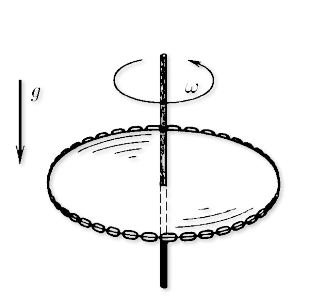
| $2.1.61^\ast$. A circular chain of mass $m$ is placed on a horizontal disk of radius $R$. The tension force of the placed chain is $T$. Find the coefficient of friction between the disk and the chain if, when the disk rotates with an angular velocity equal to or greater than $\omega$, the chain falls off it. |
| $2.1.61^\ast$. A circular chain of mass $m$ is placed on a horizontal disk of radius $R$. The tension force of the placed chain is $T$. Find the coefficient of friction between the disk and the chain if, when the disk rotates with an angular velocity equal to or greater than $\omega$, the chain falls off it. |
| |
| |
| |
|  |
| |
| |
| ### Solution |
| ### Solution |
| |
| |
| |
|  |
| |
| |
| The phrase "placed on" in this context (and the fact it falls off vertically at high speeds) implies the chain is stretched tightly around the outer cylindrical edge (rim) of the disk. |
| The phrase "placed on" in this context (and the fact it falls off vertically at high speeds) implies the chain is stretched tightly around the outer cylindrical edge (rim) of the disk. |
| |
| |
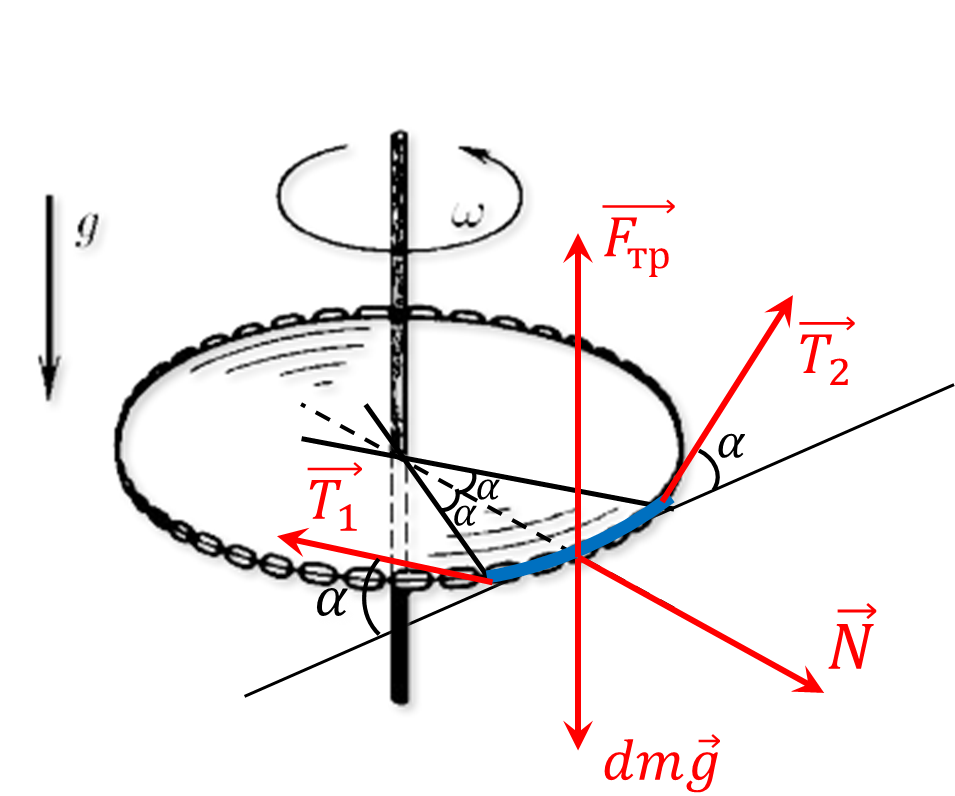
| Consider a small segment of the chain corresponding to a small angle $2\alpha$. Its length is $dl = 2\alpha R$, and its mass is $dm = m \frac{\alpha}{\pi}$. |
| Consider a small segment of the chain corresponding to a small angle $2\alpha$. Its length is $dl = 2\alpha R$, and its mass is $dm = m \frac{\alpha}{\pi}$. |
| The forces acting on this segment in the horizontal plane are the tension forces $T$ (directed tangentially) and the normal reaction force $N$ from the edge of the disk (directed radially outward). | | The forces acting on this segment in the horizontal plane are the tension forces $T$ (directed tangentially) and the normal reaction force $N$ from the edge of the disk (directed radially outward). |
| The inward radial component of the tension forces is $2T \sin\alpha \approx 2T\alpha$. | | The inward radial component of the tension forces is $2T \sin\alpha \approx 2T\alpha$. |
| | | |
| According to Newton's second law in the radial direction, the net inward force provides the centripetal acceleration $a_c = \omega^2 R$: | | According to Newton's second law in the radial direction, the net inward force provides the centripetal acceleration $a_c = \omega^2 R$: |
| $$2T\alpha - N = dm \cdot a_c = m \frac{\alpha}{\pi} \omega^2 R$$ | | $$2T\alpha - N = dm \cdot a_c = m \frac{\alpha}{\pi} \omega^2 R$$ |
| From this, the normal force exerted by the disk on the chain is: | | From this, the normal force exerted by the disk on the chain is: |
| $$N = 2T\alpha - m \frac{\alpha}{\pi} \omega^2 R$$ | | $$N = 2T\alpha - m \frac{\alpha}{\pi} \omega^2 R$$ |
| | | |
| The chain starts to fall off (slip downwards) when the maximum static friction force can no longer balance the gravity acting on the segment. | | The chain starts to fall off (slip downwards) when the maximum static friction force can no longer balance the gravity acting on the segment. |
| Vertical equilibrium condition: | | Vertical equilibrium condition: |
| $$F_{\text{fr}} = dm \cdot g \implies \mu N = m \frac{\alpha}{\pi} g$$ | | $$F_{\text{fr}} = dm \cdot g \implies \mu N = m \frac{\alpha}{\pi} g$$ |
| | | |
| Substitute the expression for $N$: | | Substitute the expression for $N$: |
| $$\mu \left( 2T\alpha - m \frac{\alpha}{\pi} \omega^2 R \right) = m \frac{\alpha}{\pi} g$$ | | $$\mu \left( 2T\alpha - m \frac{\alpha}{\pi} \omega^2 R \right) = m \frac{\alpha}{\pi} g$$ |
| | | |
| Divide the entire equation by $\alpha/\pi$: | | Divide the entire equation by $\alpha/\pi$: |
| $$\mu (2\pi T - m\omega^2 R) = mg$$ | | $$\mu (2\pi T - m\omega^2 R) = mg$$ |
| | | |
| From this, we find the coefficient of friction $\mu$: | | From this, we find the coefficient of friction $\mu$: |
| $$\mu = \frac{mg}{2\pi T - m\omega^2 R}$$ | | $$\mu = \frac{mg}{2\pi T - m\omega^2 R}$$ |
