| @@ -1,15 +1,11 @@ |
| ### Statement |
| ### Statement |
| |
| |
| $2.1.63.$ [Insert the problem statement] |
| |
| |
| |
| ### Solution |
| |
| |
| |
| ### Statement |
| |
| |
| |
| $2.1.63.$ A horizontal disk begins to spin around its axis with an angular velocity that increases linearly with time $\omega = \varepsilon t$. At what angular velocity will a body located at a distance $r$ from the disk's axis begin to slide off it, if the coefficient of friction between them is $\mu$? |
| $2.1.63.$ A horizontal disk begins to spin around its axis with an angular velocity that increases linearly with time $\omega = \varepsilon t$. At what angular velocity will a body located at a distance $r$ from the disk's axis begin to slide off it, if the coefficient of friction between them is $\mu$? |
| |
| |
| ### Solution |
| ### Solution |
| |
| |
| |
|  |
| |
| |
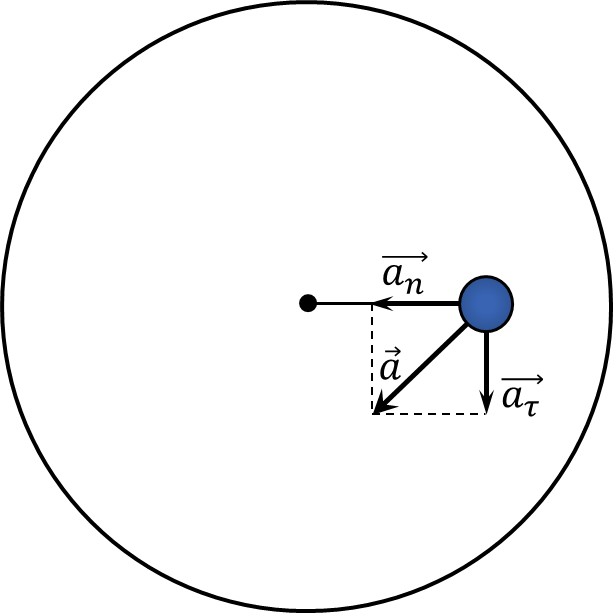
| Because the angular velocity is constantly changing, the body experiences two components of acceleration on the plane of the disk: |
| Because the angular velocity is constantly changing, the body experiences two components of acceleration on the plane of the disk: |
| 1. Centripetal (normal) acceleration, directed towards the center: $a_n = \omega^2 r$ |
| 1. Centripetal (normal) acceleration, directed towards the center: $a_n = \omega^2 r$ |
| 2. Tangential acceleration, directed perpendicular to the radius: $a_\tau = \varepsilon r$ |
| 2. Tangential acceleration, directed perpendicular to the radius: $a_\tau = \varepsilon r$ |
| | | |
| Since these two vectors are strictly perpendicular, we find the total magnitude of acceleration $a$ using the Pythagorean theorem: | | Since these two vectors are strictly perpendicular, we find the total magnitude of acceleration $a$ using the Pythagorean theorem: |
| $$a = \sqrt{a_n^2 + a_\tau^2} = \sqrt{(\omega^2 r)^2 + (\varepsilon r)^2} = r \sqrt{\omega^4 + \varepsilon^2}$$ | | $$a = \sqrt{a_n^2 + a_\tau^2} = \sqrt{(\omega^2 r)^2 + (\varepsilon r)^2} = r \sqrt{\omega^4 + \varepsilon^2}$$ |
| | | |
| The body starts to slide at the exact moment when the required force to maintain this total acceleration exceeds the maximum possible static friction force $F_{\text{fr}} = \mu N = \mu mg$. | | The body starts to slide at the exact moment when the required force to maintain this total acceleration exceeds the maximum possible static friction force $F_{\text{fr}} = \mu N = \mu mg$. |
| Writing Newton's second law for the threshold of slipping: | | Writing Newton's second law for the threshold of slipping: |
| $$ma = \mu mg \implies a = \mu g$$ | | $$ma = \mu mg \implies a = \mu g$$ |
| | | |
| Substitute the expression for total acceleration: | | Substitute the expression for total acceleration: |
| $$r \sqrt{\omega^4 + \varepsilon^2} = \mu g$$ | | $$r \sqrt{\omega^4 + \varepsilon^2} = \mu g$$ |
| | | |
| Square both sides to solve for $\omega$: | | Square both sides to solve for $\omega$: |
| $$r^2 (\omega^4 + \varepsilon^2) = \mu^2 g^2$$ | | $$r^2 (\omega^4 + \varepsilon^2) = \mu^2 g^2$$ |
| $$\omega^4 + \varepsilon^2 = \frac{\mu^2 g^2}{r^2}$$ | | $$\omega^4 + \varepsilon^2 = \frac{\mu^2 g^2}{r^2}$$ |
| $$\omega^4 = \frac{\mu^2 g^2}{r^2} - \varepsilon^2$$ | | $$\omega^4 = \frac{\mu^2 g^2}{r^2} - \varepsilon^2$$ |
| | | |
| Taking the fourth root, we find the angular velocity $\omega$: | | Taking the fourth root, we find the angular velocity $\omega$: |
| $$\omega = \left( \frac{\mu^2 g^2}{r^2} - \varepsilon^2 \right)^{1/4}$$ | | $$\omega = \left( \frac{\mu^2 g^2}{r^2} - \varepsilon^2 \right)^{1/4}$$ |
| | | |
| <i>Note: This solution is physically meaningful only if the expression under the root is positive, i.e., $\varepsilon < \mu g / r$. If the angular acceleration $\varepsilon$ is extremely large ($\varepsilon \ge \mu g / r$), the tangential acceleration alone immediately overcomes friction, and the body slips at $t=0$ when $\omega = 0$.</i> | | <i>Note: This solution is physically meaningful only if the expression under the root is positive, i.e., $\varepsilon < \mu g / r$. If the angular acceleration $\varepsilon$ is extremely large ($\varepsilon \ge \mu g / r$), the tangential acceleration alone immediately overcomes friction, and the body slips at $t=0$ when $\omega = 0$.</i> |
| | | |
