$2.1.64.$ What is the maximum speed a motorcyclist can ride on a horizontal plane, describing a circle of radius $R$, if the coefficient of friction is $\mu$? At what angle from the vertical must they lean? By what factor does the maximum permissible speed of the motorcyclist increase when moving on an inclined track with an angle of inclination $\alpha$ to the horizontal compared to the maximum permissible speed when moving on a horizontal track with the same turning radius and the same friction coefficient?
### Solution
+
+
<b>1. Motion on a horizontal track:</b>
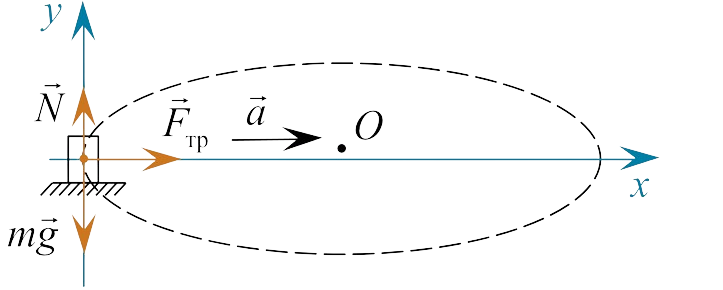
The forces acting on the motorcyclist are gravity $m\vec{g}$, the normal reaction force $\vec{N}$, and the static friction force $\vec{F}_{\text{fr}}$.
The centripetal acceleration can only be provided by the static friction force directed radially towards the center $O$.
Newton's second law in projections:
$$Ox: F_{\text{fr}} = m \frac{v_1^2}{R}$$
$$Oy: N - mg = 0 \implies N = mg$$
@@ -21,10 +17,15 @@Solution
Given that the maximum static friction force is $F_{\text{fr}} = \mu N = \mu mg$, we find the maximum speed $v_1$ on the horizontal track:
+
To prevent a tipping moment (torque), the resultant of the normal force and the friction force must pass through the center of gravity of the motorcyclist. Therefore, the motorcyclist must lean towards the center of the circle by an angle $\beta$ from the vertical:
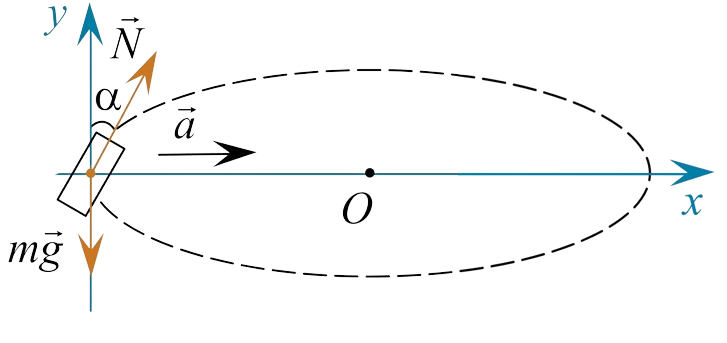
Now consider the motion on a track inclined at an angle $\alpha$ to the horizontal. To achieve the maximum speed $v_2$, the static friction force $\vec{F}_{\text{fr}}$ must act downwards along the incline (preventing the motorcycle from sliding outward).
Newton's second law in projections onto the vertical ($Y$) and horizontal ($X$) axes:
$2.1.64.$ What is the maximum speed a motorcyclist can ride on a horizontal plane, describing a circle of radius $R$, if the coefficient of friction is $\mu$? At what angle from the vertical must they lean? By what factor does the maximum permissible speed of the motorcyclist increase when moving on an inclined track with an angle of inclination $\alpha$ to the horizontal compared to the maximum permissible speed when moving on a horizontal track with the same turning radius and the same friction coefficient?
$2.1.64.$ What is the maximum speed a motorcyclist can ride on a horizontal plane, describing a circle of radius $R$, if the coefficient of friction is $\mu$? At what angle from the vertical must they lean? By what factor does the maximum permissible speed of the motorcyclist increase when moving on an inclined track with an angle of inclination $\alpha$ to the horizontal compared to the maximum permissible speed when moving on a horizontal track with the same turning radius and the same friction coefficient?
### Solution
### Solution

<b>1. Motion on a horizontal track:</b>
<b>1. Motion on a horizontal track:</b>
The forces acting on the motorcyclist are gravity $m\vec{g}$, the normal reaction force $\vec{N}$, and the static friction force $\vec{F}_{\text{fr}}$.
The forces acting on the motorcyclist are gravity $m\vec{g}$, the normal reaction force $\vec{N}$, and the static friction force $\vec{F}_{\text{fr}}$.
The centripetal acceleration can only be provided by the static friction force directed radially towards the center $O$.
The centripetal acceleration can only be provided by the static friction force directed radially towards the center $O$.
Newton's second law in projections:
Newton's second law in projections:
$$Ox: F_{\text{fr}} = m \frac{v_1^2}{R}$$
$$Ox: F_{\text{fr}} = m \frac{v_1^2}{R}$$
$$Oy: N - mg = 0 \implies N = mg$$
$$Oy: N - mg = 0 \implies N = mg$$
@@ -21,10 +17,15 @@Solution
Given that the maximum static friction force is $F_{\text{fr}} = \mu N = \mu mg$, we find the maximum speed $v_1$ on the horizontal track:
Given that the maximum static friction force is $F_{\text{fr}} = \mu N = \mu mg$, we find the maximum speed $v_1$ on the horizontal track:

To prevent a tipping moment (torque), the resultant of the normal force and the friction force must pass through the center of gravity of the motorcyclist. Therefore, the motorcyclist must lean towards the center of the circle by an angle $\beta$ from the vertical:
To prevent a tipping moment (torque), the resultant of the normal force and the friction force must pass through the center of gravity of the motorcyclist. Therefore, the motorcyclist must lean towards the center of the circle by an angle $\beta$ from the vertical:
Now consider the motion on a track inclined at an angle $\alpha$ to the horizontal. To achieve the maximum speed $v_2$, the static friction force $\vec{F}_{\text{fr}}$ must act downwards along the incline (preventing the motorcycle from sliding outward).
Now consider the motion on a track inclined at an angle $\alpha$ to the horizontal. To achieve the maximum speed $v_2$, the static friction force $\vec{F}_{\text{fr}}$ must act downwards along the incline (preventing the motorcycle from sliding outward).
Newton's second law in projections onto the vertical ($Y$) and horizontal ($X$) axes:
Newton's second law in projections onto the vertical ($Y$) and horizontal ($X$) axes:
