Edits to “Statement”, “Solution”, “Answer”

en/11.1.23.md
+7 −5
| @@ -1,15 +1,17 @@ | |||
| ### Statement | |||
| − | $11.1.23.$ [Insert the problem statement] | ||
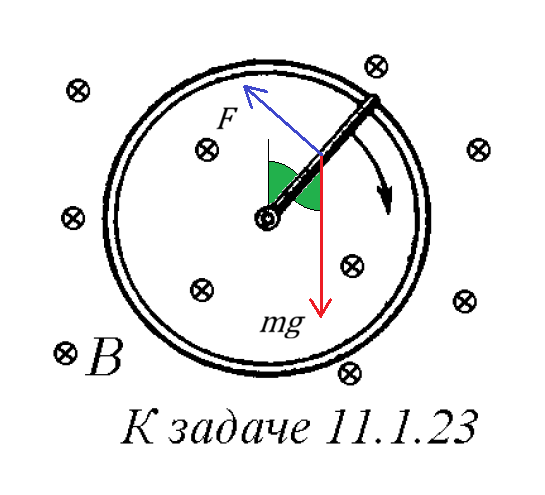
| + | $11.1.23.$ A metal ring is placed vertically in the gravity field. A metal rod of length $L$ and mass $m$ is pivotally fixed in the center of the ring and touches it with the other end. A uniform magnetic field of induction $B$ is perpendicular to the ring plane. By what law is it necessary to change the current in the rod so that the rod rotates evenly with an angular velocity $\omega$, if at the initial moment the rod was in the upper position? Ignore the friction. | ||
| + | |||
| + | |||
| ### Solution | |||
| − |  | ||
| − | The angle between the rod and the vertical (shown in green) is $\omega t$ at time $t$ after the initial mom | ||
| + | The angle between the rod and the vertical (shown in green) is $\omega t$ at time $t$ after the initial moment. If there is current $I$ flowing radially outward through the rod, then the magnetic force on the rod is $F=IBL$. The angular speed is constant when counterclockwise moment due to $F$ equals clockwise moment due to gravity $mg$. Thus, | ||
| − | \[ | ||
| + | \[F\cdot\frac{L}{2}=mg\cdot\frac{L}{2}\cdot\sin(\omega t)\qquad\Rightarrow\qquad I=\frac{mg}{BL}\cdot\sin(\omega t).\] | ||
| #### Answer | |||
| − | [Insert a concise answer or boxed result] | ||
| + | $I=\frac{mg}{BL}\cdot\sin(\omega t)$ | ||
| @@ -1,15 +1,17 @@ | |||
| ### Statement | ### Statement | ||
| $11.1.23.$ [Insert the problem statement] | $11.1.23.$ A metal ring is placed vertically in the gravity field. A metal rod of length $L$ and mass $m$ is pivotally fixed in the center of the ring and touches it with the other end. A uniform magnetic field of induction $B$ is perpendicular to the ring plane. By what law is it necessary to change the current in the rod so that the rod rotates evenly with an angular velocity $\omega$, if at the initial moment the rod was in the upper position? Ignore the friction. | ||
| ### Solution | ### Solution | ||
|  | ||
| The angle between the rod and the vertical (shown in green) is $\omega t$ at time $t$ after the initial mom |
The angle between the rod and the vertical (shown in green) is $\omega t$ at time $t$ after the initial moment. If there is current $I$ flowing radially outward through the rod, then the magnetic force on the rod is $F=IBL$. The angular speed is constant when counterclockwise moment due to $F$ equals clockwise moment due to gravity $mg$. Thus, | ||
| \[ |
\[F\cdot\frac{L}{2}=mg\cdot\frac{L}{2}\cdot\sin(\omega t)\qquad\Rightarrow\qquad I=\frac{mg}{BL}\cdot\sin(\omega t).\] | ||
| #### Answer | #### Answer | ||
| [Insert a concise answer or boxed result] | $I=\frac{mg}{BL}\cdot\sin(\omega t)$ | ||