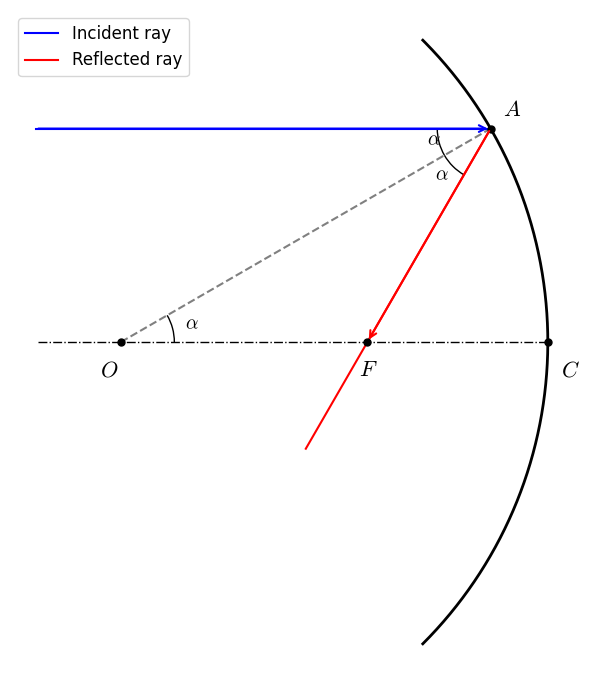
13.1.13. Determine the focal length of a spherical mirror of radius of curvature R.
Solution
Consider a ray parallel to the principal optical axis incident on a spherical mirror at point $A$.
The radius of the mirror $OA = R$ is the normal to the surface at the point of incidence. According to the law of reflection, the angle of incidence equals the angle of reflection: $\angle (\text{incident ray}, OA) = \angle OAF = \alpha$.
Since the incident ray is parallel to the principal optical axis $OC$, the alternate interior angle $\angle AOF$ is also equal to $\alpha$.
Therefore, triangle $\triangle AOF$ is isosceles, which implies: $$|OF| = |AF|$$
Let us drop a perpendicular from point $F$ to the segment $OA$. In an isosceles triangle, this perpendicular also acts as a median, hence: $$|OF| \cos \alpha = \frac{R}{2} \implies |OF| = \frac{R}{2 \cos \alpha}$$
The distance from the pole of the mirror $C$ to the focus $F$ (the focal length) is given by: $$F = |OC| - |OF| = R - \frac{R}{2 \cos \alpha}$$
For paraxial rays, which form a sharp image, the angle $\alpha$ is small ($\alpha \to 0$). In this approximation, $\cos \alpha \approx 1$.
Taking this limit, we obtain the focal length of the spherical mirror: $$F = R - \frac{R}{2} = \frac{R}{2}$$