New solution

en/2.4.13.md
+37 −0
| @@ -0,0 +1,37 @@ | |||
| + | ### Statement | ||
| + | |||
| + | $2.4.13.$ [Insert the problem statement] | ||
| + | |||
| + | ### Solution | ||
| + | |||
| + |  | ||
| + | |||
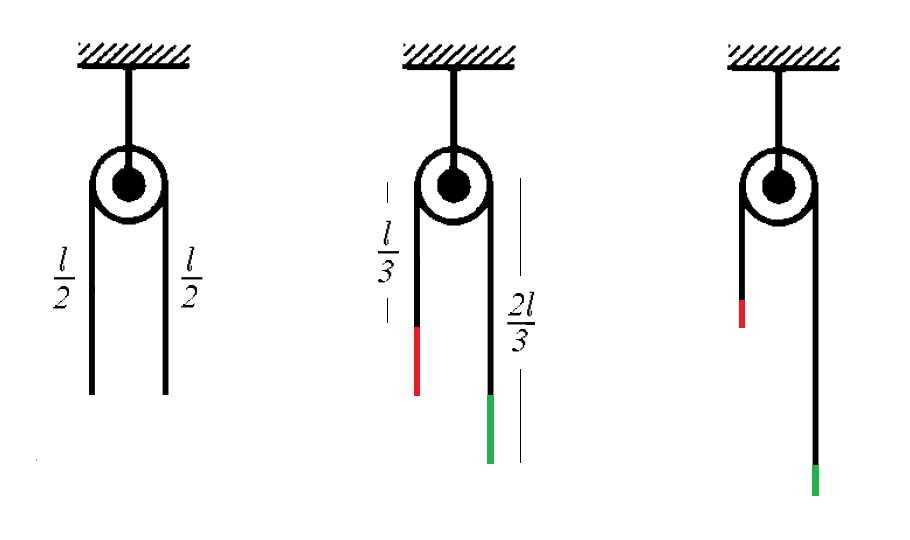
| + | From the initial moment (left figure) to the moment in question (middle figure), the rope of length $l/6$ moves from the left part to the right part (assuming that the pulley is small). The change in gravitational potential energy is that of the rope of mass $m/6$ moving from the red section to the green section in the middle figure, i.e. | ||
| + | |||
| + | \[\frac{m}{6}\cdot g\cdot\left(-\frac{l}{6}\right)=-\frac{mgl}{36}$. | ||
| + | |||
| + | If $v$ is the speed of the rope, then conservation of energy yields | ||
| + | |||
| + | \[\frac{1}{2}mv^2-\frac{mgl}{36}=0\qquad\Rightarrow\qquad v^2=\frac{gl}{18}.\] | ||
| + | |||
| + | In a short time interval $\Delta t$ afterward, the rope of length $v\Delta t$ and mass $\Delta m=mv\Delta t/l$ moves from the left part to the right part. The change in gravitational potential energy is that of the rope of mass $\Delta m$ moving from the red section to the green section in the right figure, i.e. | ||
| + | |||
| + | \[\Delta m\cdot g\cdot\left(-\frac{l}{3}\right)=-\frac{mgv\Delta t}{3}.\] | ||
| + | |||
| + | Conservation of energy yields | ||
| + | |||
| + | \[\frac{1}{2}m(v+\Delta v)^2-\frac{1}{2}mv^2-\frac{mgv\Delta t}{3}=0\qquad\Rightarrow\qquad\Delta v\approx\frac{g\Delta t}{3}\] | ||
| + | |||
| + | Consequently, the change in downward momentum of the right part of the rope is | ||
| + | |||
| + | \[\frac{2m}{3}\cdot\Delta v+\Delta m\cdot v=\frac{5}{18}\cdot mg\Delta t,] | ||
| + | |||
| + | and the change in upward momentum of the left part of the rope is | ||
| + | |||
| + | \[\frac{m}{3}\cdot\Delta v-\Delta m\cdot v=\frac{1}{18}\cdot mg\Delta t,] | ||
| + | |||
| + | Thus, the downward impulse on the entire rope is $4mg\Delta t/18=2mg\Delta t/9$, which means that the total force on the rope is $2mg/9$. Since gravity is $mg$, the upward normal force from the pulley is $7mg/9$, which has the same magnitude as the force that the rope exerts on the pulley. | ||
| + | |||
| + | #### Answer | ||
| + | |||
| + | [Insert a concise answer or boxed result] | ||
| @@ -0,0 +1,37 @@ | |||
| ### Statement | |||
| $2.4.13.$ [Insert the problem statement] | |||
| ### Solution | |||
|  | |||
| From the initial moment (left figure) to the moment in question (middle figure), the rope of length $l/6$ moves from the left part to the right part (assuming that the pulley is small). The change in gravitational potential energy is that of the rope of mass $m/6$ moving from the red section to the green section in the middle figure, i.e. | |||
| \[\frac{m}{6}\cdot g\cdot\left(-\frac{l}{6}\right)=-\frac{mgl}{36}$. | |||
| If $v$ is the speed of the rope, then conservation of energy yields | |||
| \[\frac{1}{2}mv^2-\frac{mgl}{36}=0\qquad\Rightarrow\qquad v^2=\frac{gl}{18}.\] | |||
| In a short time interval $\Delta t$ afterward, the rope of length $v\Delta t$ and mass $\Delta m=mv\Delta t/l$ moves from the left part to the right part. The change in gravitational potential energy is that of the rope of mass $\Delta m$ moving from the red section to the green section in the right figure, i.e. | |||
| \[\Delta m\cdot g\cdot\left(-\frac{l}{3}\right)=-\frac{mgv\Delta t}{3}.\] | |||
| Conservation of energy yields | |||
| \[\frac{1}{2}m(v+\Delta v)^2-\frac{1}{2}mv^2-\frac{mgv\Delta t}{3}=0\qquad\Rightarrow\qquad\Delta v\approx\frac{g\Delta t}{3}\] | |||
| Consequently, the change in downward momentum of the right part of the rope is | |||
| \[\frac{2m}{3}\cdot\Delta v+\Delta m\cdot v=\frac{5}{18}\cdot mg\Delta t,] | |||
| and the change in upward momentum of the left part of the rope is | |||
| \[\frac{m}{3}\cdot\Delta v-\Delta m\cdot v=\frac{1}{18}\cdot mg\Delta t,] | |||
| Thus, the downward impulse on the entire rope is $4mg\Delta t/18=2mg\Delta t/9$, which means that the total force on the rope is $2mg/9$. Since gravity is $mg$, the upward normal force from the pulley is $7mg/9$, which has the same magnitude as the force that the rope exerts on the pulley. | |||
| #### Answer | |||
| [Insert a concise answer or boxed result] | |||