Edits to “Statement”, “Answer”

en/2.2.9.md
+2 −10
| @@ -1,13 +1,9 @@ | |||
| ### Statement | |||
| − | $2.2.9.$ [Insert the problem statement] | ||
| − | |||
| − | ### Solution | ||
| − | |||
| − | ### Statement | ||
| − | |||
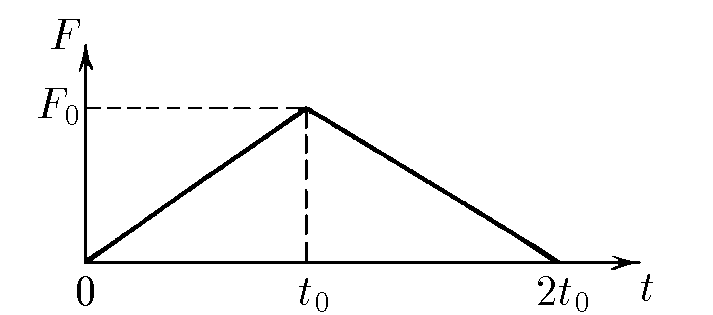
| $2.2.9^\ast$. A body of mass $m_2$ moving at a velocity $v$ strikes a stationary body of mass $m_1$. The force arising from the interaction of the bodies, linearly dependent on time, grows from zero to a value $F_0$ during a time $t_0$, and then uniformly decreases to zero during the same time $t_0$. Determine the velocity of the bodies after the interaction, assuming all motion occurs along one straight line. | |||
| + |  | ||
| + | |||
| ### Solution | |||
| From the definition of Newton's second law in impulse form, it is known that $F dt = dp$. Then, by finding the area under the graph $F(t)$, we obtain the change in momentum. | |||
| In our case: | |||
| $$\int_0^{2t_0} F(t) dt = F_0 t_0 = \Delta p$$ | |||
| Since the first body was at rest: | |||
| $$m_1 v_1 = \Delta p \implies v_1 = \frac{F_0 t_0}{m_1}$$ | |||
| On the second body, the force acts in the opposite direction, correspondingly decreasing its momentum, then: | |||
| $$m_2 v_2 = m_2 v - F_0 t_0 \implies v_2 = v - \frac{F_0 t_0}{m_2}$$ | |||
| @@ -22,7 +18,3 @@Solution | |||
| #### Answer | |||
| $u_1 = F_0 t_0 / m_1$; $u_2 = v - F_0 t_0 / m_2$ | |||
| − | |||
| − | #### Answer | ||
| − | |||
| − | [Insert a concise answer or boxed result] | ||
| @@ -1,13 +1,9 @@ | |||
| ### Statement | ### Statement | ||
| $2.2.9.$ [Insert the problem statement] | |||
| ### Solution | |||
| ### Statement | |||
| $2.2.9^\ast$. A body of mass $m_2$ moving at a velocity $v$ strikes a stationary body of mass $m_1$. The force arising from the interaction of the bodies, linearly dependent on time, grows from zero to a value $F_0$ during a time $t_0$, and then uniformly decreases to zero during the same time $t_0$. Determine the velocity of the bodies after the interaction, assuming all motion occurs along one straight line. | $2.2.9^\ast$. A body of mass $m_2$ moving at a velocity $v$ strikes a stationary body of mass $m_1$. The force arising from the interaction of the bodies, linearly dependent on time, grows from zero to a value $F_0$ during a time $t_0$, and then uniformly decreases to zero during the same time $t_0$. Determine the velocity of the bodies after the interaction, assuming all motion occurs along one straight line. | ||
|  | |||
| ### Solution | ### Solution | ||
| From the definition of Newton's second law in impulse form, it is known that $F dt = dp$. Then, by finding the area under the graph $F(t)$, we obtain the change in momentum. | From the definition of Newton's second law in impulse form, it is known that $F dt = dp$. Then, by finding the area under the graph $F(t)$, we obtain the change in momentum. | ||
| In our case: | In our case: | ||
| $$\int_0^{2t_0} F(t) dt = F_0 t_0 = \Delta p$$ | $$\int_0^{2t_0} F(t) dt = F_0 t_0 = \Delta p$$ | ||
| Since the first body was at rest: | Since the first body was at rest: | ||
| $$m_1 v_1 = \Delta p \implies v_1 = \frac{F_0 t_0}{m_1}$$ | $$m_1 v_1 = \Delta p \implies v_1 = \frac{F_0 t_0}{m_1}$$ | ||
| On the second body, the force acts in the opposite direction, correspondingly decreasing its momentum, then: | On the second body, the force acts in the opposite direction, correspondingly decreasing its momentum, then: | ||
| $$m_2 v_2 = m_2 v - F_0 t_0 \implies v_2 = v - \frac{F_0 t_0}{m_2}$$ | $$m_2 v_2 = m_2 v - F_0 t_0 \implies v_2 = v - \frac{F_0 t_0}{m_2}$$ | ||
| @@ -22,7 +18,3 @@Solution | |||
| #### Answer | #### Answer | ||
| $u_1 = F_0 t_0 / m_1$; $u_2 = v - F_0 t_0 / m_2$ | $u_1 = F_0 t_0 / m_1$; $u_2 = v - F_0 t_0 / m_2$ | ||
| #### Answer | |||
| [Insert a concise answer or boxed result] | |||