| @@ -1,13 +1,9 @@ |
| ### Statement |
| ### Statement |
| |
| |
| $7.1.4.$ [Insert the problem statement] |
| |
| |
| |
| ### Solution |
| |
| |
| |
| ### Statement |
| |
| |
| |
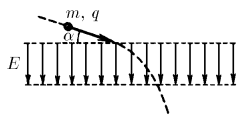
| $7.1.4.$ A particle of mass $m$ with a charge $q > 0$ enters a flat capacitor, the plates of which are metal grids. The field strength in the capacitor is $E$, the distance between the grids is $d$. The initial velocity $v$ of the particle makes an angle $\alpha$ with the plane of the first grid. With what velocity and at what angle to the plane of the second grid will the particle fly out of the capacitor? |
| $7.1.4.$ A particle of mass $m$ with a charge $q > 0$ enters a flat capacitor, the plates of which are metal grids. The field strength in the capacitor is $E$, the distance between the grids is $d$. The initial velocity $v$ of the particle makes an angle $\alpha$ with the plane of the first grid. With what velocity and at what angle to the plane of the second grid will the particle fly out of the capacitor? |
| |
| |
| |
|  |
| |
| |
| ### Solution |
| ### Solution |
| |
| |
| The problem can be solved either using the kinematic approach or the energetic approach. The energetic method of solution is chosen here (it is shorter). |
| The problem can be solved either using the kinematic approach or the energetic approach. The energetic method of solution is chosen here (it is shorter). |
| | | |
| The work done by the electric field goes into changing the kinetic energy of the particle: | | The work done by the electric field goes into changing the kinetic energy of the particle: |
| $$\frac{1}{2}mu^2 - \frac{1}{2}mv^2 = qEd$$ | | $$\frac{1}{2}mu^2 - \frac{1}{2}mv^2 = qEd$$ |
| | | |
| From here, we immediately find the magnitude of the velocity at which the particle exits the capacitor: | | From here, we immediately find the magnitude of the velocity at which the particle exits the capacitor: |
| $$u = v\sqrt{1 + \frac{2qEd}{mv^2}}$$ | | $$u = v\sqrt{1 + \frac{2qEd}{mv^2}}$$ |
| | | |
| Let's decompose the initial and final velocities of the particle along the axes: one axis is directed parallel to the plates (perpendicular to the field strength vector), the other axis is parallel to the field. | | Let's decompose the initial and final velocities of the particle along the axes: one axis is directed parallel to the plates (perpendicular to the field strength vector), the other axis is parallel to the field. |
| Initial velocity components: $v_{\perp} = v \cos\alpha$ (this component does not change, since no forces act along this axis), $v_{\parallel} = v \sin\alpha$. | | Initial velocity components: $v_{\perp} = v \cos\alpha$ (this component does not change, since no forces act along this axis), $v_{\parallel} = v \sin\alpha$. |
| | | |
| Final velocity components: $u_{\perp} = v_{\perp} = v \cos\alpha$, and we find the component $u_{\parallel}$ from the Pythagorean theorem: | | Final velocity components: $u_{\perp} = v_{\perp} = v \cos\alpha$, and we find the component $u_{\parallel}$ from the Pythagorean theorem: |
| $$u_{\parallel} = \sqrt{u^2 - u_{\perp}^2} = \sqrt{\left(v^2 + \frac{2qEd}{m}\right) - v^2 \cos^2\alpha} = \sqrt{v^2 \sin^2\alpha + \frac{2qEd}{m}}$$ | | $$u_{\parallel} = \sqrt{u^2 - u_{\perp}^2} = \sqrt{\left(v^2 + \frac{2qEd}{m}\right) - v^2 \cos^2\alpha} = \sqrt{v^2 \sin^2\alpha + \frac{2qEd}{m}}$$ |
| Or rewritten as: | | Or rewritten as: |
| $$u_{\parallel} = v \sin\alpha \sqrt{1 + \frac{2qEd}{mv^2 \sin^2\alpha}}$$ | | $$u_{\parallel} = v \sin\alpha \sqrt{1 + \frac{2qEd}{mv^2 \sin^2\alpha}}$$ |
| | | |
| The tangent of the exit angle of the particle from the capacitor ($\beta$) is the ratio of the parallel component to the perpendicular component relative to the plates: | | The tangent of the exit angle of the particle from the capacitor ($\beta$) is the ratio of the parallel component to the perpendicular component relative to the plates: |
| $$\tan\beta = \frac{u_{\parallel}}{u_{\perp}} = \frac{v \sin\alpha \sqrt{1 + \frac{2qEd}{mv^2 \sin^2\alpha}}}{v \cos\alpha} = \tan\alpha \sqrt{1 + \frac{2qEd}{mv^2 \sin^2\alpha}}$$ | | $$\tan\beta = \frac{u_{\parallel}}{u_{\perp}} = \frac{v \sin\alpha \sqrt{1 + \frac{2qEd}{mv^2 \sin^2\alpha}}}{v \cos\alpha} = \tan\alpha \sqrt{1 + \frac{2qEd}{mv^2 \sin^2\alpha}}$$ |
| | | |
