Edits to “Statement”, “Solution”, “Answer”

en/7.4.37.md
+4 −4
| @@ -1,14 +1,14 @@ | |||
| ### Statement | |||
| − | $7.4.37.$ [Insert the problem statement] | ||
| + | $7.4.37.$ Three charged bodies of the same mass, flying apart, always form an isosceles triangle with angles $\alpha$ at the vertex. The charge of the body located at the top of the triangle is how many times the charge of the body at its base? | ||
| ### Solution | |||
| − | 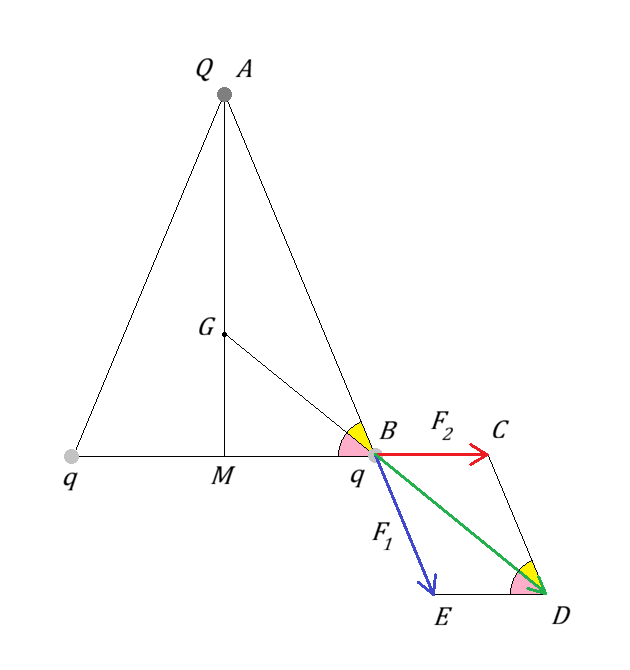 | ||
| Since the center of mass $G$ of the system remains stationary, the total force $\vec F=\vec F_1+\vec F_2$ on a charge $q$ must be in the same direction as the line joining $G$ and the charge. As the masses of the three charges are the same, $G$ is the geometric centroid of the triangle; that is, $G$ is on the median $AM$ such that $AG=2\cdot MG$. The magnitudes of $\vec F_1$ and $\vec F_2$ are | |||
| − | \[F_1=\frac{kQq}{(AB^2}\qquad\mbox{and}\qquad F_2=\frac{kq^2}{(2\cdot AB\sin(\alpha/2))^2}.\] | ||
| + | \[F_1=\frac{kQq}{(AB)^2}\qquad\mbox{and}\qquad F_2=\frac{kq^2}{(2\cdot AB\sin(\alpha/2))^2}.\] | ||
| Let $\angle GBM=\angle BDE=\phi$ (shown in pink) and $\angle GBA=\angle BDC=\theta$ (shown in yellow). Using the law of sines in $\triangle BDE$ and $\triangle BDC$, we have | |||
| \[\frac{F_1}{\sin\phi}=\frac{BD}{\sin(180^\circ-(\theta+\phi))}=\frac{F_2}{\sin\theta}.\] | |||
| Consequently, | |||
| \[\frac{\sin\theta}{\sin\phi}=\frac{F_2}{F_1}=\frac{q}{Q}\cdot\frac{1}{(2\sin(\alpha/2))^2}.\] | |||
| Using the law of sines in $\triangle GBM$ and $\triangle GBA$, we have | |||
| \[\frac{MG}{\sin\phi}=\frac{GB}{\sin90^\circ}\qquad\mbox{and}\qquad\frac{AG}{\sin\theta}=\frac{GB}{\sin(\alpha/2)}.\] | |||
| As a result, | |||
| \[\frac{\sin\theta}{\sin\phi}=\frac{AG}{MG}\cdot\sin(\alpha/2)=2\sin(\alpha/2).\] | |||
| Equating the two expressions we have for $\sin\theta/\sin\phi$, we obtain | |||
| \[\frac{q}{Q}\cdot\frac{1}{(2\sin(\alpha/2))^2}=2\sin(\alpha/2)\qquad\Rightarrow\qquad\frac{Q}{q}=\frac{1}{(2\sin(\alpha/2))^3}.\] | |||
| @@ -32,4 +32,4 @@Solution | |||
| #### Answer | |||
| − | [Insert a concise answer or boxed result] | ||
| + | $\frac{1}{(2\sin(\alpha/2))^3}$ | ||
| @@ -1,14 +1,14 @@ | |||
| ### Statement | ### Statement | ||
| $7.4.37.$ [Insert the problem statement] | $7.4.37.$ Three charged bodies of the same mass, flying apart, always form an isosceles triangle with angles $\alpha$ at the vertex. The charge of the body located at the top of the triangle is how many times the charge of the body at its base? | ||
| ### Solution | ### Solution | ||
|  | ||
| Since the center of mass $G$ of the system remains stationary, the total force $\vec F=\vec F_1+\vec F_2$ on a charge $q$ must be in the same direction as the line joining $G$ and the charge. As the masses of the three charges are the same, $G$ is the geometric centroid of the triangle; that is, $G$ is on the median $AM$ such that $AG=2\cdot MG$. The magnitudes of $\vec F_1$ and $\vec F_2$ are | Since the center of mass $G$ of the system remains stationary, the total force $\vec F=\vec F_1+\vec F_2$ on a charge $q$ must be in the same direction as the line joining $G$ and the charge. As the masses of the three charges are the same, $G$ is the geometric centroid of the triangle; that is, $G$ is on the median $AM$ such that $AG=2\cdot MG$. The magnitudes of $\vec F_1$ and $\vec F_2$ are | ||
| \[F_1=\frac{kQq}{(AB^2}\qquad\mbox{and}\qquad F_2=\frac{kq^2}{(2\cdot AB\sin(\alpha/2))^2}.\] | \[F_1=\frac{kQq}{(AB)^2}\qquad\mbox{and}\qquad F_2=\frac{kq^2}{(2\cdot AB\sin(\alpha/2))^2}.\] | ||
| Let $\angle GBM=\angle BDE=\phi$ (shown in pink) and $\angle GBA=\angle BDC=\theta$ (shown in yellow). Using the law of sines in $\triangle BDE$ and $\triangle BDC$, we have | Let $\angle GBM=\angle BDE=\phi$ (shown in pink) and $\angle GBA=\angle BDC=\theta$ (shown in yellow). Using the law of sines in $\triangle BDE$ and $\triangle BDC$, we have | ||
| \[\frac{F_1}{\sin\phi}=\frac{BD}{\sin(180^\circ-(\theta+\phi))}=\frac{F_2}{\sin\theta}.\] | \[\frac{F_1}{\sin\phi}=\frac{BD}{\sin(180^\circ-(\theta+\phi))}=\frac{F_2}{\sin\theta}.\] | ||
| Consequently, | Consequently, | ||
| \[\frac{\sin\theta}{\sin\phi}=\frac{F_2}{F_1}=\frac{q}{Q}\cdot\frac{1}{(2\sin(\alpha/2))^2}.\] | \[\frac{\sin\theta}{\sin\phi}=\frac{F_2}{F_1}=\frac{q}{Q}\cdot\frac{1}{(2\sin(\alpha/2))^2}.\] | ||
| Using the law of sines in $\triangle GBM$ and $\triangle GBA$, we have | Using the law of sines in $\triangle GBM$ and $\triangle GBA$, we have | ||
| \[\frac{MG}{\sin\phi}=\frac{GB}{\sin90^\circ}\qquad\mbox{and}\qquad\frac{AG}{\sin\theta}=\frac{GB}{\sin(\alpha/2)}.\] | \[\frac{MG}{\sin\phi}=\frac{GB}{\sin90^\circ}\qquad\mbox{and}\qquad\frac{AG}{\sin\theta}=\frac{GB}{\sin(\alpha/2)}.\] | ||
| As a result, | As a result, | ||
| \[\frac{\sin\theta}{\sin\phi}=\frac{AG}{MG}\cdot\sin(\alpha/2)=2\sin(\alpha/2).\] | \[\frac{\sin\theta}{\sin\phi}=\frac{AG}{MG}\cdot\sin(\alpha/2)=2\sin(\alpha/2).\] | ||
| Equating the two expressions we have for $\sin\theta/\sin\phi$, we obtain | Equating the two expressions we have for $\sin\theta/\sin\phi$, we obtain | ||
| \[\frac{q}{Q}\cdot\frac{1}{(2\sin(\alpha/2))^2}=2\sin(\alpha/2)\qquad\Rightarrow\qquad\frac{Q}{q}=\frac{1}{(2\sin(\alpha/2))^3}.\] | \[\frac{q}{Q}\cdot\frac{1}{(2\sin(\alpha/2))^2}=2\sin(\alpha/2)\qquad\Rightarrow\qquad\frac{Q}{q}=\frac{1}{(2\sin(\alpha/2))^3}.\] | ||
| @@ -32,4 +32,4 @@Solution | |||
| #### Answer | #### Answer | ||
| [Insert a concise answer or boxed result] | $\frac{1}{(2\sin(\alpha/2))^3}$ | ||