Edits to “Solution”, “Answer”

en/13.5.9.md
+18 −27
| ### Problem | |||
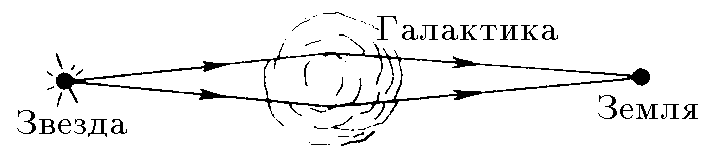
| $13.5.9^*.$ Large masses of matter in the Universe can focus light from distant objects, forming a "gravitational lens". Estimate the focal length of a spherical galaxy of radius $R \approx 20000 \text{ pc}$ and mass $M \approx 3 \cdot 10^{11} M_\odot$ (where $M_\odot$ is the mass of the Sun), assuming that the mass in the galaxy is distributed uniformly. | |||
|  | |||
| ### Solution | |||
| @@ -8,50 +8,41 @@Solution | |||
| 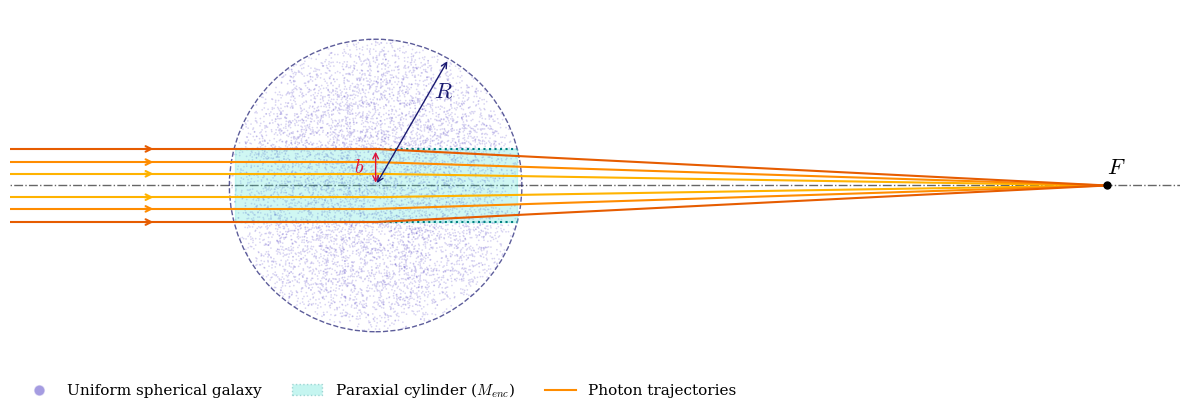 | |||
| + | Since the light is coming from exceptionally distant astronomical objects, we can treat the incident light rays reaching our galaxy as practically parallel. | ||
| + | |||
| According to General Relativity, the deflection angle of a light ray passing a mass with an impact parameter $b$ is: | |||
| + | $$ \alpha = \frac{4GM_{enc}}{c^2 b} $$ | ||
| + | Here, $M_{enc}$ is the effective mass responsible for the gravitational pull. | ||
| + | Let's consider paraxial rays ($b \ll R$) to determine the focal length. As the photon travels through the galaxy in a straight line, it forms a chord. The exact length of this path inside the spherical galaxy is $L = 2\sqrt{R^2 - b^2}$. Since $b$ is negligibly small compared to $R$, we can approximate the path length as the diameter of the galaxy: $L \approx 2R$. | ||
| − | $$\alpha = \frac{4GM_{enc}}{c^2 b}$$ | ||
| + | Why do we evaluate the mass inside a cylinder? As the photon travels along its straight trajectory at the speed of light, it experiences a transverse gravitational force. By symmetry, the components of the gravitational pull from the mass outside the photon's cylindrical path cancel each other out when integrated along the line of sight. Therefore, the net deflection is strictly caused by the matter enclosed within a cylinder of radius $b$ and length $L \approx 2R$. | ||
| − | Let's consider paraxial rays ($b \ll R$) to determine the focal length. For a ray passing close to the center, the path length inside the spherical galaxy is approximately equal to its diameter ($L \approx 2R$). | ||
| + | The volume of this effective cylinder is: | ||
| + | $$ V_{cyl} \approx \pi b^2 \cdot 2R = 2\pi R b^2 $$ | ||
| − | By symmetry, the gravitational effect on the photon is exerted only by the matter enclosed within a cylinder of radius $b$, whose axis coincides with the line of sight. The volume of this cylinder is approximately: | ||
| − | |||
| − | |||
| − | $$V_{cyl} \approx \pi b^2 \cdot 2R = 2\pi R b^2$$ | ||
| − | |||
| Since the density of matter in the galaxy is uniform ($\rho = \frac{M}{\frac{4}{3}\pi R^3}$), the enclosed mass within the cylinder is: | |||
| + | $$ M_{enc} = \rho V_{cyl} = \frac{M}{\frac{4}{3}\pi R^3} \cdot 2\pi R b^2 = \frac{3M}{2R^2} b^2 $$ | ||
| − | |||
| − | $$M_{enc} = \rho V_{cyl} = \frac{M}{\frac{4}{3}\pi R^3} \cdot 2\pi R b^2 = \frac{3M}{2R^2} b^2$$ | ||
| − | |||
| Substituting this mass into the deflection angle formula, we get: | |||
| + | $$ \alpha(b) = \frac{4G}{c^2 b} \left( \frac{3M}{2R^2} b^2 \right) = \frac{6GM}{c^2 R^2} b $$ | ||
| − | |||
| − | $$ | ||
| − | |||
| − | From geometrical optics, a thin lens focuses paraxial rays if the deflection angle is proportional to the impact parameter: $\alpha = \frac{b}{F}$. Thus, the central part of the galaxy acts as an ideal lens with a focal length $F$: | ||
| − | |||
| − | |||
| − | $$\frac{1}{F} = \frac{6GM}{c^2 R^2} \quad \implies \quad F = \frac{c^2 R^2}{6GM}$$ | ||
| − | |||
| + | For small deflection angles, the geometry of a right triangle gives us the relationship $\tan \alpha \approx \alpha = \frac{b}{F}$. | ||
| + | Notice that our derived deflection angle $\alpha$ is directly proportional to the impact parameter $b$. This means the focal length $F$ is constant for all paraxial rays, proving that the central part of the uniform galaxy acts as an ideal thin lens: | ||
| + | $$ \frac{1}{F} = \frac{6GM}{c^2 R^2} \quad \implies \quad F = \frac{c^2 R^2}{6GM} $$ | ||
| Now, we estimate the numerical values in SI units: | |||
| - $R \approx 20000 \text{ pc} \approx 6 \cdot 10^{20} \text{ m}$ | |||
| - $M \approx 3 \cdot 10^{11} M_\odot \approx 6 \cdot 10^{41} \text{ kg}$ | |||
| - $c \approx 3 \cdot 10^8 \text{ m/s}$ | |||
| - $G \approx 6.67 \cdot 10^{-11} \text{ m}^3/(\text{kg} \cdot \text{s}^2)$ | |||
| + | |||
| Calculating the focal length in meters: | |||
| + | $$ F = \frac{(3 \cdot 10^8)^2 \cdot (6 \cdot 10^{20})^2}{6 \cdot 6.67 \cdot 10^{-11} \cdot 6 \cdot 10^{41}} \approx 1.35 \cdot 10^{26} \text{ m} $$ | ||
| − | |||
| − | $$F = \frac{(3 \cdot 10^8)^2 \cdot (6 \cdot 10^{20})^2}{6 \cdot 6.67 \cdot 10^{-11} \cdot 6 \cdot 10^{41}} \approx 1.35 \cdot 10^{26} \text{ m}$$ | ||
| − | |||
| Converting the distance back to parsecs ($1 \text{ pc} \approx 3 \cdot 10^{16} \text{ m}$): | |||
| + | $$ F \approx \frac{1.35 \cdot 10^{26}}{3 \cdot 10^{16}} = 4.5 \cdot 10^9 \text{ pc} $$ | ||
| − | |||
| − | $$F \approx | ||
| − | |||
| − | #### Answer | ||
| − | |||
| − | $$F \approx 10^9 \text{ pc}$$ | ||
| + | ### Answer | ||
| + | $$ F \approx 10^9 \text{ pc} $$ | ||
| ### Problem | ### Problem | ||
| $13.5.9^*.$ Large masses of matter in the Universe can focus light from distant objects, forming a "gravitational lens". Estimate the focal length of a spherical galaxy of radius $R \approx 20000 \text{ pc}$ and mass $M \approx 3 \cdot 10^{11} M_\odot$ (where $M_\odot$ is the mass of the Sun), assuming that the mass in the galaxy is distributed uniformly. | $13.5.9^*.$ Large masses of matter in the Universe can focus light from distant objects, forming a "gravitational lens". Estimate the focal length of a spherical galaxy of radius $R \approx 20000 \text{ pc}$ and mass $M \approx 3 \cdot 10^{11} M_\odot$ (where $M_\odot$ is the mass of the Sun), assuming that the mass in the galaxy is distributed uniformly. | ||
|  |  | ||
| ### Solution | ### Solution | ||
| @@ -8,50 +8,41 @@Solution | |||
|  |  | ||
| Since the light is coming from exceptionally distant astronomical objects, we can treat the incident light rays reaching our galaxy as practically parallel. | |||
| According to General Relativity, the deflection angle of a light ray passing a mass with an impact parameter $b$ is: | According to General Relativity, the deflection angle of a light ray passing a mass with an impact parameter $b$ is: | ||
| $$ \alpha = \frac{4GM_{enc}}{c^2 b} $$ | |||
| Here, $M_{enc}$ is the effective mass responsible for the gravitational pull. | |||
| Let's consider paraxial rays ($b \ll R$) to determine the focal length. As the photon travels through the galaxy in a straight line, it forms a chord. The exact length of this path inside the spherical galaxy is $L = 2\sqrt{R^2 - b^2}$. Since $b$ is negligibly small compared to $R$, we can approximate the path length as the diameter of the galaxy: $L \approx 2R$. | |||
| $$\alpha = \frac{4GM_{enc}}{c^2 b}$$ | Why do we evaluate the mass inside a cylinder? As the photon travels along its straight trajectory at the speed of light, it experiences a transverse gravitational force. By symmetry, the components of the gravitational pull from the mass outside the photon's cylindrical path cancel each other out when integrated along the line of sight. Therefore, the net deflection is strictly caused by the matter enclosed within a cylinder of radius $b$ and length $L \approx 2R$. | ||
| Let's consider paraxial rays ($b \ll R$) to determine the focal length. For a ray passing close to the center, the path length inside the spherical galaxy is approximately equal to its diameter ($L \approx 2R$). | The volume of this effective cylinder is: | ||
| $$ V_{cyl} \approx \pi b^2 \cdot 2R = 2\pi R b^2 $$ | |||
| By symmetry, the gravitational effect on the photon is exerted only by the matter enclosed within a cylinder of radius $b$, whose axis coincides with the line of sight. The volume of this cylinder is approximately: | |||
| $$V_{cyl} \approx \pi b^2 \cdot 2R = 2\pi R b^2$$ | |||
| Since the density of matter in the galaxy is uniform ($\rho = \frac{M}{\frac{4}{3}\pi R^3}$), the enclosed mass within the cylinder is: | Since the density of matter in the galaxy is uniform ($\rho = \frac{M}{\frac{4}{3}\pi R^3}$), the enclosed mass within the cylinder is: | ||
| $$ M_{enc} = \rho V_{cyl} = \frac{M}{\frac{4}{3}\pi R^3} \cdot 2\pi R b^2 = \frac{3M}{2R^2} b^2 $$ | |||
| $$M_{enc} = \rho V_{cyl} = \frac{M}{\frac{4}{3}\pi R^3} \cdot 2\pi R b^2 = \frac{3M}{2R^2} b^2$$ | |||
| Substituting this mass into the deflection angle formula, we get: | Substituting this mass into the deflection angle formula, we get: | ||
| $$ \alpha(b) = \frac{4G}{c^2 b} \left( \frac{3M}{2R^2} b^2 \right) = \frac{6GM}{c^2 R^2} b $$ | |||
| For small deflection angles, the geometry of a right triangle gives us the relationship $\tan \alpha \approx \alpha = \frac{b}{F}$. | |||
| $$ |
Notice that our derived deflection angle $\alpha$ is directly proportional to the impact parameter $b$. This means the focal length $F$ is constant for all paraxial rays, proving that the central part of the uniform galaxy acts as an ideal thin lens: | ||
| $$ \frac{1}{F} = \frac{6GM}{c^2 R^2} \quad \implies \quad F = \frac{c^2 R^2}{6GM} $$ | |||
| From geometrical optics, a thin lens focuses paraxial rays if the deflection angle is proportional to the impact parameter: $\alpha = \frac{b}{F}$. Thus, the central part of the galaxy acts as an ideal lens with a focal length $F$: | |||
| $$\frac{1}{F} = \frac{6GM}{c^2 R^2} \quad \implies \quad F = \frac{c^2 R^2}{6GM}$$ | |||
| Now, we estimate the numerical values in SI units: | Now, we estimate the numerical values in SI units: | ||
| - $R \approx 20000 \text{ pc} \approx 6 \cdot 10^{20} \text{ m}$ | - $R \approx 20000 \text{ pc} \approx 6 \cdot 10^{20} \text{ m}$ | ||
| - $M \approx 3 \cdot 10^{11} M_\odot \approx 6 \cdot 10^{41} \text{ kg}$ | - $M \approx 3 \cdot 10^{11} M_\odot \approx 6 \cdot 10^{41} \text{ kg}$ | ||
| - $c \approx 3 \cdot 10^8 \text{ m/s}$ | - $c \approx 3 \cdot 10^8 \text{ m/s}$ | ||
| - $G \approx 6.67 \cdot 10^{-11} \text{ m}^3/(\text{kg} \cdot \text{s}^2)$ | - $G \approx 6.67 \cdot 10^{-11} \text{ m}^3/(\text{kg} \cdot \text{s}^2)$ | ||
| Calculating the focal length in meters: | Calculating the focal length in meters: | ||
| $$ F = \frac{(3 \cdot 10^8)^2 \cdot (6 \cdot 10^{20})^2}{6 \cdot 6.67 \cdot 10^{-11} \cdot 6 \cdot 10^{41}} \approx 1.35 \cdot 10^{26} \text{ m} $$ | |||
| $$F = \frac{(3 \cdot 10^8)^2 \cdot (6 \cdot 10^{20})^2}{6 \cdot 6.67 \cdot 10^{-11} \cdot 6 \cdot 10^{41}} \approx 1.35 \cdot 10^{26} \text{ m}$$ | |||
| Converting the distance back to parsecs ($1 \text{ pc} \approx 3 \cdot 10^{16} \text{ m}$): | Converting the distance back to parsecs ($1 \text{ pc} \approx 3 \cdot 10^{16} \text{ m}$): | ||
| $$ F \approx \frac{1.35 \cdot 10^{26}}{3 \cdot 10^{16}} = 4.5 \cdot 10^9 \text{ pc} $$ | |||
| ### Answer | |||
| $$F \approx |
$$ F \approx 10^9 \text{ pc} $$ | ||
| #### Answer | |||
| $$F \approx 10^9 \text{ pc}$$ | |||